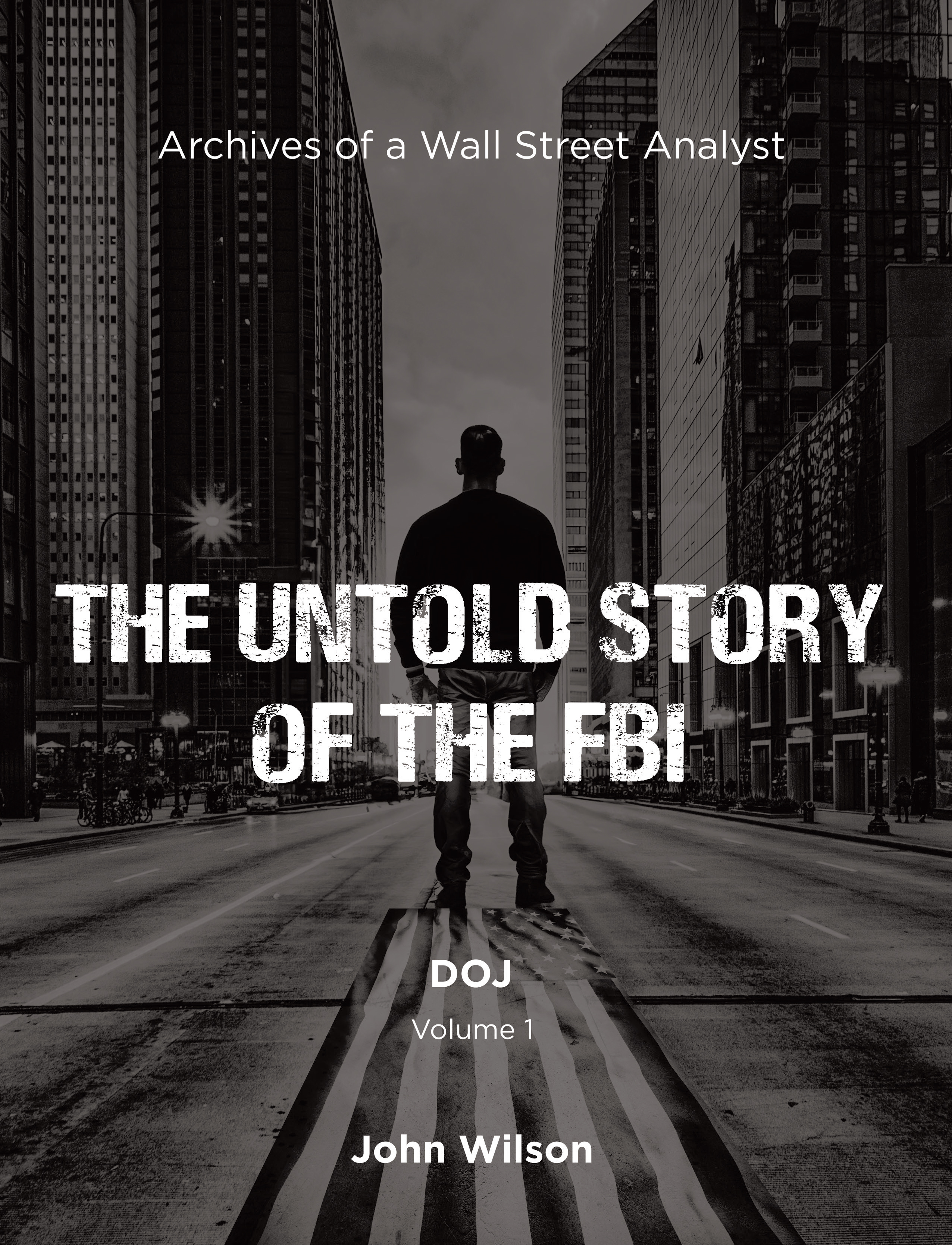
The Untold Story of the FBI: Archives of a Wall Street Analyst: DOJ Volume 1

[Book excerpt below: Front material pages 1- 60]


Archives of a Wall Street Analyst

The Untold Story of the FBI

DOJ
Volume 1

John Wilson
August 2024

Resource Capital Research
Sydney 
Copyright © 2024 John Wilson

All rights reserved. No part of this book may be reproduced
or used in any manner without the prior written permission of the copyright owner,
except for the use of brief quotations in a book review. The author has asserted his moral right to be identified as the author of this work.

To request permissions, contact the publisher at info@rcresearch.com.au

Title: The Untold Story of the FBI, Archives of a Wall Street Analyst, DOJ Volume 1
Hardcover: ISBN 978-1-7635214-1-4
Paperback: ISBN 978-1-7635214-0-7
e-book: ISBN 978-1-7635214-2-1
Subjects: Freeport Indonesia, Inc
Freeport-McMoRan Copper & Gold Inc
West Papua, Indonesia
Grasberg mine
Department of Justice – United States
National security – United States
National security – Australia
Federal Bureau of Investigation
Australian Security intelligence Organisation
Australian Secret Intelligence Service
Political
Memoir

First hardcover edition August 2024.

Resource Capital Research
Level 21, 68 Pitt Street,
Sydney NSW 2000
Australia

GPO Box 5030
Greenwich NSW 2065
Australia

rcresearch.com.au

“They went after high-ranking military officers; they went after members of Congress, both Senate and the House, especially on the intelligence committees and on the armed services committees and some of the – and judicial. But they went after other ones, too. They went after lawyers and law firms. All kinds of – heaps of lawyers and law firms. They went after judges. One of the judges is now sitting on the Supreme Court that I had his wiretap information in my hand. Two are former FISA court judges. They went after State Department officials. They went after people in the executive service that were part of the White House – their own people. They went after antiwar groups. They went after U.S. international – U.S. companies that that do international business, you know, business around the world. They went after U.S. banking firms and financial firms that do international business. They went after NGOs that – like the Red Cross, people like that that go overseas and do humanitarian work. They went after a few antiwar civil rights groups. So, you know, don’t tell me that there’s no abuse, because I’ve had this stuff in my hand and looked at it. And in some cases, I literally was involved in the technology that was going after this stuff.”
(NSA whistleblower Russell Tice)

Contents

FOIA Attorney Pete Sorenson Comment 7
Preface 8
Introduction 9
Backstory 9
Who runs America? 25
West Papua, Indonesia 35
Conclusion 40
Archive Overview 45
Appendix 62
Section I Department of Justice and the FBI 64
I-1a FBI conduct not in “good faith” 66
I-1b Background PI report: FBI operative Dr. Steve Garber 78
Section II Letter to AUSA Mr. John Moustakas – 2023 84
II-1a Letter from Pete Sorenson to AUSA Mr. John Moustakas: 87
I. Background on the Matter 88
II. FBI/DOJ Acting in “Bad Faith” 89
III. FBI/DOJ Misapplication of FOIA Exemptions 91
IV. Assistance with Locating Responsive Records 91
A. Documents Not Searched 92
1) Susan Holmes, or Susan Acker[son] Holmes 92
2) Dr Steven Garber, or Steve Garber 92
3) Wilson and people operating on behalf of the FBI or other DOJ elements 92
4) Freeport McMoran Copper and Gold Inc 92
5) S.G. Warburg and SBC Warburg – Wilson’s work related to Freeport McMoran 92
6) All records of encounters and discussions between John Wilson and Susan Holmes 93
7) Susan Holmes: NYC, June 1999 disclosure of existence of Wilson FBI file 94
8) Susan Holmes – FBI work visit to Australia for background on Wilson – C.2002 94
9) Susan Holmes – NYC, Café Fiorello covert interview (2003) 95
10) Susan Holmes: introduction 98
11) Susan Holmes: NYC, Café Fiorello (cont.): Gaslighting – psychological attack. 100
12) FBI knowledge of photographs of Wilson NYC, C1996-97 102
13) Solicitation of Wilson by an undercover drug dealer, NYC, C.1996-97 104
14) Steve Garber – New York records: C.1996-1998 105
15) Steve Garber – Prescott, AZ records: 1999 106
16) Steve Garber – vicinity of Central Park and Upper West Side, NYC: C.June 2004 108
17) Steve Garber – vicinity of Union Square, NYC: C.Sept 2004 109
18) Colorado rafting trip 1997 109
19) Dave Foreman – New York records 109
20) Dave Foreman – Colorado, Utah, Arizona records 110
B. Documents Withheld Entirely 111
C. Documents Redacted Inappropriately 111
II-2a Email exchange: AUSA Mr. John Moustakas: 114
Section III Declarations of John Wilson 120
III-1a John Wilson’s second Declaration: 30 August 2022 123
III-2a John Wilson’s first Declaration: 16 November 2021 200
Section IV General Correspondence 296
IV-1 Correspondence 2004 to 2010/11 298
FBI/DOJ 299
Senator Charles Schumer 314
Congressman Jerrold Nadler 340
House Judiciary Committee (HJC) 358
United Nations Human Rights Committee (UNHRC) 365
Other 371
IV-2 Correspondence 2010 to 2014 373
House Judiciary Committee (HJC) 374
Other 375
IV-3 Correspondence 2015 to 2019 377
FBI/DOJ 378
Senator Charles Schumer 397
IV-4 Correspondence 2020 to 2023 422
FBI/DOJ 423
Senator Charles Schumer 429
Senator Kirsten Gillibrand 434
Congressman Jerrold Nadler 437
Section V FBI – Freedom of Information (FOIA) 440
V-1 FOIA requests, appeals and OGIS mediation: 2004 to 2005 442
V-2 FOIA requests, appeals and OGIS mediation: 2013 to 2014 451
V-3 FOIA requests, appeals and OGIS mediation: 2019 to 2020 564
V-4 FOIA requests, appeals and OGIS mediation: 2021 to 2023 577
Section VI FBI – FOIA Judicial Review 632
VI-1 First FBI – FOIA Judicial Review – BLHNY: 8 December 2020 634
Complaint 635
Judge’s Report and Recommendation 641
VI-2 Second FBI – FOIA Judicial Review – Sorenson: 8 October 2022 657
Complaint 658
Summary Declaration of John Wilson 666
Expert Witness Report: 25-year veteran of the FBI—Jennifer Coffindaffer 681
INDEX 695


Table of Exhibits

Section I – Department of Justice and the FBI
Exhibit 1: April 2021. BLHNY—private investigator’s report on FBI operative Steve Garber. 78
Exhibit 2: 8 April 2024. Email from DOJ to attorney Pete Sorenson – re FBI redaction policy. 80

Section II – Correspondence with AUSA Mr. John Moustakas – 2023
Exhibit 3: 11 July 2023. Letter from Attorney Pete Sorenson to AUSA Moustakas outlining FBI abuse. 87
Exhibit 4: August 2023. DOJ, AUSA Moustakas: “Is this the mining expert? Or it that L______?” 114

Section III – Declarations of John Wilson
Exhibit 5: 30 August 2022. Second notarized Declaration of John Wilson. 123
Exhibit 6: 16 November 2021. First notarized Declaration of John Wilson. 200

Section IV – General Correspondence
Exhibit 7: 17 January 2005. Letter from John Wilson via Attorney Barry Fisher to DOJ, OIG 299
Exhibit 8: 16 April 2005. Letter from John Wilson via Attorney Barry Fisher to DOJ/OIG 300
Exhibit 9: 16 August 2005. Email from John Wilson to DOJ, Marvin Hernandez 301
Exhibit 10: 27 August 2005. Email from Barry Fisher to John Wilson re DOJ, Hernadez. 302
Exhibit 11: 10 February 2006. Letter from DOJ to Attorney Barry Fisher. 302
Exhibit 12: 22 February 2006. Email from John Wilson to Barry Fisher re DOJ, Hernandez. 303
Exhibit 13: 22 February 2006. Email from Barry Fisher to John Wilson to re DOJ, Hernandez. 304
Exhibit 14: 22 February 2006. Email from John Wilson to Barry Fisher re DOJ, Hernandez – confirms “they are agents”. 305
Exhibit 15: 22 February 2006. Email from John Wilson to DOJ, Marvin Hernandez – FBI denies agents are “employees”, but does not deny they are “contractors”. 305
Exhibit 16: 8 March 2006. Email from DOJ, Marvin Hernandez to John Wilson. 306
Exhibit 17: 8 March 2006. Email from John Wilson to DOJ, Marvin Hernandez. 306
Exhibit 18: 11 May 2006. Email from DOJ, Marvin Hernandez to John Wilson – FBI confirms one agent is an “employee”. 307
Exhibit 19: 11 May 2006. Email from John Wilson to Barry Fisher re DOJ, Hernandez – DOJ backtracking on agent admission. 308
Exhibit 20: 19 May 2006. Email from John Wilson to DOJ, Marvin Hernandez. 308
Exhibit 21: 14 June 2006. Email from John Wilson to DOJ, Marvin Hernandez. 309
Exhibit 22: 23 August 2006. Letter from John Wilson via Barry Fisher to DOJ, OIG. 309
Exhibit 23: 19 September 2007. Email from John Wilson to Attorney Barry Fisher re ABC reporter. 311
Exhibit 24: 7 December 2006. Letter from John Wilson via Attorney Barry Fisher to DOJ, OIG. 312
Exhibit 25: 22 April 2005. Letter from John Wilson via Attorney Barry Fisher to Senator Schumer. 314
Exhibit 26: 25 May 2006. Letter from John Wilson via Attorney Barry Fisher to Senator Schumer. 316
Exhibit 27: 9 June 2006. Email from Barry Fisher to John Wilson. 318
Exhibit 28: 13 June 2006. Letter from Senator Schumer to DOJ. 319
Exhibit 29: 20 June 2006. Email from Barry Fisher to John Wilson. 320
Exhibit 30: 9 August 2006. Letter from the DOJ, OIG to Senator Schumer. 320
Exhibit 31: 15 August 2006. Email from Barry Fisher to John Wilson 321
Exhibit 32: 23 August 2006. Letter from John Wilson via Attorney Barry Fisher to Senator Schumer. 321
Exhibit 33: 1 January 2007. Letter from John Wilson via Attorney Barry Fisher to Senator Schumer. 326
Exhibit 34: 20 February 2007. Letter from John Wilson via Attorney Barry Fisher to Senator Schumer. 327
Exhibit 35: 3 April 2007. Letter from Senator Schumer to DOJ. 328
Exhibit 36: 7 May 2007. Letter from the DOJ to Senator Schumer. 329
Exhibit 37: 7 June 2007. Letter from Senator Schumer to DOJ. 330
Exhibit 38: 7 June 2007. Letter from John Wilson via Attorney Barry Fisher to Senator Schumer. 331
Exhibit 39: 9 August 2007. Letter from the DOJ to Senator Schumer. 333
Exhibit 40: 6 September 2007. Letter from John Wilson via Attorney Barry Fisher to Senator Schumer. 334
Exhibit 41: 27 February 2008. Letter from John Wilson via Attorney Barry Fisher to Senator Schumer. 336
Exhibit 42: 12 June 2008. Letter from John Wilson via Attorney Barry Fisher to Senator Schumer. 339
Exhibit 43: 12 June 2007. Letter from John Wilson via Attorney Barry Fisher to Congressman Nadler. 340
Exhibit 44: 19 September 2007. Email from John Wilson to Congressman Jerrold Nadler. 341
Exhibit 45: 2 September 2009. Letter from John Wilson via Barry Fisher to Rep. Jerrold Nadler. 343
Exhibit 46: 2009-2011. Email trail between John Wilson and Rep. Nadler’s staffers. 344
Exhibit 47: 17 January 2005. Letter from John Wilson via Attorney Barry Fisher to Rep. Conyers, HJC. 358
Exhibit 48: 16 April 2005. Letter from John Wilson via Barry Fisher to Rep. Conyers, HJC. 360
Exhibit 49: 26 July 2005. Letter from John Wilson via Attorney Barry Fisher to HJC. 361
Exhibit 50: 14 September 2005. Email from office of Rep. Scott, ranking member of the HJC to Wilson. 363
Exhibit 51: 28 September 2005. Email from John Wilson to Mindy Barry, staffer, HJC. 364
Exhibit 52: 14 April 2007. Letter from John Wilson via Attorney Barry Fisher to UNHRC. 365
Exhibit 53: 24 April 2007. Letter from UNHRC to John Wilson via Attorney Barry Fisher. 367
Exhibit 54: 24 August 2007. Letter from UNHRC to John Wilson via Attorney Barry Fisher. 369
Exhibit 55: 2 May 2005. Letter from John Wilson via Attorney Barry Fisher to Senator Clinton. 371
Exhibit 56: 15 September 2010. Letter from John Wilson via Barry Fisher to HJC. 374
Exhibit 57: 25 February 2013. Email from John Wilson to United Steelworkers. 375
Exhibit 58: 27 February 2013. Email from United Steelworkers to John Wilson. 376
Exhibit 59: 9 March 2015. Letter from John Wilson to DOJ, Office of the Inspector General. 378
Exhibit 60: 9 March 2015. Fax from John Wilson to DOJ, Office of the Inspector General. 380
Exhibit 61: 2 October 2015. Email from John Wilson to Attorney Barry Fisher re DOJ/FBI. 381
Exhibit 62: 8 February 2016. Fax from Attorney Barry Fisher to DOJ/FBI. 382
Exhibit 63: 9 February 2016. Letter from DOJ, FBI to John Wilson. 392
Exhibit 64: 23 February 2016. Letter from John Wilson to DOJ, FBI. 393
Exhibit 65: 25 May 2016. Letter from DOJ, OIG to John Wilson’s Attorney Barry Fisher. 395
Exhibit 66: 24 June 2016. Letter from Attorney Barry Fisher to the US Attorney General, DOJ and FBI. 396
Exhibit 67: 14 March 2016. Online Casework Request from John Wilson to Senator Schumer. 397
Exhibit 68: 9 February 2017. Online and faxed Casework Request from John Wilson to Sen. Schumer. 400
Exhibit 69: 15 March 2017. Letter from John Wilson to Senator Schumer re Casework Request. 410
Exhibit 70: 2017-2021. Email trail: John Wilson, Attorney Barry Fisher and Senator Schumer. 412
Exhibit 71: 1 March 2019. Emails: John Wilson and Senator Schumer’s office re OGIS. 419
Exhibit 72: 5 June 2020. Letter from Attorney Barry Fisher to FBI, Director Wray. 423
Exhibit 73: 26 June 2020. Letter from FBI to Attorney Barry Fisher. 426
Exhibit 74: 18 March 2022. Letter from John Wilson to US Attorney General Garland. 427
Exhibit 75: 2021-2022. Various emails between John Wilson, attorneys and Senator Schumer. 429
Exhibit 76: 25 May 2022. Online Caseworker Request from John Wilson to Senator Gillibrand. 434
Exhibit 77: 2022. Various emails from John Wilson to Senator Gillibrand. 436
Exhibit 78: 26 May 2022. Copy of online Casework Request from John Wilson to Jerrold Nadler. 437
Exhibit 79: 26 May 2022. Automated email response from Congressman Nadler to John Wilson. 438

Section V – FBI – Freedom of Information Requests (FOIA)
Exhibit 80: 12 October 2004. FOIA letter from Attorney Rachel Minter to FBI. 444
Exhibit 81: 25 October 2004. FOIA letter from FBI to Attorney Rachel Minter. 445
Exhibit 82: 19 December 2004. FOIA appeal letter from John Wilson to FBI, cc Barry Fisher. 446
Exhibit 83: 30 December 2004. FOIA appeal letter from FBI to John Wilson. 448
Exhibit 84: 16 April 2005. FOIA appeal letter from FBI to John Wilson. 449
Exhibit 85: 6 September 2005. FOIA appeal letter from FBI to John Wilson. 450
Exhibit 86: 14 June 2013. FOIA letter from John Wilson to FBI. 453
Exhibit 87: Jul-Nov 2013. Emails between Wilson, FBI – Sobonya; and FOIA Attorney David Sobel. 454
Exhibit 88: 20 November 2013. Letter from FBI to John Wilson (received circa December 2013). 460
Exhibit 89: 23 December 2013. Appeal letter from John Wilson FOIA Attorney David Sobel to FBI. 462
Exhibit 90: 25 February 2014. Appeal letter from FBI to Attorney David Sobel. 466
Exhibit 91: 14 June 2013. FOIA letter from John Wilson to FBI. 469
Exhibit 92: 29 January 2014. FOIA letter from FBI to John Wilson. 470
Exhibit 93: 20-25 March 2014. Emails between John Wilson and Attorney David Sobel. 474
Exhibit 94: 26 March 2014. FOIA Request email from John Wilson to FBI. 475
Exhibit 95: 6 May 2014. Letter assigning FOIA No. from FBI to John Wilson. 483
Exhibit 96: 25 September 2014. Letter and disc of released documents from FBI to John Wilson. 494
Exhibit 97: 25 September 2014. Disc contents – released documents from FBI to John Wilson. 499
Exhibit 98: 6 November 2014. FOIA Request Appeal letter from John Wilson to FBI. 510
Exhibit 99: 6 November 2014. FOIA Appeal letter from FBI to John Wilson. 513
Exhibit 100: 23 February 2015. FOIA Appeal decision letter from FBI to John Wilson. 514
Exhibit 101: May 2017 – Nov 2018. Emails between Wilson, Barry Fisher and OGIS – 2017-2019. 516
Exhibit 102: 8 June 2017. Email from OGIS to John Wilson: Assigned case no. 201703007. 523
Exhibit 103: 16 August 2017. Email from OGIS to John Wilson: Assigned case no. 201703993. 528
Exhibit 104: 2 November 2017. Email from OGIS to John Wilson: Apology from OGIS for delays and confusion – Case no. “sent in error”. 532
Exhibit 105: 18 December 2018. OGIS mediation FOIA Appeal decision letter to John Wilson re case no. 201703007. 543
Exhibit 106: 12 April 2019. Email letter from OGIS to John Wilson: Closing case no. 201703007. 548
Exhibit 107: 23 October 2019. Website FOIA Request from John Wilson to FBI. 566
Exhibit 108: 29 October 2019. FOIA Response from FBI to John Wilson. 568
Exhibit 109: 18 February 2020. FOIA Request Appeal from John Wilson to FBI. 572
Exhibit 110: 21 February 2020. FOIA Appeal confirmation letter to John Wilson from FBI, OIP. 573
Exhibit 111: 21 March 2020. FOIA Appeal decision review letter to John Wilson from FBI, OIP. 575
Exhibit 112: 20 May 2022. FOIA Request from Attorney Pete Sorenson for John Wilson to the FBI. 579
Exhibit 113: 13 June 2022. FOIA response from the FBI to Pete Sorenson re John Wilson. 587
Exhibit 114: 1 September 2022. FOIA Administrative Appeal to the OIP, DOJ from Pete Sorenson. 591
Exhibit 115: 1 September 2022. FOIA Admin. Appeal receipt from the OIP, DOJ to Pete Sorenson. 599
Exhibit 116: 28 April 2023. FOIA “litigation release” letter and disc sent to Attorney Pete Sorenson. 600
Exhibit 117: 28 April 2023. Disc contents – released documents from FBI to John Wilson. 604

Section VI – FBI – FOIA Judicial Review
Exhibit 118: 8 December 2020. Complaint: First FOIA litigation filed in the US District Court for the Southern District of New York by Attorney David Rankin. 636
Exhibit 119: 16 February 2022. Report and Recommendation. 641
Exhibit 120: 8 October 2022. Complaint: Second FOIA litigation filed in the United States District Court for the District of Columbia by Attorney Pete Sorenson. 659
Exhibit 121: 17 March 2014. Summary Declaration of John Wilson 666
Exhibit 122: 17 March 2024. Independent Expert’s Report: Jennifer Coffindaffer – a 25 year veteran of the FBI. 681


Glossary
USA
AUSA Assistant United States Attorney – US Department of Justice, attorneys who represent the federal government of the United States in civil and appellate litigation and in federal criminal prosecutions.
CIA Central Intelligence Agency
DOJ Department of Justice
FBI Federal Bureau of Investigation
FOIA Freedom of Information Act
NSA National Security Agency
OGIS The Office of Government Information Services – an FOIA mediation resource
OIG Office of the Inspector General – responsible for conducting internal investigations of DOJ employees and programs, including allegations of criminal wrongdoing or administrative misconduct by DOJ employees.
OPIC Overseas Private Investment Corporation

Australia
ASIO Australian Security Intelligence Organisation
ASIS Australian Secret Intelligence Service
IGIS Inspector General of Intelligence and Security


FOIA Attorney Pete Sorenson Comment

It’s been my extreme pleasure and honor to represent John Wilson on two Freedom of Information Act (FOIA) cases. Both cases are still pending in the District Court in Washington, DC. One case involves the FBI’s hoarding and refusing to release records. The other involves the US State Department dragging its feet on a simple request for records of its investigation of US mining company Freeport-McMoRan. In the latter case, John is aware of and requested the interim and final reports by the State Department undertaken around 1996 following its investigation into the company which was launched after eyewitness allegations the company was involved with the killing of Indigenous protestors and other human rights abuses in the vicinity of its large Grasberg copper and gold mine in West Papua, Indonesia in the mid-1990s. John has pursued these cases, under FOIA, in an effort to exercise his rights to access justice in the USA in a struggle against these large and corrupt state bureaucracies that protect vested interests. He’s also pursuing these cases to uncover the truth about the Federal Bureau of Investigation (FBI), the Department of Justice (DOJ) and the State Department’s complicity in unwarranted persecution of US citizens at home and foreign nationals in far flung places like West Papua, Indonesia.

C. Peter Sorenson, Senior Attorney, Sorenson Law LLC

Preface

The documents in this archive tell the story of the US Department of Justice’s (DOJ) and the Federal Bureau of Investigation’s (FBI) corruption and evasion of accountability when targeting civil society “dissidents”. It also tells of my efforts to hold the FBI and DOJ to account.

The official documents and correspondence appended in the archive paint the picture of the corrupt means by which these agencies crush and silence civil society in support of America’s corporate behemoths. Their tactics are Orwellian and Kafkaesque. For the most part, my efforts from 2004 to the publication of this work in 2024, and those of my attorneys over the past twenty years, have been thwarted, compromised by hollowed out oversight agencies and regulators.

Intended as a historical record of official documents, appended are my notarized Declarations and court documents that include evidence of FBI malfeasance, oppressive surveillance, wiretaps, gaslighting and cancel culture. These Declarations contain detailed accounts of events, and disclosure of FBI methods targeting “dissidents”. Agents are named, dates and locations provided, and details of events discussed. The archive comprises correspondence either directly by me, or my attorneys, with various FBI/DOJ departments, elected representatives including Senator Charles Schumer and Congressman Jerrold Nadler, and Freedom of Information requests (FOIA).

This preface provides backstory of the events that have occurred since my Wall Street analyst report came out in 1996 critical of US mining company Freeport-McMoRan’s activities in West Papua, Indonesia. It sheds light on the travesty occurring in resource rich West Papua, Indonesia, backed by the US, where New York Stock Exchange (NYSE) listed Freeport-McMoRan has interests in the massive Grasberg copper and gold mine. The preface also contains background on the US surveillance state. It provides context for the complaint letters, included in the appended archive, I have sent over the years to the FBI and DOJ, among others, and outlines FBI retribution against me. Key points and timelines are provided in this volume, however, it is not intended as a narrative that offers a complete account of events. A narrative will be included in volume two.

At least seven other people in the USA were targeted for their criticism of Freeport-McMoRan around this time, including journalists and academics. Our intelligence agencies frequently covertly target professionals, those who speak out, or protest, against establishment interests, typically on business and human rights issues. As one agent, Steve Garber said to me, most people in America don’t even realize they’ve been targeted.

This is part one of a four-part archive series. Volume one covers the DOJ, which is responsible for the FBI. As mentioned above, it comprises notes and reflections on disparate aspects of this story including the FBI’s targeting of civil society, and the lack of effective oversight. Notes and reflections in the preface cover topics such as the FBI’s personal attacks on me, the public’s fear of authority, notes on Henry Kissinger’s past close association with Freeport, corruption of Western intelligence agencies, the methods used to oppress civil society and target leaders, professionals, and anyone else with influence, and the Western backed atrocities against Indigenous people in West Papua, Indonesia and elsewhere, to access their natural resources.

Other archives planned for release are volume two, which is focused on the Department of State; volume three, on Australian partnering agencies to the FBI – Australian Security Intelligence Organisation (ASIO) and Australian Secret Intelligence Service (ASIS); and volume four, a detailed transcript of a covert interview conducted by the FBI in 2003 at Café Fiorello in New York City.

Introduction

Part A

Backstory

A Personal Reckoning

Of the passions of youth, finding a life partner and establishing a career path are prominent. Optimism and dreams—the energy that drives innovation and change, and the will to hold authority to account—brush up against establishment interests and a previous generation’s way of doing things. Arriving in New York City in 1993 at the age of thirty, unknown to me at the time, I was about to embark on a journey that contained a copious mix of all these.

There is no hard and firm definition of what makes someone a dissident in the US, no red line one crosses on the journey as a regular citizen to becoming a political target of the State. However, once that line is crossed, one is sanctioned, “kneecapped”, the silent, democratic way—in secret—isolated and cast aside socially and economically as effectively as if renditioned to a remote halfway house enroute to a gulag archipelago somewhere in Siberia. The “virtual gulags” of modern-day America and its allies are built on oppressive surveillance, interference with relationships, cancel culture, blacklisting and gaslighting.

In my case, I found where the line is drawn after publication of a standard work report to global fund managers and analysts that touched on the US mining company Freeport-McMoRan Grasberg mine deaths in West Papua, Indonesia, in the mid-1990s—killings of Indigenous protestors at the hands of the Indonesian military, written about by the New York Times. I thought my report could possibly meet with professional rebuke from within the corporate hierarchy and a chance I would lose my job if the world were truly corrupt, but that proved to be a gross understatement. It was yet another rite-of-passage, the choice to stand up for justice, or hunker down, remain silent and be complicit in the killings. A pang of guilt arose. It was an awful realisation, that in the worst case I might be forced to make the choice—my job or justice.

At the time, I was a young mining analyst, with a recent Wharton MBA working in the New York equity research division of SG Warburg (now part of UBS). My research report (published March 12, 1996: refer to the Appendix) had raised the issue of US mining company Freeport-McMoRan. According to media reports, it was under investigation by the US Department of State following widely reported eyewitness allegations it was involved in the killing of Indigenous protestors at its massive Grasberg gold and copper mine in remote West Papua, Indonesia. The company denied any role in human rights abuses, and allegations were not subsequently proven in court.

Freeport’s problems weren’t limited to eyewitness’ allegations of company personnel being directly involved in human rights abuses, a notion “reinforced by overwhelming evidence” provided in two independent human rights reports in 1995 (ACFOA, and the Catholic Church).

The US government, concerned at the negative publicity, rescinded the company’s Overseas Private Investment Corporation (OPIC) political risk insurance, intended as a slap on the wrist. OPIC is a US federal agency that supports US investment offshore. It canceled its US$100 million political risk insurance to Freeport citing environmental degradation in a letter dated October 10, 1995—the first time it had ever canceled a policy in its 25-year history. In setting out its reasons for doing so, OPIC implied the company had misled both it and the market on its environmental record. It was a major embarrassment for the company and potentially a significant liability.

In 1996, Henry Kissinger, former US Secretary of State, a board member of Freeport-McMoRan and company advisor was doing the rounds in Washington DC, along with former CIA Director and Freeport advisor James Woolsey, desperately attempting to have the rescinded OPIC insurance policy re-instated.

It appeared Freeport was highly sensitive and increasingly apprehensive about the prospects of a backlash and potential for shareholders (some with very deep pockets) to launch a lawsuit against the company for misrepresentation of its activities in West Papua, Indonesia. The last thing, it seemed, the FBI and Freeport wanted was Wall Street analysts to factor these issues into their valuations and publish details that are sent directly to fund managers around the world, despite commentary by the wider media within the US.

At the end of the day, the actual response my research report drew was vicious. I had not envisaged the full-on onslaught the US and its allied foreign intelligence agencies were inclined to launch against a regular citizen, led by the FBI. This story is about American power and the disturbing way it is deployed both at home and abroad. What happened to me could happen to any young professional doing their job if they come up against people in power who have something to hide.

In 1996 and 1997, the FBI launched an undercover wide-ranging attack against me in retribution that included targeting my career, relationships—both personal and professional, and oppressive surveillance. It targeted the long-term relationship between Susan Holmes (my girlfriend, undercover FBI agent and environmentalist) and me, on the cusp of a marriage engagement, used tactics to sow doubt and mistrust between us which contributed to our relationship break-up. We split up in late 1997 after dating for three years. FBI tactics included the deletion of critical phone messages between us, intervention to arrange “work” trips away for each of us at key times to derail efforts to get back together after we broke up (her FBI role was known by her employer at the Sierra Club who obliged the FBI’s requests whenever possible, in my case the FBI interacted covertly with management), FBI honey traps, arranged for Susan, apparently as a honey trap, to visit a California US Congressional candidate, among other things (recounted in more detail in my Declaration in the appendix, and in a narrative to be published in volume two of this series).

After our split up in 1997 and my return to Australia in mid-1999, we both eventually found new partners. By 2003, Holmes was married, living in Washington D.C., and now complicit with the FBI in targeting me. However, evidently, she had lingering reservations about the FBI and divided loyalties concerning me. I assume this was on account of our long, personal history, and what she now knew about the true nature of the agency’s activities. 

Based on revelations by undercover FBI agents Susan Holmes to me in 2003 during a covert interview at Café Fiorello in New York City, and Dr. Steven Garber to me in 2004, the FBI has undertaken extensive surveillance of me and my contacts, turning and recruiting whoever they could, bugging my apartment, telephone, intercepting emails, and recording conversations (for more details refer to my sworn court Declarations in the Appendix). The agency has taken extraordinary pains to delve deeply into all aspects of my past. Over the course of my life, I have had many hundreds of friends, colleagues, and acquaintances. Several dozens of these I am now aware have been approached, and in cases interfered with and recruited. In addition to people I already knew, others have made themselves known to me, in cases befriending me, only later to reveal their involvement with an intelligence agency.

The intelligence agencies have no compunction about targeting their own agents or citizens when it suits their purposes, like Susan and the Christmas of 1997 when they targeted and undermined our anticipated engagement, or the West Papuans that so loyally served their interests giving vital support and land position to General Douglas MacArthur in the Pacific during WWII. The West Papuan’s were blithely sacrificed to the Indonesians when it served American interests to do so in the 1960s. Virtually, anyone can be sacrificed, and replaced, when it suits the changing interests of those in power.

I have faced political and authoritarian demons I never contemplated I would encounter in my life. This story sheds as much light on the conduct of the Western intelligence agencies, under the leadership of the US, at home as it does the plight of Indigenous people caught in military conflict zones abroad. Innocent bystanders everywhere caught in wars: The hidden, secret places of the world, like West Papua, Indonesia; Nigeria; the Democratic Republic of Congo (DRC); Ecuador, and elsewhere, with domestic and foreign backers funding armed violence to secure resources, deserves much greater public attention. It is moral bankruptcy for the world’s most powerful to target Indigenous people. They are easy military targets, no match for the US and allies with their modern weaponry. Targeting Indigenous people in this way is a war crime, as with targeting innocent civilians in any war—it’s against everything just and noble the United States and West profess to stand for.

Undercover FBI agent Dr Steve Garber’s disclosure to me in 2004 in New York City was in the days before mass social media networking and the FBI assumed this story would never be heard.

Dissidents on Wall Street—the “new cold war”

The research report I wrote on Wall Street on Freeport-McMoRan (dated March 12, 1996) followed international media reports of further killings and strike activity at the Grasberg mine. The 1994 Christmas Day massacre in which seven people were killed, and which was widely reported in the world media, represented just a small portion of the thirty-seven Indigenous protesters reported killed in the vicinity of the mine in 1994 and 1995.

Below is a paragraph from the March 12, 1996, report:

Our view is that increased military presence poses potential for escalation of the violence in the mid term, heightening the political risk of Freeport’s investment in Irian Jaya [West Papua, Indonesia]. Ultimately, Freeport needs to deal with the civil aspects of this situation to allay investors concerns, and possibly also those of the US Department of State. The timing is unfortunate for Freeport as it coincides with the arbitration over whether $100 million in OPIC political risk insurance should be rescinded. The company has increasingly come under scrutiny following reported human rights abuses in the area of the mine and also concerns over its environmental record. The latter was cited by OPIC last November as the basis for withdrawing the $100 million in insurance.

The report touched on the Grasberg killings and environmental concerns and indicated a civil, rather than a military, solution was preferable in resolving labor disputes at Grasberg. In the scheme of things, my comments offered a relatively mild rebuke, but the extremity of the response of the authorities shows how sensitive they were, and remain in the present, to the issues. With people like Henry Kissinger, a former US Secretary of State on the board, former American ambassadors to Indonesia, military advisers and company security department staffed with former US military personnel, CIA, and FBI agents, the company seemed to appreciate its tenuous position on the political and security fronts.

The mention of Freeport in the context of human rights and environmental abuses raised the company’s profile with investors in a way that had potential to create a negative financial backlash against it. Indeed, over the years, substantial investment funds have dumped their holdings in Freeport amid global publicity on ethical concerns about the company’s activities, including the large Government Pension Fund of Norway. It dumped and blacklisted Freeport’s shares in 2006 citing environmental concerns. Other government funds to blacklist Freeport shares include New Zealand (2012) and Sweden (2013).

New Zealand’s Superannuation Fund in September 2012 blacklisted Freeport-McMoRan from its investment funds citing human rights concerns. It was the first major fund to blacklist Freeport on grounds that specifically included human rights concerns, saying:

Freeport McMoRan has been excluded [from the fund] based on breaches of human rights standards by security forces around the Grasberg mine, and concerns over requirements for direct payments to government security forces by the company in at least two countries in which it operates…[2]

The area around Freeport’s concession areas in West Papua, Indonesia has had a long history of killings, ostensibly by the Indonesian military, which continues up to the present (2024). Many hundreds, indeed thousands, of deaths have been documented by human rights agencies. In 1994, the brutality seemed to be spiraling out of control with seven Indigenous protestors shot and killed in a short period around Christmas Day. Some of the protestors were reportedly killed at point-blank range, inside steel shipping containers on Freeport property. For a sensitive topic, it received unusually wide publicity and the US State Department had reportedly taken the unusual step of launching a formal investigation. 

Little is known of the Indonesian province of West Papua (formerly called Irian Jaya), which is located on the western half of the island of New Guinea, just north of Australia. Indeed, many people confuse it with the adjacent independent country of Papua New Guinea (PNG), which is located on the eastern half of the same island. West Papua has been the subject of an official media blackout by the Indonesian government since its military invaded in 1962. It was not till the advent of the internet in the early 1990s that word of the plight of the Indigenous people and the atrocities inflicted on them reached the rest of the world, including the shocking reports of the 1994—95 massacre.

The FBI and Freeport were evidently nervous about the impact of this shift in media influence and the obvious potential for serious political and financial market backlash against the company—including in New York, where the financial community played a key role in the financing of Freeport’s activities.

The human rights abuses committed against the Indigenous people of West Papua, Indonesia, ostensibly by the Indonesian military, are extensive and include arbitrary detention, torture, rape, and extra-judicial killings. Transmigration is also an insidious part of West Papuan history under Indonesian rule—an Indonesian government policy whereby large numbers of people, mostly ethnic Asians, from other parts of Indonesia are relocated to West Papua on a scale that makes the original Melanesian inhabitants minorities in the province, and which has prompted claims of genocide (including a report by Yale Law School)[3]. Further, the new arrivals historically have received benefits and opportunities not available to the Indigenous people.

In 2003, Freeport publicly acknowledged it had been directly paying Indonesian military and police units and officials who were involved in maintaining security around the mine. As disturbing as the payments themselves was the startling scale of the amounts of money involved. In 2005, the New York Times reported that the company had paid US$20 million between 1998 and 2004 for these services including paying one individual US$150,000. The size of the payments to the military and police appears to have increased significantly over time (looking at years 2005 to 2011). For example, Freeport’s Securities and Exchange Commission (SEC) filings indicate the spending on internal civilian security in 2011 was US$37 million, plus an additional US$14 million paid directly to the Indonesian government and military—a total of US$51 million spent in relation to Grasberg—just in 2011 alone.

It seems surprising that these payments pass muster with the US DOJ and are not in breach of the US Foreign Corrupt Practices Act which the US government aggressively enforces against foreign corporations. Indeed, the US United Steelworkers union in 2011 asked the DOJ to investigate Freeport’s payments but the powerful union was fobbed off and heard nothing substantive back on the matter (refer to correspondence in the Appendix).

In an article published in 2011 to coincide with the fiftieth anniversary of Indonesian occupation of West Papua, anthropologist and academic Hugh Brody referred to the large sums of money and Freeport’s close links to the Indonesian military as the “militarization of mining[4]. Indeed, Freeport CEO Jim-Bob Moffett reported security matters relating to the mine as the “new cold war” and said there was “no alternative to our reliance on the Indonesian military and police….”

With the killings of 1994—96 attracting worldwide attention, Freeport’s public relations machine went into overdrive. It paid for a full-page ad in the New York Times, made an infomercial, threatened to sue journalists and academics covering the matter and withdraw a financial donation made by the company to endow a chair in environmental communications at the local Loyola University in New Orleans.

But what is little known, and never reported is the role that the FBI played during this time to lower the profile of Freeport’s controversial Grasberg operation and silence discussion in the US that included targeting Wall Street analysts.

The use of FBI power in this way is more disturbing given the agency’s dual role in helping to identify and interview eyewitnesses to the alleged human rights abuses on location in West Papua, Indonesia. The killings in West Papua, Indonesia of Indigenous people have continued to the present day attributed to the Indonesian military. With the region virtually closed to foreigners and a media blackout enforced, little of what is happening there is reported by the mainstream media.

Meeting with the FBI and Freeport—May 1996

A couple of months later after the publication of my March 12, 1996, report, I was in Freeport McMoRan’s boardroom at its head office, then in New Orleans, at a briefing for Wall Street analysts. During the briefing Q&A, I asked the Chairman and CEO, James (Jim Bob) Moffett, a question about the US State Department’s human rights investigation into the company’s activities in West Papua, Indonesia. He affirmed that the investigation was ongoing. Unusual for a CEO of a major NYSE corporation, he became increasingly agitated and angry during a rambling, long-winded reply.

In response to the analyst report and question I asked during the analysts’ briefing, the FBI’s threat came promptly. The FBI was, in hindsight, ready and waiting. It was delivered by their man who had been sitting among the analysts in Freeport’s boardroom, where Moffett had just conducted the annual analyst briefing and Q&A.

The FBI’s man came up to me and threatened me in an icy tone that left no uncertainty as to its ill intent. He was around my age (early thirties) and dressed in a business suit. He had stood near me as I spoke briefly with Moffet in the boardroom alcove after the meeting. As I started to move away from Jim Bob, the FBI’s man moved with me. Emerging from my shadow, he stepped squarely in front of me and without introducing himself addressed me using my first name.

“John, I respect you for asking that question,” he said, referring to my question during the briefing. “But you might wish you hadn’t.”

Ignoring my own surprise that he knew my name, I replied, “So what? What do I care? What can they do to me?”

“You might not want to find out,” he said firmly.

I held his gaze for a moment and then moved away.

It was a threat in no uncertain terms. More accurately, it was an absolute decree, a disclosure from which there was no turning back. It was as if a nest of tarantulas had awoken; the FBI and its agents, the supposed protector of democratic freedoms in the US, had emerged from its dark cover and was on the prowl.

At the time the FBI campaign commenced, supported by ASIO and ASIS, I was young—thirty-three years old—on the cusp of establishing a career and on the verge of committing to a life partner, an undercover FBI agent and professional environmentalist, with the intention of having a family. I was still new to Wall Street, a relatively unknown analyst with limited influence, which made me an easy target. Certainly, I had no connections into the political world at a level that could be called upon to pull strings and potentially haul the FBI into line on this issue. With former Secretary of State Henry Kissinger (of Vietnam, Cambodia, East Timor, Chile, and Nixon-era fame) on the board, former US ambassadors to Indonesia advising the company, and the US heavily involved in supplying and supporting Indonesia’s military, the company’s interests seemed well protected in Washington DC.

Almost as disturbing as what has, and continues to, unfold in West Papua, Indonesia, to the present day, are the US government’s tactics in silencing dissent both at home and abroad, laying the foundation for atrocities with the FBI and CIA brooking no criticism, even to the mildest forms of protest.

What has unfolded since my March 1996 report has been a dystopian, Orwellian-Kafkaesque retribution unleashed by the FBI and their allied Western intelligence agencies against me (and Susan) using invasive tools and predatory instincts so well exposed in recent years by the likes of WikiLeaks and Edward Snowden. The agencies targeted my career, my family and friends, endeavored to undermine my credibility and call into question my sanity. In the years that followed, I have encountered and been targeted by a small battalion of FBI agents in the US, some flying to Australia, and ASIO /ASIS agents in Australia, some flying to New York City to target me. Moving beyond the surveillance powers of the state, the collection of data and invasion of privacy, I know firsthand what they can do with all that information, how that information has been used mercilessly to interfere in my life in surprising places and in astonishing ways, in places I assumed could never be compromised (refer to my sworn Declarations in the Appendix. I expect to publish more details in narrative form in volume two of this series).

I have come to see the wisdom of the Founding Fathers with a new, deeper appreciation wrought from the realization of the shortcomings of human nature from which flow the persistent character flaws and abuses of those in power. The separation of powers, heralded as fundamental to democracy and essential to reining in corrupt or selfish leaders and political agendas, has been eroded to a devastating extent in the US and the West more broadly.

Undercover FBI Operatives Holmes, Garber, etc: Silencing Domestic “Dissent”

Complicating things, at the time of my work on Freeport-McMoRan in 1996, my long-term girlfriend, Susan Holmes (from 1994 to 1997), was an environmentalist and undercover FBI agent. During the time we went out, she disclosed to me and discussed her role with the FBI many times, showed me her undercover FBI ID card, and other FBI work items. Included in her disclosures was the work the FBI does in targeting dissidents (see my Declaration of 2022 published in Section III in this volume). One of her dissident targets she was close to, was the high-profile environmental activist and co-founder of Earth First! Dave Foreman. Her close association with Foreman is particularly significant to this story. Susan always said Dave Foreman was no longer a primary concern of the FBI, but it was the people attracted to him and that hung out with him, who the FBI was concerned about.  

After the FBI’s campaign commenced against me in 1996 due to my Freeport-McMoRan work, it used Susan’s close connection to Foreman to misrepresent me as a close contact and confidant of Foreman, an association that is a red flag marker for law enforcement. As detailed in my Declaration in the Appendix, Holmes naively, at the behest of the FBI, arranged for me to attend occasions with her where Foreman was present—a lecture in New York City in 1997, and a rafting trip down the Colorado River, in the summer of 1997. The rafting trip down the Colorado River was with Susan and twenty or so other activists and journalists, and I was placed in Foreman’s dory with two others. These encounters were fully documented by the FBI according to what Susan later told me, including photos—all planned by the FBI. The intention was to make me appear a legitimate target of the FBI to both compromise and satisfy oversight agency screening processes. The screening processes were well understood by senior intelligence officials, people like Henry Kissinger and James Woolsey, who were then able to abuse and subvert them if they were inclined to. The trip organisers allocated me to Dave Foreman’s dory for the duration of the trip of several days. Associating me with David Foreman, a person targeted by the FBI, seemed to be a well-planned and deliberate tactic by the FBI to falsify evidence and subvert oversight screening mechanisms intended to stop agency corruption.

In retrospect Susan seemed to have limited awareness, or misunderstood, who the FBI targeted under the term “dissident”. One afternoon in 1997 in my apartment on Amsterdam Avenue, she tried to recruit me to work undercover for the FBI, explaining that the FBI wanted more undercover agents working on Wall Street. She gave me the full pitch but I had no interest in applying.

At the time of her disclosures in the mid-1990s about her work for the FBI when we dated, she fervently held, based on her training by the FBI, that dissidents were “really bad people” intent on destroying America and they deserved what they got from the FBI.

Had she been deceived? Susan said she had been taught and believed the FBI’s political targets were wayward dissidents. She had been inculcated to believe they were obnoxious, loud, unrelenting, ungrateful malcontents intent on undermining America. Susan is an intelligent person, Dartmouth-educated, but she genuinely believed that. And she genuinely believed they deserved harsh treatment and got what they deserved.

Little did she realize at the time that she would soon experience the other side of this dissident suppression treatment. The authority and power of the FBI, combined with her privileged upbringing, may have resulted in blindsiding her critical reasoning about the agency’s activities. Steve Garber once said that the FBI’s recruitment screening process continued through training sessions over years—with agents often self-selecting out of the agency as more about the FBI’s mission and methods were disclosed.   

Other FBI agents seemed similarly indoctrinated to misunderstand what the agency was having them do to dissidents. In 2007, my elected representative in Sydney, Tanya Plibersek, MP, raised my complaint about ASIO and the FBI in federal Parliament. Shortly after, while I was visiting Arizona, I explained to a pesky young undercover FBI agent, Ben Worden, ensconced at the Diamond Mountain Buddhist retreat centre, that my complaint about the FBI/ASIO and the connection to Freeport-McMoRan had been raised in the Australian Parliament. I attempted to hand him the two-page transcript, but he refused to take it. I found other agents did likewise. FBI agents consistently refused to accept the transcript, whereas others I spoke with and offered it to, were invariably interested and accepted. Presumably, this behaviour is part of the FBI training to insulate inexperienced agents from the activities of the corrupt agency and hold them under the sway of FBI propaganda. I don’t think many FBI agents, let alone regular Americans, have any understanding of the FBI’s real intent and agenda. Susan seemed to have everything else going for her. Perplexed, I wondered why she would take on a job with the FBI. It was an unspoken sticking-point in our relationship.

By 1999, Susan’s opinion seemed to have softened. We had broken-up by then but were contemplating getting back together. She told me, “You would not believe how surprised I was when I saw your name on the work files.” Alluding to “work” was a euphemism for the FBI. We were having dinner at the South Sea Port in New York City, and she added cryptically, “I’m not going to let them do this to you!” It didn’t click with me at the time what she was talking about, and she didn’t elaborate when I asked her to explain.

It is not clear why anyone would want to help an agency do the things the FBI does. Susan learned this directly, when, as one of their own agents, she was ruthlessly targeted to get to me! But why would she still want to work for them after seeing this and learning what she had?

The FBI had interfered in our relationship in 1997, deliberately sabotaging it at a time we had been discussing marriage. She had invited me to her family home in Detroit that year for Christmas, which was intended as an opportunity to propose and announce our engagement. But it wasn’t to happen. In 2003, when she subsequently covertly interviewed me for the FBI in New York City, she said she had vomited as she came to understand what had happened to me, and between us.

Defying the orders of authority is no easy task for most. Reference Stanley Milgram, the Yale University psychologist who famously demonstrated this in the 1960s with his electric shock experiment. So why would you put yourself in the position where you are required to follow the orders of what amounts to a veiled, secret-police-like agency to do who knows what to whomever they want it done? Why would you knowingly put yourself in the employ of someone, like the FBI or ASIO/ASIS, etc., that may demand you turn on friends and family?

What sort of people want to work for the FBI I wondered—hasn’t everyone read Orwell, or Kafka? Why would someone choose to work there? Why do people select the careers they do? What does it say about their personal talents and aspirations given the alternative possibilities? Why would they choose the FBI as an employer, especially considering the political abuse they know they would be involved with? Is it a James Bond syndrome? Of course, crime fighting is noble, but what control does a recruit have over the decision to fight crime or “fix” political opponents. No control, I assumed. They were obedient, and they did what they were told like in any other job, or they left. Not so much the dashing, mythical James Bond figure as the hollowed-out Adolf Eichmann, the hapless Nazi bureaucrat convicted of war crimes at Nuremberg, whose insipid obedience to directives from the authorities inspired the term “the banality of evil”.

The FBI identifies and sabotages as many of its targets’ relationships and opportunities as it can. They spread smears cast by small army of undercover agents paid to do what they are told without asking questions. They spread or fabricate rumors and inuendo of socially derogatory traits, creating an echo chamber—whatever they can get traction with, illicit sex of all sorts including paedophilia, illicit drugs and alcohol abuse, anything that can be portrayed as abusive or sneaky, criminal or anti-social, modified and tailored to maximise damage to each target. The target at one time or another may be painted as gay, alcoholic, deficient in some core attribute and unemployable, or guilty of physical and sexual assault. The target is never directly confronted with the rumours, let alone the evidence, and they are given no chance to offer a counter narrative or challenge accusations.

In my case, I was surprised people in the rumor mill in most cases didn’t seek independent verification from me, clarification or to provide context. As one fire burns out, another is lit by the agencies. The first I know of it is an odd reaction by someone, strange looks or a cryptic remark—in the work place, a friend over dinner, or from an acquaintance in the street. I don’t know what their allegations are, I don’t know which other agencies are involved, nor does there appear to be any way to bring it to a head, hold them to account, in any forum, let alone the courts.

The worst of human nature is easily preyed upon by the intelligence agencies. Susan told me in the mid-1990s that if Americans knew the true number of undercover operatives at work domestically, they would think they were living in a totalitarian state. In East Germany, the notorious Stasi secret police recruited around one in ten civilians to work as “spies”—recruiting from a broad cross section of society to penetrate all and every aspect of community and civil life. All kinds of people were hired, and the only commonality was a preparedness to work against their fellow citizen, inform on and betray their neighbors, work colleagues, friends and family in the name of the state’s ideals and their own personal financial aspirations.

Who hasn’t been readied for the head-to-head with the totalitarian hydra? As high school kids, we read George Orwell’s 1984 and Animal Farm, Huxley’s Brave New World, and Aleksandr Solzhenitsyn’s One Day in the Life of Ivan Denisovich. Kafka, we read later. Each described dystopias, where personal relationships took second seat to priorities enforced by abstract State ideals. History and literature are replete with States where the worth of our human values was displaced and supplanted by the pressing abstract ideals of the government in vogue at the time. Many seem blind to these same forces, here and now, at home in our “liberal” West.

Freeport Critics Targeted

I don’t regret having asked the questions about Freeport, but I do regret the aggression and violence of the FBI’s response.

I am not the only one targeted for speaking out about Freeport around this time. Andrew Duff of the Austin Chronicle published a list of names of seven people, at least those he was aware of, who he said were targeted with threats of legal action by Freeport unless they desisted from making “false and damaging accusations”. His list comprised journalists Robert Bryce and Daryle Slusher; university professors Steven Feld, a music ethnologist who had spent much time studying the people and tribes of West Papua, Indonesia; Alan Cline and Robert Boyer; and environmentalists Lori Udall and Bill Bunch.[5]

In an article for Mother Jones in 1996, Robert Bryce mentioned another Freeport threat. This one was against New Orleans based WWL-TV news anchor-man Bill Elder. Elder had accused Freeport CEO Jim Bob Moffett of lying to him on air during an interview about OPIC, and also subsequently accused Freeport of blocking his travel to West Papua, Indonesia, by not granting the Indonesian consulate permission for him to enter. Bryce reported that Freeport officials had visited WWL and made veiled threats to sue the station Elder worked for. [6]

But there were not just legal threats. According to reports, Freeport also demanded the return of funding, after a series of student protests, from Loyola University in New Orleans where it had funded a chair in environmental communication.

Other critics in the West were directly targeted by the intelligence agencies operating to protect Freeport’s reputation in the fallout of the spate of negative human rights and environmental reports starting to emerge from West Papua, Indonesia.

Professor and author Tim Flannery is a renowned zoologist I heard speak on climate change at the Australian Museum in Sydney in 2016 and I spoke with him after. He has spent a lot of time working with the Indigenous people in West Papua, Indonesia, and has many friends there as recorded in his engaging book Throwim Way Leg. He ruefully commented when I asked him about Freeport and West Papua, Indonesia, that “A lot of dark things are happening up there in West Papua.” He swallowed, anxiety and fear swept across his eyes, and he repeated, “It is very dark.” He was humble and had deep empathy for the people there, clearly perturbed and opposed to what was happening on a human rights front there. His response was in stark contrast to the many FBI and ASIO/ASIS agents I have met who attempt to cover up the abuses there, using tactics I have described elsewhere—apologists for Freeport and US policy. I wondered to what extent Flannery had experienced pushback and undermining from the agencies; he certainly wasn’t someone playing their game. There had been some adverse, unusual media and setbacks he had faced that are consistent with ASIO coercion, but, as usual, nothing was publicly confirmed by the agency.

I had been targeted by Freeport, too, it seemed. Not with legal action, but with an initial attempt to exclude me as a Wall Street mining analyst from their annual analyst briefing in 1996. The briefing, which I ended up attending after I requested an invitation several times and which I had attended in the past, was standard for all mining analysts from mainstream banks to be invited to.

But what was not known previously was the role the FBI, a US federal government agency that is part of the DOJ, played. Unlike OPIC, the US federal government agency that provides political risk insurance for US corporations, whose activities are in the public domain, the FBI works without operational disclosure and is protected from public visibility. According to agents Holmes (in 2003) and Garber (in 2004), and consistent with the agency interference and threats I received, the FBI was secretly batting for Freeport, no matter what, mustering its huge resources and vast reach to defend the company from critics. The FBI’s deployment and extra-judicial punishment is unconstitutional and undermines civil society, making it harder for civil society to hold public entities to account.

The FBI has threatened and attacked me from every angle: social, family, work, privacy, electronic, tracking and recruitment of friends, and gross interference in all my social and professional networks—as described elsewhere in this book—chilling professional commentary and civil society. 

It had never occurred to me to become a dissident and spend my time defending against and attacking a central pillar of American power. I did not see opposition to the killing of Indigenous protestors as a dissenting opinion as such; I assumed that everyone saw the killing as wrong and took such a position for granted. The contentiousness of the issue seems related to working on Wall Street, toeing the line, and remaining silent even where investors would benefit to know how their money is being invested!

Fabricating enemies of the state, creating “evil doers” and “dissidents” gives the US cover to do what it wants, in the name of national security, or in political police activity at home—mass surveillance. As former US president Bill Clinton said shortly after leaving office, “Y’ got to understand…there are some people in my country…who think America must always have enemies.”[7] They create opponents, find unnecessary fights and set forth to always have an enemy to show those who might oppose a government policy on more important matters to US interests to be wary. Manufacturing issues and lying about evidence are repeated behaviors mastered by the intelligence agencies—behavior and tactics with “a distinct resemblance to the Bush administration’s determination to invent a case that Saddam possessed weapons of mass destruction.” 

Why should the FBI try to link me to the “environmental terrorists” targeted by Susan in her work for the FBI? If I were a real enemy of the state, there would be no need to engineer a “problem” for which they offer the “solution”. The answer is the FBI wanted cover for something else. Presumably, they show the manufactured adverse evidence to the oversight agencies to justify their interest in me. On the other hand, they show the treatment, banishment and abuse of an outspoken analyst to other public spokespeople with a view to intimidating and controlling their behavior.

It is not clear what word best describes someone targeted in the US for political “crimes”, for speaking out, but “dissident” seems as good as any. Wikipedia describes dissidents as those who inform society “about violation of laws and human rights”. The term “dissident” is frequently used by the US government to describe foreign citizens subjected to unconscionable acts by their governments for speaking out in opposition, and it was widely used from the 1940s to describe people opposed to totalitarian systems or policies of totalitarian governments, especially under the Soviets.

The US has always maintained in relation to other governments that it is necessary not only to protect dissidents but to encourage and facilitate opinion, debate and access to information to enable a strong democracy. It says tolerance of dissent and free speech is the foundation of a free and open society, and thereby a healthy and resilient government and people. I wish it would follow its own advice!

My newfound status as a state target seems to reflect the nervousness of government officials in the US involved with the Freeport issue than any objective risk posed by my note or question. Their response seems to reflect a new way of doing things in the US. It is a disturbing trend, a move away from democracy and the rule of law.

In 2012, US Senator Bernie Sanders (I-VT) stated that “[w]e are seeing our country move toward an oligarchic government.” And another senator referred to the US as practicing a new form of fascism.

Domestic Surveillance—The FBI is Not Acting in “Good Faith”

The FBI is not acting in “good faith” as attested to in 2024 in a Declaration (see Appendix) by former FBI agent, a twenty-five-year veteran of the agency, and Expert Witness, Jennifer Coffindaffer. In her Declaration she points out multiple shortcomings of the FBI— skirting its obligations under FOIA—based on my request for information from the agency and suggests a number of key databases the agency neglected to search. Her conclusion is consistent with my experience of the agency’s conduct in general since it commenced targeting me in 1996—that it’s not acting in “good faith”.

The FBI (and ASIO/ASIS) has thrown nets over all my communications, identifying and targeting family, friends, associates and colleagues. The presence of the FBI surveillance in the home, workplace, car, and other places regularly frequented by the target, and now via iPhone GPS tracking and remote activation of microphone and video, gives the agency potential for 24/7 near blanket surveillance capability.

The FBI targets all areas it identifies as important to the target—means of making a living, interests, friends, family, and spiritual life, to name a few. The FBI attacks in silence, inflicting life-changing interference to careers and relationships, among other things. It identifies and recruits agents or informants in all these areas to inflict material and psychological damage. Its target “dissidents” are frequently not even aware the FBI is responsible for sabotaging some key aspects of their life. The FBI, and other intelligence/security agencies lie and deceive seamlessly to shore-up their own reputations while diminishing their target’s—to make any good features of their target seem bad, and bad features monstrous.

Emails, telephone, internet browsing, you name it—anything with an electronic footprint is picked up and stored. Many members of the public declare that they have nothing to fear from this, that they have done nothing wrong. But it is misplaced confidence, a judgement that mistakes the risk of this kind of intrusion. Make no mistake, if you give someone unfettered access to all aspects of your life, and they are of a mind to do so, they will use this information in a way that will harm you. Its potential uses are diverse—to interfere and manipulate, to embarrass the target, or help their adversaries. It is naïve to simply say you have nothing to hide.

The public now knows from Ed Snowden’s National Security Agency (NSA) leaks in 2013 that the government has undertaken illegal mass surveillance, without specific warrants or meaningful oversight, of domestic and foreign telephone calls, email, online chats and browser histories. Another NSA whistleblower, Russell Tice said, among all the officials the NSA secretly targeted, there was a big push to target lawyers: “They [the NSA] went after lawyers and law firms. All kinds of–heaps of lawyers and law firms. They went after judges.” [8] (The full quote from Tice is in the next section, and upfront in this book). I have found many of my lawyers, but not all, compromised at some level. Some have gone as far as trying to undermine my case. It certainly makes a mockery of “conflict of interest”, “attorney client privilege”, and any notion of “justice” or the “separation of powers”. (I filed a detailed complaint with an Australian regulator against a lawyer in Sydney, where the same level of agency interference occurs as in the USA. The regulator found against the lawyer, Rocco Ardino, and sanctioned him, though stopped short of saying he was compromised by a law enforcement or intelligence agency. The regulator drolly said I had not provided sufficient evidence to prove that link.)

According to the NSA leaks, the government spies on contacts with up to three degrees of separation: That would mean targeting my contacts, their contacts, and, in cases, their contacts.[9] As FBI agent Susan Holmes said, they maliciously connect to virtually everyone the target knows. It is a process that takes time, power, and money, and requires extensive intrusive and illegal surveillance. An excellent opinion piece in the New York Times (June 15, 2013) “I Know What You Think of Me” discusses the damage that can be done when someone else takes control to record and selectively disclose your information.

Where the Constitution or national legislation precludes invasive wiretaps and data harvesting, by whichever country, whether it be Australia, America, or any other allied country, it is simply outsourced out of the jurisdiction of the oversight agencies and courts. As journalist and whistleblower Annie Machon, a former intelligence officer for MI5, the UK security service, wrote in articles that appeared in newspapers around the world:

If the capability continues to exist to watch the rest of the world, how can Americans be sure that the NSA et al won’t stealthily go back to watching them once the scandal has died down—or just ask their best buddies in GCHQ to do their dirty work for them?

I’m sure that the UK’s GCHQ will be happy to step into the breach. It is already partially funded by the NSA, to the tune of $100 million over the last few years; it has a long history of circumventing US constitutional rights to spy on US citizens (as foreigners), and then simply passing on this information to the grateful NSA….In fact, this is positively seen to be a selling point to the Americans from what we have seen in the Snowden disclosures.[10]

If democracy fails in the US or its institutions fail in major part, as some already have, like the media, it won’t be the fault of the president of the USA or some adversary like the Russians or the Chinese. The culprits will be sitting under our very noses, right at home in Washington or Canberra or London—our home-grown autocrats, secretive domestic intelligence agencies.

The Stanley Milgram Experiment

So, each of us is expected to co-operate with our government—with every level of government, every policy and regulation it produces—and never challenge anything? What is co-operation? Co-operation is defined as individuals working together to achieve a common goal or benefit. How deep is this singularity in outlook expected to run?

Why are “common” people, Joe citizens, so ready to do what is wrong and so easily recruited by their government for misguided missions? The Stanley Milgram experiments conducted in the 1960s while he was a professor of social psychology at Yale University showed even regular people, let alone “divinely chosen leaders”, were capable of torture and execution of innocent people if they believed they were acting on the orders of those in authority. In what was widely hailed as a landmark study of social psychology, Milgram showed committing abuses and atrocities against others was not something unique to the Nazi’s personal constitution or some other idiosyncratic feature of totalitarian states but a common trait of human nature. This lack of personal moral responsibility was a resource that could be tapped by any state with devious intentions.

In the Milgram Experiment, the “victims” were actors pretending to be innocent subjects. The perpetrators, whose actions were being studied, were directed to administer electrical shocks to them. The perpetrators were directed by authority figures and believed they were delivering real electric shocks (they weren’t, in fact), directed to hurt and in cases kill the subjects (who acted the appropriate pain or death scene response). The experiment proved people were prepared to do harm and, in cases, kill if directed to do so by those they deemed to hold legitimate authority. 

Milgram demonstrated that regular people abdicate moral responsibility if they believe they are acting on state orders. Knowing the difference between right or wrong was irrelevant to their action. As Milgram himself concluded: “The social psychology of this century reveals a major lesson: often it is not so much the kind of person a man is as the kind of situation in which he finds himself that determines how he will act.”[11]

Some people will do anything to endear themselves to authority and enhance their own standing selfishly and ruthlessly against the interests of the group. All authority need do is ask. Status of “authority” itself is sufficient grounds to command obedience and sideline questions of personal responsibility, moral right or wrong. People, like machines, are reduced to obedient minions of authority capable of even the worst atrocities without moral compunction. No personal responsibility. Armies of such people, manipulated by this basic instinct to blindly obey authority, can participate in atrocities most individuals would never dream of committing alone.

The interests of those in power are not always clear. The rich seek protection from the poor, and the poor seek protection from their circumstances. Their goals are inconsistent and changeable.

Irrespective of whether you are rich or poor, deep down, most of humankind lives with anxiety that comes from knowing we are only temporary residents of this earth. There is no eternal tether to here, and we are no more permanently tethered to our bodies than we are to this time or the land we live in. At some point not of our choosing, we will lose it all, every bit of “me and mine” stripped away by inexorable forces. States are fighting an enemy they can’t defeat. People attempt to assuage this existential anxiety with a variety of tonics and measures, many of which lead to gross injustices for others as they attempt to postpone their own day of reckoning. This anxiety and fear will never be extinguished by deceit, bullets and war, but by the insights of the great social and religious reformers of history whose profound teachings later founded Christianity, Buddhism, and other great world religions.

“How Much Evil Must We Do in Order to Do Good?”[12]

Vietnam War US Secretary of Defense, Robert McNamara, oversaw the greatest debacle of American ideology put into practice: around 58,000 American soldiers killed, nearly 3.5 million North and South Vietnamese soldiers and civilians killed. It was a huge death toll for a war that America ultimately deemed to be a mistake. He asks in an apologetic, confessional tone in the documentary The Fog of War, “How much evil must we do in order to do good?”

My “friends” in the modern-day intelligence agencies, like their ilk through history, are siloed, told only what will motivate them to act in accord with the agencies’ desired outcome. They doubt their superiors’ justification is always for “good”. They know they may have been being lied to. They know they may be causing harm to others.  They know that they may be the perpetrators of human rights abuse against their fellow citizens. But they do it anyway. They know that their own motivation may be financial gain and their means of acquiring it deception at the expense of those around them. With averted looks and avoidance of contact, agents reveal their shame, guilt and, ultimately fear, a foreboding of the unknown: What will become of them without the money or the status that position and inclusion bring them? They attempt to take control of my life, my former girlfriend Susan’s, West Papuan’s, and others’, not out of greater ability to divine right from wrong, but on account of holding power. Simply because they can.

Some people believe they are not, as individuals, responsible for the decisions they make, nor do they feel they have any responsibility for the decisions their government makes. They tell themselves lies so often they have forgotten the truth. They tell themselves that their power to oppose this colossus is meaningless, therefore there is no moral need to stand against injustice enacted in our name no matter how obscene: no personal guilt. But the reality is not that they are powerless to speak out, but that they are cowards or indifferent to the suffering of others. We have used our military for the good of the world on occasion. There have also been times our country has gone to war on false pretences, corrupt intelligence agencies or politicians fabricating threats and deceiving the public. Not prepared to make a certain sacrifice, some people express no opposition as they watch their bombs fall on the innocent families of Iraq, in West Papua, Indonesia, Chile, Cambodia, Vietnam, Nigeria, and Ecuador, among others. There are rivers that burn, sometimes conduits for the bodies of the dead, invisible emissions that clog the skies, and untold other acts of barbarity committed around the world and at home. As we enjoy the comforts of our homes, neighborhoods and standing in the world, we proclaim we are without guilt.

Henry Kissinger, Freeport-McMoRan, and US Foreign Policy – West Papua, Indonesia

Former US Secretary of State, Henry Kissinger, warned at the time of the defeat in 1991 of the communist bloc that the greatest threat to world peace was now American unilateralism. It was a prophecy from a man whose ruthless ambition, power, and history of deployment of military violence well understood the threat posed to the world by the unbridled passions of men like himself. Indeed, the new America he played a high-profile role in helping to shape seems in his time to have abandoned the noble principles enshrined in the Declaration of Independence and the Constitution.

Kissinger’s integrity and judgement have long been in question. He stands accused of undermining the Vietnam peace accord, delaying it by years at the cost of thousands of US lives, and many more Vietnamese lives, motivated by self-interest to further Nixon’s and his own political career, among other things. As unlikely as it seemed in 1996, our paths were unfortunately to cross. He was also involved politically in the US decision that cleared the way for the military annexation of West Papua by Indonesia.

Kissinger was National Security Advisor from January 20, 1969, to November 3, 1975, under President Richard Nixon and then President Gerald Ford when Nixon was impeached in 1974. Renowned and internationally acclaimed journalist Christopher Hitchens, in his scorching book The Trial of Henry Kissinger, provided evidence and advocated that Kissinger be put on trial for war crimes and crimes against humanity. Here, I focus on Kissinger’s role as expounded by Hitchens in US atrocities in Indochina because it demonstrates a similar pattern of destruction, obfuscation and deceit seen in West Papua, Indonesia, where Kissinger’s involvement has helped shape the destruction of the Indigenous Melanesian people who inhabit the region:

There is no evidence of Henry Kissinger, as national security advisor or secretary of state, ever seeking even such modest assurances [to take prudent measures to protect the civilian population during the bombing of Cambodia]. Indeed, there is much evidence of his deceiving Congress about the true extent to which such assurances as were offered were deliberately false. Others involved, like Robert McNamara, McGeorge Bundy and William Colby, have since offered varieties of apology or contrition or at least explanation: Henry Kissinger never.

General Taylor described the practice of air strikes against hamlets suspected of “harboring” Vietnamese guerrillas as “flagrant violations of the Geneva Convention on Civilian Protection, which prohibits ‘collective penalties’ and ‘reprisals against protected persons’ and equally in violation of the Rules of Land Warfare.”

Within Kissinger’s sphere of influence arose US mining company Freeport-McMoRan of which he in time became an influential adviser and director. Freeport-McMoRan manages the Grasberg copper and gold mine in Indonesia through its subsidiary PT Freeport Indonesia (PT-FI). PT-FI is held 48.76% by Freeport-McMoRan after it partially divested its stake in recent years to PT Mineral Industri Indonesia, a state-owned enterprise (which holds 51.24%), that is wholly owned by the Indonesian government. The Grasberg mine is one of the world’s largest and most valuable deposits of copper and gold, located in the once pristine, glacier clad mountains of equatorial West Papua, Indonesia.

Historically, the company controlled the mining and exploration leases from the 1960s when US-backed Indonesian dictator General Suharto came to power and the US-backed Indonesia’s military annexation of the territory. The annexation followed a corrupt Indonesian military-controlled plebiscite in 1969. West Papua had declared independence from Dutch Colonial rule December 1, 1961, but was occupied shortly after by Indonesia. Under Indonesian occupation, the death toll of the traditional owners has been breathtaking, entire hamlets and villages targeted and families slaughtered. At others, the chiefs were tortured and thrown from helicopters. Strings of villages and subsistence smallholdings have been destroyed in tactics reminiscent of the Vietnam War with napalm, aerial strafing, infantry and cluster munitions. United Nations reports estimate 100,000 Indigenous people have been killed as a direct result of military assault, and many more displaced, livelihoods destroyed and destitute.

—————————————-

Because of what I experienced at the hands of the FBI, I read more widely about dystopian secret police forces and their state backers, and I looked more deeply into what was happening in West Papua, Indonesia. In the next two sections, I provide comments on the USA, and the FBI in particular, and some background on events in West Papua, Indonesia, where the massive Grasberg gold and copper mine is located.

Part B

Who runs America?

Separation of Powers – Undermined by US Intelligence Agencies

Research from Princeton University professor Martin Gilens[13] and Pew Research indicate America is a plutocracy—a government run by the rich and influential. Parochially, this is the “1 percent”—”the establishment”. The practical aspects of how this is achieved and maintained is considered here. I contend that it is the intelligence agencies’ systematic undermining of the separation of powers, and their deep, coercive intrusions into individuals’ private space that makes this possible.

The US agencies have incredible leeway to snoop at home and interfere with any individual they choose. As NSA analyst and whistleblower Edward Snowden told The Guardian newspaper in 2013, “I, sitting at my desk, certainly had the authority to wiretap anyone, from you or your accountant, to a federal judge, to even the President.”[14]

The intelligence agencies in the West, like their kin in parts of the world with more notorious reputations, use their powers “strategically” for institutional advancement or to embellish individual career paths, but not necessarily to protect and advance American (and Western) values—values that we still like to think of as truth, justice and human rights. These values have been surrendered to the political expediency of realpolitik by wealthy and political oligarchs. As MIT professor Noam Chomsky said, “The governments seek to extend power and domination and to benefit their primary domestic constituencies—in the US, primarily the corporate sector … We see that all the time.” [15]

Banyan Tree Model of Secret Power

Through the deep penetration of undercover intelligence agents and their comprehensive networks of informants and collaborators, anthropologist and sociologist Eben Kirksey accounts for how the “architecture of power” is constructed using the metaphor of the banyan tree. This is a strangler fig from Indonesia that grows on its host as a parasite, then as it matures, chokes, and kills it.[16] This alternative “architecture of power”, as Kirksey describes it, sheds light on the construction and institutional growth of alternative power structures right over the top of existing structures. It is a model of political “subversion, replication, and domination” which describes the Indonesian subjugation of West Papua, Indonesia as an example. It also aptly describes the way our Western intelligence agencies have subsumed, infiltrated, and hollowed out our own democratic institutions.

Applying the Banyan Tree Model of Secret Power to the US, the domestic intelligence agencies secretly unite disparate, notionally independent institutions and link them together by recruiting individuals at all levels, especially “individuals occupying high ranking positions in different institutions”.

Individuals in positions of power who are secretly joined together can include “journalists, professors, pastors, corporate executives, and development workers”. The list is extended to include any individual, organization or institution in a position to influence public opinion, from bureaucrats, lawyers, members of the judiciary, the executive, legislators and their staffers, civil society leaders, academics, bankers and scientists, to folk singers, actors, poets and writers. Their secret “latticed network of connections” constructed “inside key structures of power” is a powerful tool of subversion. Their links enable coordinated control by the chain of command they secretly report to—the intelligence agencies—and “quietly working together” use “subtle tactics to influence the agenda of the national dialogue” and beyond.

The network, connected via “unofficial channels”, is invisible to outsiders. Together, “these people form[ed] a latticed network of connections … that are difficult to disrupt”. In the US, this network is vast, billions of dollars are invested annually to maintain it, and over three million people reportedly have security clearance representing a complete cross section of society.

The increased power of intelligence agencies has diminished the political relevance of elected officials, public opinion and political debate. In this new system, much more is achieved through hidden channels than the public forums of earlier times, and the human rights of the governed are increasingly ignored and difficult to defend.

Journalist Kurt Opsahl of Electronic Frontier Foundation reports:

“The administration keeps on attempting to justify the NSA spying by claiming there is oversight from the other branches of government. But, as Pentagon Papers whistleblower Daniel Ellsberg noted in the Why Care About NSA Spying[17] video, spying makes a mockery of that separation. How can that oversight be meaningful if the NSA’s huge storehouse of information contains the private…habits of every senator, representative, and judge? When the only protection against abuse is internal policies, there is no serious oversight.”[18]

This vast latticed network of secretly interconnected individuals and the ever-expanding power of technology gives our intelligence agencies easier and deeper reach to collect information, influence, and control us—as private individuals and as public officials. It is a system in which duty is redefined, personal morality and human relationships are surrendered to a different loyalty: The people running the intelligence agencies—are the self-decreed masters of the state.

NSA whistleblower Russell Tice revealed to the New York Times in 2005 that the NSA was targeting a broad spectrum of society from key US officials to NGOs and civil society groups. Below is an interview excerpt with Tice, in which he discusses the extent to which the NSA targeted officials from judges to oversight committees, with the intent of blackmailing them, coercing, and controlling them:

They went after high-ranking military officers; they went after members of Congress, both Senate and the House, especially on the intelligence committees and on the armed services committees and some of the–and judicial. But they went after other ones, too. They went after lawyers and law firms. All kinds of–heaps of lawyers and law firms. They went after judges. One of the judges is now sitting on the Supreme Court that I had his wiretap information in my hand. Two are former FISA court judges. They went after State Department officials. They went after people in the executive service that were part of the White House–their own people. They went after antiwar groups. They went after US international–US companies that that do international business, you know, business around the world. They went after US banking firms and financial firms that do international business. They went after NGOs that–like the Red Cross, people like that that go overseas and do humanitarian work. They went after a few antiwar civil rights groups. So, you know, don’t tell me that there’s no abuse, because I’ve had this stuff in my hand and looked at it. And in some cases, I literally was involved in the technology that was going after this stuff.[19]

Who is ultimately calling the shots in our political system now? Domestic spying makes a mockery of the separation of powers that is the keystone of democracy. The security forces have gone way beyond using their power to protect legitimate democratic national security interests and undermined democracy by targeting the judiciary, media and legislators. The intelligence agencies have discarded protections and freedoms, we are told, in the name of “national security”, but really, they have abandoned them, and in their place set their sights on the high economic growth achieved in recent decades in countries like China and Singapore. Now elements of the Chinese model, notably elements of authoritarian control, are deemed advantageous to business, reducing business risk, increasing certainty and predictability of earnings and reduced investment timeframes, but at the loss of civil liberties. A unilateral decision has been made on our behalf to dispense with the purely “democratic experiment” in favor of more authoritarian government. It is a change that underwrites greater freedom for business, but with the necessary trade-off being less freedom for individuals with ever greater state controls and coercive powers over civil society.

In championing this transition of power to the secret realm of the intelligence agencies, they claim it serves the “national interest”. Indeed, they say, no matter what they do, it serves the “national interest”. “National interest” amounts to anything they want it to mean, and which perversely is the reason they claim they don’t need strong oversight. Of course, they are also acting in their self-interest, elevating their stature and power as the natural alternative authority to Parliament, Congress, or other legislative body, the media, and the courts.

If the public remains apathetic and passive as the intelligence agencies move our political system away from democratic values to a non-representative model of government, the general population will likely find it has a heavy burden to carry. History has shown how authoritarian, non-representative governments respond in times of great social stress with ruthless treatment of individuals, undesirable outcomes which democracies are designed to prevent. Populations that desire the benefits of centralized control in the good times, give up the benefits of being part of a democracy in difficult times. No system is perfect, or near perfect, but democracy offers powerful checks and balances. As Churchill said, “Democracy is the worst form of government, except for all those other forms that have been tried from time to time.”

It is the ability to constructively tap the power of the masses that gives democracy its strength; and in undermining this, government abuses abound and freedom withers. Our leaders’ choices as to what level and type of force, violence not excluded, to inflict against individuals, including against asylum seekers and dissidents, are ultimately constrained by exposure and potential public sanction.

Budgets of the intelligence agencies have ballooned in recent years. For example, in Australia, ASIO, reflects this shift in self-appointed rulership, and has built itself a massive headquarters in a prominent position in the nation’s capital, Canberra, competing with Parliament House and the other key democratic institutions of the nation for public prominence.

The transition involving the erosion of our rights has been a gradual spiral downward, like the rise of apartheid in South Africa. Armed with coercive powers and capabilities enhanced continuously with new and incremental legislation—legislative creep—they breach trust, break the law, circle and constrict the heart of democratic government. In doing so they act without fear of being caught, without fear of accountability, unconstrained by public scrutiny.

As the infamous and hubristic Henry Kissinger declared: “The illegal we do immediately; the unconstitutional takes a little longer.” He craved power, indeed was addicted to it, going so far as to say, “Power is the ultimate aphrodisiac.” His decisions and influence, often conducted in secret, directly impacted the lives of hundreds of millions, if not billions, of people. Was his high worth the global pain?

Privacy and Power

In a gross perversion of the Constitution, in twenty-first century America, these tactics have become a staple of mainstream power. The government and executive impose ever greater sanctions against those citizens and others who expose their secrets and violate their “privacy”, while simultaneously enabling ever greater ease of access to and weakening the right to privacy of the governed.

One of the most troubling aspects of the NSA, as revealed by Snowden and reported by Glenn Greenwald in The Guardian was the effort the agency went to in hiding its true intent and ambitions regarding its mass collection and use of personal information from congress and the American people:

The general revelation that the objective of the NSA is literally the elimination of global privacy: ensuring that every form of human electronic communication—not just those of The Terrorists™—is collected, stored, analyzed and monitored.

The NSA has so radically misled everyone for so long about its true purpose that revealing its actual institutional function was shocking to many, many people, and is the key context for understanding these other specific revelations.[20]

Greenwald went further in a 2013 article, pointing out that James Clapper, the Director of National Intelligence (2010—2017), “repeatedly deceived the American people”, lied to congress and his agency appeared to be complicit in the CIA’s spying on the Senate Intelligence Committee. Despite this, he was not prosecuted. On the contrary, he was shielded, protected, and defended by Washington:

Indeed, if I had to pick the single most revealing aspect of this entire NSA scandal—and there are many revealing ones about many different realms—it would be that James Clapper lied to the faces of the Senate Intelligence Committee about core NSA matters, and not only was he not prosecuted for that felony, but he did not even lose his job, and continues to be treated with great reverence by the very Committee which he deliberately deceived. That one fact tells you all you need to know about how official Washington functions.[21]

The agencies have the surveillance tools to access and threaten people where they are most vulnerable: their private lives. It is the most fundamental door to power—to understand people’s desires and fears in relation to wealth, power, influence, intimate relationships, status, the protection of family—and be able to collect information to threaten or enhance these outcomes. As J Edgar Hoover demonstrated, targeting and revealing individuals’ privacy is the realm where real power resides; the files that allow its keepers to coerce presidents and senators, indeed anyone who gets in the way. The protection of privacy is key.

The separation of private and public life ensures power is distributed and kept in check. Attacking people’s privacy is a key weapon of abuse, as Kurt Opsahl of Electronic Frontier Foundation reports:

As Cato Fellow Julian Sanchez points out, there is a lengthy and disturbing history of abuse. FBI Director ‘J. Edgar Hoover maintained a notorious “Sex Deviate” file filled with salacious bits of information on the sexual proclivities of prominent Americans: actors, columnists, activists, members of Congress, and even presidents.’ Hoover used that information to ensure appropriations for the FBI and expand his political power.[22]

Author and journalist Richard Kessler describes how Hoover opened fissures and breached privacy at the FBI, establishing a way of doing business that today is still very much a part of the FBI’s modus operandi:

“The moment [Hoover] would get something on a senator,” said William Sullivan, who became the number three official in the bureau under Hoover, “he’d send one of the errand boys up and advise the senator that ‘we’re d[o]ing an investigation, and we by chance happened to come up with this data on your daughter. But we wanted you to know this. We realize you’d want to know it.’ Well, Jesus, what does that tell the senator? From that time on, the senator’s right in his pocket.”

Lawrence J. Heim, who was in the Crime Records Division, confirmed to me that the bureau sent agents to tell members of Congress that Hoover had picked up derogatory information on them.

“He [Hoover] would send someone over on a very confidential basis,” Heim said. As an example, if the Metropolitan Police in Washington had picked up evidence of homosexuality, he [Hoover] would have him say, ‘This activity is known by the Metropolitan Police Department and some of our informants, and it is in your best interests to know this.’ But nobody has ever claimed to have been blackmailed. You can deduce what you want from that.” [23]

Kessler goes on to say that President Truman, a month after taking office in 1945, sounded the alarm bells about Hoover’s FBI: “We want no Gestapo or Secret Police. FBI is tending in that direction. They are dabbling in sex life scandals and plain blackmail.” He followed this up two years later adding, “All Congressmen and Senators are afraid of him.” [24]  

The NSA leaks might be news, but none of what is described is new. This kind of political targeting has been going on for decades, ever since Hoover perfected the techniques to support his and the agency’s agenda. He gradually turned the intelligence agencies from crime fighters and technocrats defending the national security into king makers and political henchmen. It’s a legacy that continues to this day. Kurt Opsahl continues:

[While the intelligence agencies] support using surveillance to tarnish the reputation of people the NSA considers “radicalizers,” US officials have in the past used similar tactics against civil rights leaders, labor movement activists and others. Under J. Edgar Hoover, the FBI harassed activists and compiled secret files on political leaders ….[25]

Further, NSA documents released by Snowden exemplify how individuals’ “personal vulnerabilities” can be learned through electronic surveillance, and then exploited to undermine a target’s credibility, reputation and authority.” [26] Private information gathered through surveillance, including collection of communications content, metadata (the time, duration, location of communications, but not its content) is exploited to neutralise targets, by leaking that information publicly, or to a select network of friends, work and industry colleagues, peers and associates of the target specially recruited at great effort by the agencies for that purpose; or the target might be blackmailed depending on what the information is. Once they have the information, the agencies have multiple options in how it can be used. The excerpt below is from an article by Glenn Greenwald, quoting Jameel Jaffer of the American Civil Liberties Union:

Jameel Jaffer, deputy legal director of the American Civil Liberties Union, said these revelations give rise to serious concerns about abuse. “It’s important to remember that the NSA’s surveillance activities are anything but narrowly focused—the agency is collecting massive amounts of sensitive information about virtually everyone,” he said.

“Wherever you are, the NSA’s databases store information about your political views, your medical history, your intimate relationships and your activities online,” he added. “The NSA says this personal information won’t be abused, but these documents show that the NSA probably defines ‘abuse’ very narrowly.”[27]

The methods of the intelligence agencies are highly susceptible to abuse. How can the government justify, among other things, the targeted collection of video surveillance of innocent Americans in their bedrooms—the targeting of “embarrassing sexually explicit information”? This is not a tactic reserved only for high profile leaders—like Dr. Martin Luther King Jr., it extends to everyone.

With the wall of privacy dismantled the most valuable things to an individual, things that have no price tag and no market value, are accessible to government interference: our relationships are no longer protected from interference; our memories can be scandalized and exploited; and the government manipulates our careers, reputations and status. Once the agencies have the information on a target, they control the timing and extent of the leaks. With it, they maliciously poison their personal environment—stirring up domestic, professional, and social problems, causing conflict on multiple fronts, economic and potentially legal problems, to produce instability and insecurity.

Maligning reputations and making people out to be predators, deviants, abusers, addicts or possessing some other cocktail of socially undesirable traits does not protect the state’s military interests. The claims to secrecy around these domestically targeted “techniques and methods” is fraudulent, made to protect the agencies’ techniques and methods in the war of propaganda and control at home—creating heroes and villains and encouraging behavioral norms that serve their goals. With these techniques—video, secret recordings, dodgy dossiers, and the like—they influence workplace culture, public policy, and broader society to reflect the interests of the wealthy and politically connected.

Psychological Torment

While in Tasmania in 2010, I chanced to visit the notorious Australian convict prison Port Arthur. The prison represented a shift in the penal system away from physical punishment toward psychological punishment, from hard labor to extended periods of solitary confinement. A quote from Charles Dickens appears on a wall plaque at Port Author today:

“I hold this slow and daily tampering with the mysteries of the brain to be immeasurably worse than any torture of the body; and because its ghastly signs and tokens are not so palpable to the eye and sense of touch as scars upon the flesh; … and it exerts few cries that human ears can hear; therefore I the more denounce it…” (American Notes, 1842)

Dickens comments pertained to the effects of solitary confinement at Eastern State Penitentiary in Philadelphia, which he visited in 1842. Since the mid-nineteenth century, considerable advances in the psychological tools of punishment have taken this to a new level of sophistication and incapacitation.

Today’s psychological war chest deployed by our intelligence agencies against civil society is sophisticated and secretive, intentionally inflicting various forms of psychiatric injury, including heightened stress, anxiety, paranoia, and psychosis—with practices generically known as cancel culture, gas lighting, and industrial smear campaigns. While the injuries inflicted are readily visible to observers, the causes are not. Chillingly, it is not by accident that our agencies have developed means of attack that don’t leave physical evidence that might implicate them. They leave no calling card by which they may be held to account, and in Australia they (ASIO/ASIS) conceal even the locations of their outposts for fear of reprisal attacks, as has occurred from time to time in the USA against the FBI by citizen vigilantes.

Our agencies have taken their oppressive craft from that practiced and refined in recent European history, shaping it to fit their own time and culture. The eastern European oppression under the Stasi and other notorious secret police regimes has found its way to the modern-day West where it thrives in arbitrary bubbles of totalitarian dystopia thrown around the lives of specific targets.

Silencing Dissent

The sophisticated methods of the West’s intelligence and security agencies’ domestic operations, in particular those of the Five-Eyes anglosphere intelligence alliance—the USA, UK, Canada, Australia and NZ—came into sharper focus as I read about security and police state organizations like the FBI, CIA, ASIO and ASIS and their brethren. Again, as on the topic of Freeport-McMoRan and West Papua, Indonesia, I read widely about oppressive domestic intelligence agencies.

I read some interesting books, including Dirty Secrets: Our ASIO Files by Australian academic Meredith Burgmann which is about ASIO’s targeting of civil society in Australia (contrary to ASIO’s strident denials that it targets civil society). Leading Australians who are, or were, targeted by ASIO recount their experiences. Many were writers, journalists, academics, and other members of civil society who were in the public eye. A blurb about the book describes it as:

Stories of leading Australians—including Mark Aarons, Phillip Adams, Nadia Wheatley, Michael Kirby, Peter Cundall, Gary Foley and Anne Summers—who were under surveillance by ASIO. Writers from across the political spectrum have opened their ASIO files, read what the state’s security apparatus said about them and confronted their pasts. Reflecting on the interpretations, observations and proclamations that anonymous officials make about your personal life is not easy. Yet we see outrage mixed with humour, not least as ASIO officers got basic information wrong a lot of the time and many of the writers had to contend with personal betrayal. [T]hose who were spied on now look right back at the watchers.

I read Stasiland by Anna Funder, a revealing and engaging book about “individuals who resisted the East German regime, and others who worked for its secret police, the Stasi”. Other books and authors I read that stand out include The Castle by Franz Kafka, Silencing Dissent by Clive Hamilton, books by Naomi Wolf, Noam Chomsky, Hannah Arendt, George Orwell, Aldous Huxley, and Aleksandr Solzhenitsyn. There was a 2006 movie, The Lives of Others, written and directed by Florian Henckel von Donnersmarck, a suspenseful story of a writer targeted by the Stasi in East Germany. Another excellent 2006 movie, The Good Shepherd – a thriller set in the 1960s about the CIA, revealing and critical of the agency, starring Matt Damon and Angelina Jolie, directed by Robert De Niro. I read an interesting play by Henrik Ibsen, An Enemy of the People. I perused ground-breaking articles by Yale University psychologist Stanley Milgram (described earlier). I read articles by journalists and whistle-blowers such as Julian Assange and Edward Snowden, articles about the American Senate’s Church Commission in 1975, which investigated intelligence agency abuses including assassinations; and journalist reports disclosing the US NSA’s watchlists which contained thousands of names of prominent and powerful Americans.

So many books, movies and articles speak to the corrupt secret police powers that shape and control societies—including the USA today.

Worlds Collide – The Castle, by Franz Kafka

There are strong parallels between Kafka’s characters and the way modern day “dissidents” are targeted and punished silently by the likes of the FBI and ASIO in the West today. 

The Castle tells of the protagonist, “K.”, a regular member of civil society, who tried to arrange a meeting with the mysterious, out of reach authorities to clear up what he felt must have been an unfortunate misunderstanding. K. sought to meet the authorities to resolve what he thought must be an error in their classification and mistreatment of him as a dissident and enemy of the state. While Kafka started the book in 1922 and died in 1924 before finishing it, he indicated the intention was K., despite his various efforts, would wait a lifetime and still not succeed in his mission—neither being granted a meeting by the authorities (the government officers and secret police/security agencies who control “the Castle”), nor resolve his problem.

A timeless book, Kafka superbly captures the human impact of these agencies’ intrusions on the life of the target. He describes the mysterious and surreal impact to the life of a target that has offended and subsequently fallen out of favor with the authorities. The modern-day Western intelligence agencies’ equivalent efforts diminish, and silence (“de-platform”) targets include gas lighting, industrial level cancel culture and oppressive surveillance.

The quote below is from Kafka’s The Castle:

We all knew there would be no specific punishment; people just avoided us, people from the village as well as from the Castle. But while of course we noticed that the people from the village avoided us, there was no sign from the Castle. But then we hadn’t seen any sign of help from the Castle before, so how could we have noticed any change of attitude now? This silence was the worst, far worse than the people here avoiding us; they hadn’t done it out of conviction, perhaps they didn’t have anything against us at all, there was none of the contempt they have today, they had only acted out of fear, and now they were waiting to see how things would develop ….

“How can I explain?” said Olga. “We weren’t afraid of what was going to happen, we were already suffering, we were in the process of being punished….They were all sorry for what they had done—when a family respected in the village is suddenly completely ostracised like that, everyone losses out in the same way; they had only thought they were doing their duty by avoiding us, we would have done just the same in their place. And they hadn’t even known exactly what it was all about … but again, it wasn’t out of hostility towards us at all, it was simply out of duty, just as it would have been anyone else’s in the same situation.”

The authorities never formally notify K. of his new status, but K. experiences new mysterious blocks, locked out of a system and relationships he once took for granted. From afar, the authorities in The Castle attempt to destroy him by derailing his career, relationships and hopes, to isolate and effectively remove him from the “normal” workings of society.

Indeed, the authorities in the Castle interfered in the lives of the subjects freely without official notification, as in the West today, certainly in Australia and the USA. As agent Steve Garber of the FBI said to me, most people never realize they’ve been targeted or interfered with.

Waiting for months, then years, and eventually decades for the DOJ, FBI and ASIO and ASIS to respond to my requests for information, for records, to explain their interference parallels the timeframes and frustrations of K. All the while, questions remain unanswered and unacknowledged. The public interest and accountability of our agencies is not served by their actions: I have never been formally notified I was under investigation for any crime, or for any other reason, let alone formally questioned or charged. Formal requests, even FOIA lawsuits, encounter evasive or non-responsive responses, a brick wall of untestable exemptions and unchallengeable denials put forward by today’s occupants in the Castle. 

In The Castle, as with the FBI and ASIO/ASIS, protagonists are silently blacklisted, ostracized, and their relationships are maliciously and meticulously targeted and undermined. In one case, Kafka’s authorities went so far as to ensure the extended family lost its business, collateral damage, in the authorities’ efforts to remove the last supporting network available to the target. These are disturbingly consistent with agent Steve Garber’s disclosures to me about how and why the FBI (and ASIO/ASIS) targets dissidents in the USA (and more broadly, in the West) today, to smear and damage them socially and professionally, gradually and meticulously removing their support networks till the target collapses in a breakdown. The FBI uses the metaphor of the kids game “Kerplunk”, in which sticks holding up balls are gradually removed by the players till the balls collapse.

Kafka describes what could pass for the experience of the agencies’ timeless interference tactics. Ostracism by recruiting one’s peers—peers who meekly oblige the authorities’ requests but have no awareness of the background circumstances; blacklisting to diminish economic means and social status; gaslighting and entrapment. These are cornerstone features of the FBI and ASIO/ASIS’s approach to marginalizing and isolating targeted citizens today.

Widespread collection of metadata, electronic surveillance of all kinds and variety, give the intelligence agencies vast access to our lives today and with that great power over every individual they personally target. It is the most sophisticated system of control and influence likely ever devised and implemented. Friends, family and other people with influence over the target are recruited, scripted, sometimes with tainted advice, and sent unannounced, as a powerful tools of FBI sabotage.

Like K., eventually, the target finds they are living in a world in which there is no such thing as a “normal” interaction, trust is undermined, and any meaningful interaction is rare. One can be ambushed at any moment by friend or stranger, and frequently is. The agencies use this enormous trove of electronic data and other surveillance material to fortify and buttress their attacks—for any purpose—they are not required to specify—and against any individual—including the most powerful, those lower down and even against those within their own ranks.

There is pain for the targets in having friends and family betray them, bought out by the agencies with cash or other rewards. At least American agencies, too, know the pain of betrayal and the problems it causes. They, too, know the relatively low cost paid by foreign agencies to recruit and “turn” their own agents. Some high-profile US moles, recruits and defectors include Robert Hanssen of the FBI, Aldrich Ames of the CIA, and Ed Snowden—high profile defectors.

Modern-day “Virtual Gulag”

The US offered safe-haven to Nazis after WWII, to individuals from whom there was something to be gained in return—rocket technology, military, science, and access to spy networks developed by the German spy agencies throughout Russia. With their entry to the US, baggage arrived in the form of knowledge and know-how in notorious police state tactics.

The extent to which these German war criminals shaped American agencies like the FBI and CIA isn’t clear. Irrespective of whether the methods were imported or homegrown, insights offered by Czech writer Franz Kafka in works like The Castle, The Trial, and Metamorphosis about the subtle and horrifying impact of secret government police agencies remain chillingly prescient for the West today.  

In summary, I have seen firsthand how our intelligence agencies, spearheaded by the vast powers given to agencies like the FBI, ASIO/ASIS and the CIA, have abused the separation of powers intended as the bulwark of accountability and foundation of our democratic system. Centralized and secretive, the agencies’ vast powers and secret surveillance are potent tools of social and political control. Through the banyan tree analogy of the strangler fig, our intelligence agencies have undermined the separation of powers, compromised the independence of democratic institutions like the media, oversight agencies, regulators, legislators and civil society. Their stranglehold renders redress all but impossible without political backing. And into this space American and Western “dissidents” are gathered, marginalized or removed, like a virtual gulag. In the modern-day virtual gulags of the West, given its secret and isolated targeting of individuals, there is no brotherhood, no bonding within a community of similarly designated “dissidents”, no sense of solidarity.

The agencies continue to do all this, their multitude of non-public programs, intrusions, surveillance and interference, in secret. They pull down the shutters and claim national security privilege. No meaningful response from the FBI, DOJ, various inspector’s general and oversight agencies despite multiple efforts at accountability, detailed complaint letters, requests under Freedom of Information Act, approaches from lawyers. Stonewalled and still waiting. Years of prolonged harassment and interference met with repeated and disingenuous denials; the Western government’s omerta – bound by a brotherhood of silence, with the unofficial mantra deny, deny, deny.

In the next section, I provide comments about West Papua, Indonesia, why American authorities are so sensitive about the region, its military annexation by Indonesia and rising adverse publicity.

Part C

West Papua, Indonesia

Militarised Mining

West Papua, Indonesia, is a region that possesses vast resource wealth, is populated by militarily weak Indigenous populations, and people with strong connections in Washington take an avid interest in it.

Denise Leith provides deep and disturbing insights into corporate America’s relationships to US intelligence agencies and military, and to foreign governments that intersect with the personal details of my story. She details the company Chairman and CEO Jim Bob Moffett’s motive and background for his emergency flight to West Papua, Indonesia, on March 12, 1996, the same day my contentious report was published. She put in sharp focus the motivation for silencing not only me, but at least seven other professionals in the USA she names (named earlier).

As the reality in West Papua, Indonesia, and the FBI’s response at home to control and silence dissent sunk in, I read more widely and deeply to find perspective. Initially, I did not fully appreciate how dire and unjust was the situation of the Indigenous people in West Papua, Indonesia, in 1996, and that continues to the present day, nearly thirty years later in 2024. Descriptions of the military attacks backed and enabled by Western governments led by the USA were shocking, as were the pernicious deployment of Western intelligence agencies to chill civil society and hide these evil acts from the public at home. 

As I learned more about why these agencies reacted the way they did in response to my 1996 work report and subsequent question to Freeport Chairman and CEO Jim Bob Moffett at the company briefing for Wall Street analysts at its headquarters in New Orleans, the insights of writer Hermann Hesse could not have rung more true or timely as I reread Steppenwolf, one of my favorite books from youth:

Every age, every culture, every custom and tradition has its own character, its own weakness and its own strength, its beauties and cruelties; it accepts certain sufferings as matters of course, puts up patiently with certain evils. Human life is reduced to real suffering, to hell, only when two ages, two cultures and religions overlap.[28]

Hesse’s insight well describes the forces at work in West Papua following the military annexation by Indonesia. Anthropologist and academic Hugh Brody, Canada Research Chair in Aboriginal Studies at the University of the Fraser Valley, wrote in 2011 directly of the military annexation of West Papua by Indonesia backed by the USA as a betrayal of its former WWII ally:

What we have to understand is that Indonesia invaded an independent country. It did so with the help of UN confusions and many forms and levels of trickery, and with US collusion. This invasion depended on a profound disregard for the rights and aspirations of the people of Papua.

The flow of political turmoil in Jakarta, the resultant deals with US military interests and the unleashing of unrestricted mining in West Papua—this set of events was the underlying cause of the oppression, imprisonment and murder of horrifyingly large numbers of tribal people, as well as the total destruction of many of their homes and villages.[29]

The history of the Indonesian military, not only under Suharto but since, reveals the military authority in Indonesia acts with a culture of impunity, is responsible for gross human rights abuses, including murder, rape, and torture. The country has one of the worst human rights records in the world. The Indigenous people have never had much of a chance in defending themselves with primitive weapons against an army supplied with modern US weapons, technology and supported by US military advisers. The death toll in West Papua, Indonesia, has been horrendous. While it is difficult to pin down firm numbers, Australian observers estimated in 2005 that 100,000 West Papuans have been killed by the military since 1969, and other sources indicated another 100,000 or more people displaced.

The brutality of the Indonesian military in West Papua is documented only sporadically. The province is all but closed to foreign visitors, and it remains under media blackout. Nonetheless, enough information has emerged to paint a clear picture of the devastating consequences for the traditional Papuan landowners, and particularly the original inhabitants of the Freeport concession area, dominated by the Amungme and Kamoro, but also the Moni, Nduga and other peoples. Though closed to the official media, news reports of ongoing human rights abuses in West Papua, Indonesia, still find their way into the Western media via NGOs and the internet.

Colonial history is repeating in West Papua, Indonesia, in the twentieth and twenty-first centuries. Large numbers of traditional landowners have been killed in recent decades in an undeclared war that has wiped out villages, entire communities, their livestock—all trace of them gone. It is the frontline of another interminable war financed and supported by America and the West in the jungles of Southeast Asia. Unlike colonial wars in Australia and the war in Vietnam, this war is on-going, part of a grim “general silence that surround[s] the process of occupation.”[30]

A Yale Law School report for the Indonesia Human Rights Network (April 2004) described the secret war in West Papua, Indonesia, targeting the Indigenous people:

Strafing and bombing missions killed numerous West Papuan villagers and caused thousands to flee their homes into the jungles. In May 1977, OV-10 Broncos dropped antipersonnel “Daisy Cluster” bombs near the village of Ilaga, located on the other side of the Puncak Jaya mountain chain from Freeport’s mine. At the end of August, two OV-10 Bronco Bombers shelled the region of Akimuga. Soldiers also destroyed most of the food gardens belonging to Papuans in the region. As a result, many Papuan children suffered severe malnutrition.[31]

A footnote stated:

“Daisy Cluster” or “Cluster bombing” is a high-altitude delivery of a 15,000-pound conventional bomb designed to kill everyone present within a huge area. Originally it was designed to create an instant clearing in the jungle.

The Politics of Power: Freeport in Suharto’s Indonesia by Australian academic Denise Leith was one of the most confronting books I read of the atrocities of modern-day West Papua, Indonesia. Leith describes the operation against the Indigenous people in and around the Freeport concession:

American Broncos and helicopter gunships carpet bombing, strafing, and reputedly napalming the surrounding villages. This operation was aimed at punishing the perpetrators and deterring further attacks on the mine.[32]

The Amungme people from the highlands near the mine were especially targeted by the military to clear them from the area of the mine. Those that survived this napalm-fueled fire were forced to move to the lowlands where many died from malaria, a pervasive disease to which highland people had little or no resistance.[33]

The tribal chiefs and leaders were singled out for special treatment. As if further intimidation were required, the US advised military captured the headmen at different villages in the Baliem Valley, took them up in helicopters and hurled them to their deaths into the jungles or sea below. It was a chilling tactic of fearsome colonial domination.[34] Eerily, the tactic is reminiscent of Chile’s US backed dictator General Augusto Pinochet who dealt in a similar way with dissidents in the 1970s and 1980s—kidnapped, drugged and pushed from helicopters far out at sea. It is a strange and frightening common thread of military dictatorships supported by the West, and the USA in particular, a cold-blooded campaign of murder intended to neutralize opposition to the regime. Disturbingly, the once feted and now infamous US statesman and businessman Henry Kissinger’s (who died in 2023) name is closely associated with both regimes during the reign of these particularly heinous dictators. Later, a systematic campaign of state sanctioned assassination of West Papuan political leaders occurred.

The Indonesian government, Freeport-McMoRan and the US government are taking no chances in West Papua, Indonesia, with the heavy militarization of the mine site in significant part, at times, paid for by Freeport. In addition, Freeport has, at times, provided logistical support to the Indonesian military; and in the US, Freeport’s extensive, high level political connections help protect it at home. Washington delivers a US-government-backed flanking maneuver initiated by the FBI to silence commentators that might otherwise raise the public profile of the project and potentially jeopardize the company’s legitimacy in the USA and elsewhere. The US government wants no repeat of the nationalist Bougainville Revolutionary Army’s successful shutdown of Bougainville Copper Ltd.’s Panguna copper mine (owned by CRA, now part of Rio Tinto) in 1989 in the neighboring independent country, Papua New Guinea (PNG).

The economic returns to Freeport in profits, and to the US and Indonesian governments in taxes and royalties, have been huge, but are still utterly insignificant compared to the US’s overall massive GDP. Encouraged and empowered by support from their countries, these men seemingly have had the ability to control West Papua, Indonesia, and have used every means at their disposal to do so. Perversely, the moral toll of the craven blood money taken at such a reputational cost to Western authority and human cost to innocent West Papuans in Indonesia is borne by the general population while a small coterie of powerful figures become rich in the process. At every level, it is a travesty of governance, a betrayal of the people and of democracy.

The American electorate would be aghast if it knew the killings of Indigenous people in West Papua, Indonesia backed by the US government and corporate-funded Indonesian military, had underwritten and maximized the profits and dividend streams to Freeport’s shareholders. The governments responsible contend there are no available alternatives to military action: No possibility of a moratorium on mining; no possibility of conducting operations in line with international environmental and social standards as per those in the US; no possibility of the expense of paying higher royalty payments to traditional owners in line with royalty payments paid to landowners in the US; and certainly no possibility of uniting the ethnically aligned Melanesians in West Papua, Indonesia, with neighboring PNG to unite the Indigenous cultures on the island of New Guinea.

With a neocolonialist worldview running deep in the West, it seems unlikely things are going to improve any time soon for the West Papuans living under the military annexation and oppressive rule of Indonesia.

The West’s Long History of Colonialism

Ongoing colonialist attitudes are evident in a long tradition of Western governments that continue to surreptitiously target Indigenous communities for their wealth in out of the way places.

In writing this section, I read with alarm histories of Australian atrocities directed against its Indigenous communities during colonial rule. Among these was an especially confronting account by Judith Wright in The Cry for the Dead, with echoes in West Papua, Indonesia today, that documented the horrifying extent and brutality of the atrocities, the dispersal and destruction of the Aboriginal people by the white settlers and governments of the nineteenth and early-twentieth centuries. These were the Black Wars in which pastoralists and governments through “an unwritten law made men keep silence” on these events.

Equally eye opening to Wright’s historical account was Senior Crown Prosecutor Mark Tedeschi, QC’s Murder at Myall Creek, to which he brings a forensic legal mind focused on a single event—the 1838 massacre of Indigenous People at Myall Creek by white settlers, and subsequent efforts by the authorities and community to bury and silence complaints. In 1838, twelve stockmen murdered twenty-eight Aboriginal men, women and children who were camped peacefully at the Myall Creek station in northern New South Wales. In an extraordinary story of legal courage and persistence in standing up to the establishment interests and powers of the day, then attorney general of NSW John Plunkett took to trial and won the conviction of seven of the stockmen responsible for the murders; they were subsequently hanged.

The techniques of the colonial powers recounted by Tedeschi and Wright closely echo the current-day methods used by the modern governments of the USA and Australia, among others. Indeed, the parallels are haunting in how they bury the evidence to silence, discredit, isolate and marginalize those of their own ilk and kind who speak out to expose their crimes. These methods include the extraordinarily long official delays in response to complaints, denials, ostracism, gaslighting, a system of captive regulators, reprisals that sabotage careers, and interference in social, family and professional networks—the modern-day definition of cancel culture. Nothing has changed in 150 years. It is even more affronting given the new deference with which governments now claim to hold local Indigenous people. Unfortunately, this support is all too hollow, spoken by an unrepentant political-military-industrial complex endlessly intent on wealth accumulation, careers and power. The Australian, British and US governments continue to fund, aid, and abet the slaughter of Indigenous groups and destroy their culture in hidden places like West Papua, Indonesia, the Niger Delta in Nigeria, Ecuador, and parts of the Amazon.

These days, people still “keep silence”, even in the face of outrageous abuses in places like West Papua, Indonesia, fearful of “security” agency retribution. Nothing has changed from colonial days except the level of sophistication, the physical and psychological torment of extra-judicial punishment to “deplatform” and cancel opponents, and chill civil society.

Leith, Wright and Tedeschi’s accounts have demonstrated the power, reach and importance of the written word and spurred my own determination to persist in telling this story.

West Papua, Indonesia: Weake – Life, Death and Human Rights

Author Peter Matthiessen[35] poignantly captures the human face of tragedy in West Papua, Indonesia. He distils the many thousands of deaths through a single lens, recounting that of a young West Papuan boy named Weake, and the impact his death had on his friends, family, and village. While Weake was not a direct casualty of a colonial landgrab, through him Matthiessen conveys the beauty and sophistication of Melanesian Indigenous culture. It is rich, sensitive, and caring, with elaborate ritual, mourning and grieving for the loss of loved ones.

He was ambushed near a river where he and a couple of his young friends were playing. Weake suffered more than twenty puncture wounds, Matthiessen describes how the boy cries out in deep pain with each breath. His friends helped him back to his village. All those with him in a room there try to comfort him but are powerless to change the outcome. He describes the elaborate funeral that follows, the personal impacts on family and friends, and the days of mourning.

The impotency these people felt in the face of Weake’s death echoes my own feelings at the death of a good school friend of mine. Diagnosed with leukemia when we were fifteen years old, he died within twelve months.  His doctors, family, and friends looked on too, powerless to change the outcome. The daily observance of physical decline, his courage, questions, angst and hope resonate deeply. It was a different coming-of-age ritual, an unusual and secret initiation into the adult world, a reality few adults in the Western world had even experienced. They lacked wisdom and knew nothing of the suffering in the loss of a child. Their collective response revealed a societal failing and existential angst that undermined their authority, and precipitated a loss of faith in their wisdom and leadership.

Our society invests so heavily in healthcare to save lives, so how perverse it is that, with the mere flick of a pen, the same society tortures and destroys innocents in distant places like West Papua, Indonesia, knowing the personal distress and devastation it causes. Why would people, our countrymen, so maliciously inflict this suffering and pain on a community of innocent, defenseless people, and do so repeatedly? I feel ashamed and aggrieved. The moral collapse of the perpetrators is yet to be reckoned with, and also of our society that gives them safe harbor and is thereby complicit in these deeds.

Part D

Conclusion

What values lie behind the notions of realpolitik and exceptionalism? State secrecy goes way beyond the common sense understanding of national security to include suppression of information about the government’s skullduggery in places like West Papua, Indonesia, where atrocities are regularly committed in support of business interests, such as the massive US mining company Freeport-McMoRan, to the spy agencies’ intrusions into our everyday lives at home. There are large unresolved questions around whom the government represents, whom it is targeting behind this veil of secrecy and why, and what exactly it hides. Capitalism is a brilliant, efficient system of organizing markets, production and services—but it requires effective regulation and political oversight to ensure it operates in the best interests of society.

Our leaders—Western governments—re-commit the tactics and injustices of past generations, secretly inflicting great harm on Indigenous people in out of the way places to take their land and wealth. Their tactics are cruel, inhumane, and devastating to Indigenous communities that face unspeakable trauma and loss. Nothing really has changed from colonial times when major power imbalances were abused in secret.

America is a country I deeply love, and I am grateful to be rooted in its people and places. In what has become an unfortunate rite-of-passage for many young professionals, one is unofficially presented with a bleak choice, to be complicit in the suffering of others by remaining silent, or face career impediment, rebuke and sanction (at the hands of our intelligence agencies). Under duress, opting for “contentment with guilt” seems to be the preferred option of many faced with that bleak choice—they conclude there is no point challenging the US government. It seems leading a “perfect” life is premised on accepting a tacit social contract of silence and complicity, no matter how egregious the abuse. Some likely repress the memory of their decision to be complicit, while others recalibrate their moral compass to allow for the infliction of suffering on others, reasoning that it is unavoidable, or possibly, that those afflicted deserve it. Some wilfully harm others if the benefits to self and others are sufficient—the utilitarian approach—maximum good for the maximum number of people. They reject the argument that intrinsic human rights should be equally respected for all people.

Personal Consequences of FBI Interference

The payback for speaking out against Freeport-McMoRan has been going on for over twenty years. For the first eight years, I didn’t realize the FBI was involved till confirmed by undercover FBI agent Steve Garber in 2004. At the same time, I have been getting on with the rest of my life. Through my consulting business when it was operating, then my wife’s professional roles, we have fortunately had sufficient income. It may not have been the career I expected, but then careers frequently, for many, are not.

I have been fortunate to have greater involvement with raising our two beautiful young children too. My wife and I have now been married going on twenty years (since 2005), despite the background issues described in this volume of intelligence agency interference and the pressures that places on relationships and the family.

My uprooting has not been as abrupt nor as painful as for many, like those ripped from earth in sudden early death, as those in West Papua, Indonesia. However, for me personally, lots has changed at the hands of agency intervention: new country, new vocation, new partner.

I moved countries to get away from the FBI’s abuse in the US, only to encounter the same allied abuses from ASIO/ASIS in Australia operating as seamless extensions of the US intelligence agencies. The FBI interfered with my career, my relationship with my then long-term girlfriend—Susan Holmes, an undercover FBI operative—my friends, and various networks.

Ironically, despite the persistence of the agencies’-imposed constraints on my social and professional life, and my loss of privacy through oppressive surveillance, I am, to use Nietzsche’s phrase, freer of the constraints of the “they”—the forces of peer and societal pressure—than I ever had been or would have been. Indeed, I have been grateful for this time, freedom and space. I have discovered a great deal about my government and myself, have been surprised by what I have encountered, and have taken time to rethink my closest held beliefs, personal and otherwise. It has at times, been a challenging journey, but overall wonderful.

I have come to see the wisdom of great religious figures, with their extraordinary transformative spiritual insights into life, death, and society. I am not saying I am better off overall because of FBI interference, though I might be. It is impossible to know for certain. As I have been forced to let go of former aspirations and opportunities, a new work-life balance opened. In their place, I have a new life with rich and rewarding insights and interests. Aside from my former small boutique research business and other consulting work, these benefits include more time for family and personal interests—like hiking, traveling, religion, contemplation, reading, writing, and more recently soccer. I am also more engaged in political and environmental activism.

Goals in Publishing

A key motivation for writing this book and accompanying archives is to shed light on the media blackout and injustice in both the military annexation of West Papua, Indonesia, and the cruel and unusual methods of our intelligence agencies to silence civil society at home in the West.

This story is in part an exposé of the corruption of our democratic institutions, the undermining of the separation of powers, and the hollowing out of these key institutions through pervasive infiltration of the intelligence agencies on the pretext of providing greater “security”. I am also seeking justice on a personal level.

The plight of, and atrocities committed against, the First Nations people of West Papua, Indonesia, and elsewhere, are acts of modern-day colonialism. It is my hope that one day West Papuans will achieve independence or form a unified nation on the island of New Guinea with their neighbor Papua New Guinea (PNG) free of Indonesian and US backed violence, to live with the safety, security, and dignity all people are entitled to, and to find peace and prosperity in their land.

Efforts to achieve transparency and accountability of the agencies and some semblance of justice in the USA through the proscribed oversight channels has been stymied at every turn for around twenty years. Writing a book to publicize the abuses both in West Papua, Indonesia, and domestically, seemed a last resort. Intriguingly, the agencies continue to interfere even in this process, at times over the years compromising advisors and editors. I am hopeful that something fruitful and positive will come of my written endeavors here but accept that this story may never end and give no more satisfaction than the telling of it.

At the end of the day, human potential is to be celebrated. All through history, across all civilizations, we have seen this blossom in extraordinary ways, irrespective of the system that claims credit for nurturing it. This book is not about criticizing the undeniable fruits of civilization. It is about bringing criminals to account, those individuals a neocolonialist system might have corruptly backed and did back in some clear cases. Simply, they are murderers and plunderers—modern day pirates—educated and armed with mighty military technology—taking what is rightfully the property of others. Their actions diminish not only their victims, but all of us, and they add nothing to the amazing scientific renaissance blooming in the modern world. They act contrary to our laws, values, and conventions, and not least, the United Nations Declaration on the Rights of Indigenous Peoples (UNDRIP).

As with mainstream journalists, people in the public eye such as celebrities, scientists, academics, artists, all potential opinion leaders, there are things mainstream analysts are apparently not allowed to mention. There is a personal sense of justice, of healthy self-esteem and power in exposing the tactics of this self-serving bully. For this I am grateful. I feel in a small way I have helped expose an abusive, secretive intelligence agency culture that uses ruthless tactics at home and abroad.

Unresponsive Oversight

The FBI abuses at home have not abated in the ensuing decades but intensified. My efforts to access justice and to hold the FBI accountable through regulatory, judicial, and media oversight channels have been thwarted at every turn through each of the successive presidencies of George W. Bush, Barack Obama, Donald Trump and now Joe Biden.

I applied to the FBI/DOJ under FOIA for my personal records. Despite all the details disclosed to me by agents Holmes in 2003 and Garber in 2004 that revealed the FBI’s extensive access to my personal information spanning decades, and the agency’s coordinated gaslighting efforts which require detailed agency record keeping, nothing was released. The inability to find the records reminded me of Holmes’ questions to me during an FBI covert interview at Café Fiorello in NYC in 2003 in which she raised the “shell game” analogy—a game run by a con artist—an apt analogy for trying to access personal records under FOIA from a government agency.

“Did you ever play the shell game?” she asked. “You know, where someone has three cups facing down and they place a ball under one of the cups. They then shuffle the cups and ask you to guess which is the cup with the ball under it?”

ChatGPT describes the game as a trick: The trick is performed in a way that makes it seem easy to keep track of the ball, but the operator of the game uses sleight of hand to manipulate the shells to keep the ball hidden. This makes it very difficult for the player to correctly identify which shell the ball is under. The shell game is typically used by con artists to cheat people out of their money, as the operator often has various tactics to ensure that the player loses.

The analogy to FOIA requests is obvious to people who have filed one – trying to identify where the records are held, only to be told there is nothing there. In the case of FOIA requests, records can be moved between agencies, filed under unspecified names or categories, held in unspecified or undisclosed databases the location of which can change or remain secret. There are lots of ways agencies can deceptively manipulate how and where the records are held to frustrate the applicant. Citizens do not have access to a fair process, and intentionally so.

I have turned to writing this archival volume after having no meaningful response from a multitude of official channels—captive regulators and ineffective oversight—including the DOJ, FBI, various offices of inspectors general, Freedom of Information requests, media, elected representatives, human rights NGOs and so on. All these have been infiltrated and compromised at some level.

As a result of ineffectual oversight, in this volume, as well as previously, I have named FBI agents and Australian intelligence agents. Naming and shaming are an important part of the accountability for people and agencies that have done the wrong thing, especially where there is no alternative effective oversight that deserves the name.

One agent in Australia told me that my efforts to address agency abuses had made a significant impact, precipitating amendments to agency protocols in targeting of dissidents. Other amendments seemed to be directed solely at strengthening the opaqueness of their work, such as new legislation that prohibits the naming of ASIO and ASIS agents, among other agencies, (a change that occurred after my meeting with, and disclosures to, former Australian Attorney General Philip Ruddock in 2013). The agent mentioned also the impact made by my having the matter raised in the Australian Parliament on several occasions though my elected representatives, publication of letters to various parliamentary enquiries critical of, and detailing, agency abuses, various prominent advertisements outing agency abuses, and social media coverage, among other things.

However, in the absence of my accessing the courts, I am skeptical there will ever be any tangible results on transparency and accountability, let alone justice. Unfortunately, a standing Royal Commission to oversee the intelligence community in Australia, a powerful fulcrum for obtaining justice and accountability, was never implemented, despite it being one of the key recommendations from Justice Hope in his Royal Commission into intelligence agency abuses in the 1970s.

Obstacles to Publication

Having little joy with official oversight channels, I decided to write a book as a way to get the story out. As the various drafts unfolded, I found the task confronting and challenging, deciding what to tell, what not to tell, thinking about what was relevant to the public, what may be relevant to my family, and eventually to my then young children. In 2009, when I first thought about writing a book, the personal aspects of the story were still raw for me—the betrayals and psychic wounds. The story was still unfolding in West Papua, Indonesia, too and potentially for Freeport-McMoRan in the US courts. I was awaiting any meaningful response from regulators and oversight authorities in the USA and Australia to my complaints—thinking, naively, that oversight might be independent and effective. Writing was frustrating and slow, as I recalled events, pieced together notes and joined the dots. The story became more complex, more nuanced, more personal.

At the very least, potential publication of this story, and others in the series, has been delayed years by agency interference and thereby, in the meantime, readers denied a chance to read a book critical of the central powers in our new Western style of government. My efforts in the first instance to retain the services of an experienced writer or ghost writer to take on the task were met with a wall of intelligence agents or collaborators coming forth to “help”, but, in fact, were spoilers. If I found someone that was independent, they were promptly compromised. Over the years, I retained some writers/editors for short standalone sections of the book, and their tactics were almost always the same: interminable delays for every draft, no matter how many pages, from individual chapters or articles of ten to twenty pages, to an entire book, stretching from an estimated several weeks to eventually take up to six months to deliver—one excuse after the next for delays. The draft eventually delivered would invariably be riddled with newly introduced inaccuracies of every kind: basic facts wrong, events turned around, ideas of benefit to the agencies introduced and accolades for their work included, meaningful events removed, errors introduced into citations and quotes. Drafts were unusable, or virtually so, and usable only with significant effort from me to re-edit them. 

In writing this, I have faced threats to my business, which have been subsequently carried out by the agencies. Since 1996, I have also received veiled and not-so-veiled threats of blackmail and death threats. The blackmail threats relate to release of any personal information that the agencies have collected on me through surveillance or other means, legal or illegal, that may cause embarrassment to me. One agent said threateningly, “If you publish, they’re [the intelligence agencies] not going to like it. You know what to expect. They will hit back.” In relation to death threats, comments from agent provocateurs, such as, “You are lucky to still be alive;” and, “How long do you think you will live?” have been directed at me with menace. “You might want to be careful. You might find your water laced with something!” They instill a sense of fear or uncertainty as to what their intentions are. And further threats in the form of “friendly advice” from inside “friends”: “You might want to be careful. These are dangerous people.” A comment left on my association Facebook page in 2013 read, “Sorry dude but you’re a dead man walking sorry man its just avmatter of time.” (sic).

It takes a special skill to write a book that would tell the story in a way that would attract wide readership and get the story out to a wider public—an artform. Sure, I could write it report style, reliably document, annotate and provide supporting references where available. I could philosophize, ruminate and provide personal background. I put it out on Facebook and WordPress. As mentioned, attempts to retain or team with co-writers, ghost writers, researchers and editors has been widely interfered with by the agencies. One qualified, accomplished and published author in Australia interested in probing and challenging the lies of government declined to help, citing concerns he held for his wife and small son.

In conclusion, I would like to thank all the wonderful people and beings in my life, my family, parents, and children in particular. All the beings I cherish, those who are friends, those that are neutral, and those that have been adversaries; we have all served each other in different ways. Thank you.

John Wilson

Sydney August 2024

Archive Overview

This archival volume contains twenty years of my correspondence and court documents in the USA. The letters and emails, starting in late 2004 and continuing to the publishing of this volume in 2024, comprise correspondence either directly by me or my attorneys with various FBI/DOJ departments, as well as elected representatives including Senator Charles Schumer and Congressman Jerrold Nadler. It also includes emails, freedom of information requests (FOIA), details of administrative reviews, two notarized Declarations I made, and two court challenges under FOIA for release of records.

Together, they tell the story of my efforts to gain FBI and DOJ accountability in the USA, efforts which for the most part have been thwarted. This follows interference since 1996 and disclosures to me by the FBI in 2003 and 2004 that I have been the subject of a “payback” operation following my March 12, 1996, analyst report published while working as a mining analyst on Wall Street for a major UK investment bank, SG Warburg (now UBS Warburg). My work as a mining analyst involved covering NYSE listed US mining companies, and one of my reports on Freeport-McMoRan came to the attention of the “authorities”. It touched on controversies surrounding Freeport and the region’s human rights record.

Freeport-McMoRan, through its associate, PT Freeport Indonesia, owns and operates the massive Grasberg copper and gold mine in West Papua, Indonesia. Today, it retains a large interest in the project of around 49% and has a special permit to operate the mine until 2041. At the time of my report in 1996, the company was reportedly under investigation by the US State Department following a series of eyewitness allegations it was involved in the killing of Indigenous protestors in and around the mine site. The company denied any role in human rights abuses and eyewitness reports were never proven in court.

Since commencing operations there, the company has surrounded itself with heavy hitter Washington insiders, retaining them as employees, consultants or board members, including former secretary of state Henry Kissinger who was both on the board and also was a consultant to the company. According to Denise Leith (author of Power of Politics: Freeport in Suharto’s Indonesia) Kissinger, around the time my report was published, was running around Washington trying desperately to get the company’s rescinded US$100M political risk insurance (OPIC) policy re-instated. It’s cancelation by the US government agency had cited environmental concerns, however, according to an FBI source, the “real” reason had been intended as a slap on the wrist for the bad press coming out of West Papua concerning allegations of Freeport human rights violations. At least seven other people in the USA were targeted for their criticism of Freeport around this time, including journalists and academics.

The archive, in aggregate, tells the story of a pervasive corrosion of justice in the USA, marked by political influence, “captive” regulators, corrupt DOJ/FBI and the power of money.  

I am a dual Australian and USA citizen. I moved to the USA from Sydney in 1991 to attend The Wharton School of the University of Pennsylvania where I graduated with an MBA in 1993 and moved to New York City. I retained the ephemeral benefits of political representation in the USA, registered as a Federal Voter in NYC, after I returned to Australia in 1999. This move followed a period of sustained harassment and interference from the FBI in my personal life and career since 1996.

Two undercover FBI agents disclosed the FBI’s involvement to me. The first was my former girlfriend from 1994 to 1997, Susan Holmes, in 2003. She was an environmentalist closely involved with the Sierra Club, living in NYC and an undercover FBI agent. The other disclosure in 2004 was from Dr. Steven Garber, a Sierra Club volunteer and biologist living in NYC, and an undercover FBI agent. These disclosures are detailed by my attorney Pete Sorenson in a letter to the DOJ, AUSA John Moustakas in 2023, and in my 2021 and 2022 notarized Declarations, both included in this volume one of my archives.

The letters and court documents reveal anything but “good faith” patterns of behavior by the FBI/DOJ to thwart accountability. These methods include their repeated refusal to officially confirm or deny the involvement of FBI operatives. The DOJ/FBI’s lack of “good faith” was evident across a range of activities, including suppression of dissent, misuse of surveillance powers, evasive and misleading responsiveness to allegations of abuse of power, attempted entrapment, political suppression, tainted records and planted evidence. Their methods echo those used by British colonialism in Australia (and by extension elsewhere) to conceal the murder of Indigenous inhabitants and supress dissent described by Mark Tedeschi in Murder at Myall Creek.

It is hoped that this book will be of value to a wide audience, including current and future citizens of the USA, UK and Australia as they seek to learn about their countries’ governance and history.

Introduction to the Archives

This is the first of an intended four volume archive; and potentially a related, though separate extended exposé and memoir narrative.

Volume 1: (2024) is focused on the backstory and accountability of the FBI/DOJ in the USA. The appendix contains court records and correspondence with the DOJ/FBI and others—emails and letters.

Volume 2: (Target release date 2024) is directed at the US State Department. The appendix contains court records, emails and letters primarily concerning the State Department. It contains a discussion of Freeport-McMoRan’s activities in West Papua, Indonesia. It will likely also include a wider ranging discussion of my story.

Volume 3: (Target release date 2024). This is a transcript based on my notes and recollections of the FBI covert interview of me in 2003 at Café Fiorello in NYC. It amounts to around four hundred pages of transcript and commentary.

Volume 4: (Target release date 2025). This is focused on efforts to seek accountability in Australia with partnering agencies of the FBI and CIA. The appendix contains emails and letters primarily concerning Australian intelligence agencies ASIO and ASIS.

At some point, I may endeavor to publish a detailed exposé-style memoir detailing the entanglement of my personal life while dating an undercover FBI agent who was an articulate, well-educated environmentalist, my work as a Wall Street analyst covering Freeport-McMoRan, and the State, whose agencies are primed to defend and promote corporate behemoths. It is an unholy alliance that apparently creates and protects wealth irrespective of the source, with flagrant disregard of the Constitution and laws, prompting one US senator decades ago to describe it as “a new form of fascism”.

Volume one of the archives is set out broadly in chronological order with the oldest material dating from 2004 up front to the FOIA court documents of 2024 at the end.

A summary of each section follows:

Section I:  DOJ/FBI – US Law Enforcement and Intelligence Agencies

FBI conduct not in “good faith”: One of the lawyers I retained in NYC early on, Rachel Minter, filed an FOI request on my behalf to the FBI in 2004. She exclaimed upon hearing my story, words to the effect, “Mr Wilson, if the FBI is involved, you can’t believe a word they say!” Such is their reputation in New York and among the legal fraternity more broadly.

In this section, with the assistance of ChatGPT, is a summary of how the FBI/DOJ fails to act in “good faith”. I have then provided specific instances from my experience where the FBI has failed to act in “good faith”—including attempted entrapment, misuse of surveillance power and political suppression.

Undercover FBI operative – contractor Dr. Steve Garber:  In 2021, I retained New York City law firm BLHNY to commence litigation against the FBI. BLHNY retained, at their instigation, the services of a private investigator to provide background reports on various undercover FBI operative – contractors involved in my long running complaint against the FBI, including Steve Garber. A redacted, abridged report on Steve Garber is included in the appendix.

Complete Social Security Numbers (SSN) for the subjects were identified but practice is not to include the complete number, nor DOB in public documents, a policy outlined and followed by the FBI. An email from Assistant United States Attorney Tabitha Bartholomew to my attorney Pete Sorenson in 2024 explains the DOJ’s policy in redacting the personal identifiers of subjects when making documents public – a practice I followed here (email excerpt below):

DOJ email from AUSA Tabitha Bartholomew:

Per our local rules, the only personal identifiers that must be redacted (unless the court orders otherwise) is SSNs, DOBs, names of minor children, and financial account numbers. …I note that … “other private information” are not subject to our local rule….

Section II: Correspondence with DOJ, AUSA John Moustakas – 2023

Letter to Assistant United States Attorney John Moustakas: This section contains a letter to Assistant United States Attorney Mr. John Moustakas. My attorney Pete Sorenson sent an extensive letter to the AUSA Moustakas concerning the search concerns we have with our FOIA request to the FBI intended as a good faith collaboration and negotiation with the FBI.

In the letter, Pete Sorenson outlines the evidence and circumstances supporting the assertion that the FBI holds records on me. Much of the material comes from my notarized sworn Declaration dated August 30, 2022, included in Section III of this volume. It includes some extra material, concerning efforts by the FBI to “gaslight” me, a form of psychological attack that necessarily involves the active use and retention of records by the FBI.

An excerpt from the letter on gaslighting explains (for full details and context see the letter and Declarations in the appendix):

Mr. Wilson believes, and has stated, that the FBI collected distinct descriptions and scenarios from Wilson in the 2003 interrogation of Wilson by Holmes at Café Fiorello, NYC and engaged in subsequent efforts using those descriptions and scenarios to gaslight Wilson as a form of psychological attack. Mr. Wilson is prepared to state that this suggests the FBI is hiding and withholding records that Wilson is entitled to.

During Holmes‘ questioning of Wilson, she would periodically ask Wilson to describe specific scenarios about the future, imaginative events, and stories. When Wilson had no response to many of her requests, Holmes would implore him to “say anything. It doesn’t matter. Just say anything. Make it up,” she said repeatedly.

In this vein, Holmes asked Wilson about 25 or 30 different topics and scenarios and Wilson gave brief answers, many of which subsequently were presented to Wilson in various ways at various times years later, gaslighting him as a form of psychological attack. Examples are below.

This information was provided to AUSA Moustakas in addition to details concerning evidence of FBI entrapment, misuse of surveillance powers, suppression of dissent, abuse of power, and so on.

The long delay by AUSA Moustakas in responding, and what he said when he did respond, was hard to interpret as being in “good faith”. When, after three weeks, there had been no response from Moustakas, my attorney sent him a follow-up email on August 3, stating “We sent that letter to you on July 11, 2023, and we would like the FBI’s response in a timely fashion.”

The next day, August 4, Moustakas responded, “Have you received any response whatever?  Is the search completely done? Is this the mining expert?  Or it that L______?” The FBI/DOJ provided no further response to the letter. It’s unlikely that anyone would interpret this as a government agency acting in “good faith”!

Six weeks later, evidently disillusioned with working for the DOJ, AUSA, John Moustakas resigned. He emailed my attorney Pete Sorenson, and forthrightly declared late on September 12, 2023, at ten minutes to midnight, “Friday I am interviewing for another position to get the f out of here”, (excerpt of email in Section II). While my attorney and Moustakas did not always see eye-to-eye, they nonetheless seemed to have a close professional relationship.

A few months later, John Moustakas departed, and this case was passed on to AUSA Tabitha Bartholomew. Both Moustakas and Bartholomew seemed to be serially behind in their work commitments, frequently requesting extensions of time to meet their obligations to the court (refer to emails in Section II). I mention these details in the summary, as it reflects on the culture and corruption of the DOJ, adding another perspective that helps put in context the struggle I faced with holding it to account.

Section III:  John Wilson Declarations – 2021 and 2022

This section contains my notarized Declarations.

The first declaration, dated November 16, 2021, deals largely with the issues surrounding my targeting following my work as an analyst on Freeport-McMoRan in 1996, including the work by my then long-term girlfriend Susan Holmes, who was an undercover FBI agent, threats made to me by a federal agent in Freeport’s boardroom alcove, threats and payback to at least seven other professionals critical of Freeport at the time, and Freeport’s activities in West Papua, Indonesia.

One of the annexures (Exhibit 3) includes the names of alleged Australian agents listed in an email I sent on June 14, 2013, to the former Australian Attorney General Philip Ruddock, whom I met with on three occasions in his electoral office to discuss my complaint. Names included:

Robert Sadleir: Sydney; son of former ASIO Director General David Sadleir (1992-96);

Dr Trent Allen: Sydney, stockbroking analyst;

Michael and Claudia Hackman: Sydney business people;

Deborah Bye: Melbourne, former lawyer;

Daniel Aitken: Central Coast, NSW, and Boston, USA;

Richard Kaan: Sydney, former business consultant; and

Fabian Babich: Sydney, former stockbroking analyst

Other alleged Australian agents named in the Declaration include Charlie Cropper (formerly of the Eastern Suburbs, Sydney). Agent Susan Holmes in 2003, during the FBI’s covert interview in New York City at Café Fiorello, went further in her discussion of Cropper. She suggested he was part of a small coterie of 1980s college boys which the FBI referred to as the “rat pack”, some of whom were recruited to work for an Australian intelligence agency. (The original “rat pack” of the 1960s was an informal group of singers Frank Sinatra, Dean Martin, Sammy Davis Jr., Peter Lawford, and Joey Bishop, known for their sordid, wild carousing). She said that via this group, Australian agencies had been influenced by a would-be rival of mine who had “white-anted” (undermined) me. Holmes used the allegory of ancient Roman justice in relation to modern-day intelligence agency processes, where authorities gave the crowds a say in the punishment of “offenders” Barabbas and Jesus. She alluded to the thumbs up or thumbs down nature of a populist process – a nod, she said, to the role small cogs play in the modern-day intelligence agency process of who can end up on a watchlist, watchlists intended to chill civil society. She alluded to the, at times, arbitrary nature of ASIO/ASIS assessments, capricious and lacking in professionalism, and that they would have been consulted in the process of the FBI launching an attack on me.

Also mentioned in the Declaration are Richard Maish (formerly of ANZ and Warrama Consulting, Sydney), and Mark B. Wilson (formerly of Avalon, Sydney). There are more names of alleged Australian agents I could provide, but this list provides enough for the record to substantiate my claims of agency interference with me.

If there is a standing Royal Commission into our agencies at some point in the future, as recommended by Justice Hope in his two Royal Commissions of the Australian intelligence agencies in 1974 and 1983, this list of names is sufficient to establish the truth of my allegations and provide a basis for the Commissioner to dig deeper. Establishing a standing Royal Commission into the intelligence agencies was a key recommendation of the Hope Royal Commission. It was a key part of a two-step oversight process. The other was an internal regulator, the Inspector General of Intelligence and Security (IGIS), which was subsequently established. However, without establishing the Royal Commission to bring judicial rigour, independence and public accountability to the oversight process, oversight of Australia’s intelligence community remains deeply flawed and open to wide abuse.

While Justice Hope designed a complete system of oversight for independence, rigor, accountability and justice, the politicians sought ultimate control of the oversight process and intentionally built it without the essential Royal Commission—a huge flaw that gives politicians backdoor control. The act of excluding the Royal Commission deprives members of the public a powerful judicial pathway for addressing grievances and a remedy for injustice.

A separate annexure (Exhibit 2) includes the name of FBI agents (operatives) I encountered through the late 1990s and 2000s in various letters sent to the DOJ/FBI over time including March 9, 2015, and February 23, 2016. Names included:

Michael Mills: the FBI agent who moved into my apartment in NYC at Apt 906, 170 West 74th Street, NY, NY 10023 in 1999 and occupied it for several years when I sublet it before my return to Australia.

Kathleen Walton: former mining analyst at Merrill Lynch in NYC.

Matthew Levey: – Kroll Associates, Inc (New York City midtown office): consulting work case manager 2003 and 2004. Former State Department employee.

Jeffrey S Robards: corporate finance, formerly Ernst & Young (E&Y) NYC. Now working for C.W. Downer & Co—a boutique M&A firm in Boston. 

Susan A. Holmes (formerly resident in New York City in the 1990s); Sierra Club NYC volunteer; Dartmouth College; resides Washington, DC.

Stephan Chenault: volunteer Sierra Club NYC Group since 1990s.

John Klotz: volunteer Sierra Club NYC Group since 1990s.

Ben Worden, Rob Haggerty and Allison Dey (Tucson area): FBI agents involved with Diamond Mountain Buddhist group in southern Arizona and California.

George Schneider and Livingston Sutro (Sierra Vista, AZ); Jennifer Conner (NYC): Associated with Diamond Mountain Buddhist group in southern Arizona.

Paul Whitby: (Tucson): biologist.

Leigh Freeman: Cherry Creek, Denver based head-hunter. Downing Teal.

Robert Schultz: Albuquerque based head-hunter. MRC Mining Search.  http://www.miningsearch.com/mining-search/our-team/

Steven D. Garber: (wife Andrea—collaborator) additional details: biologist; lived in Manhattan for much of the 1990s before taking a two-year posting to teach biology at Embry Riddle in Prescott, AZ, before returning to the New York area (White Plains). Books authored include The Urban Naturalist (New York. John Wiley and Sons. 1987). PhD in Ecology, Environmental Sciences—Rutgers, The State University of New Jersey-Newark. BS in Natural Resources, Cornell University.

First Declaration 2021: This first Declaration was submitted to the court in 2021 as part of the evidence in my first FOIA court case against the FBI. It subsequently was appended to my second Declaration.

Second Declaration 2022: My second notarized sworn Declaration, dated August 30, 2022, was submitted to the FBI as part of my new FOIA request in the administrative appeal.

This second Declaration includes much additional material about my relationship with undercover FBI agent Susan Holmes from 1994 to 1997 in part to ward off comments that she was not a real girlfriend but part of the later (post-1996) FBI operation against me. The Declaration includes disclosures from Holmes to me, disclosures about her work for the FBI that an undercover operative would not make to their target. Our relationship lasted for three years, including an invitation to her parents’ home in Detroit for Christmas in 1997 to get engaged. It commenced in 1994, well before the threats and interference I started to receive in 1996 on account of my work on US mining company Freeport-McMoRan. Her disclosures to me include, on multiple occasions, details of her work for the FBI, her mother’s disclosures of the same, showing me her FBI ID card, FBI apparel like T-shirts and jacket, disclosure of multiple aspects of various operations she was involved with for the FBI and techniques used by the FBI. All these details are readily independently verifiable should there ever be an opportunity through the court to subpoena witnesses, including Holmes and Garber, FBI officials or find an independent regulator that is not “captive”.

Interestingly, Holmes also mentioned techniques used by the DOJ/FBI to evade accountability, including the mischaracterization of FBI operatives as “employees” or some other misclassification. She said she was not technically an employee of the FBI but worked for them in a role akin to an “independent contractor” like many other undercover FBI agents, which was denoted by the black background of her FBI ID card. This contrasted with the white background of FBI employees. Retaining the services of operatives as “independent contractors” as opposed to “employees” is a legal maneuver intended to shield the FBI from legal accountability for these agents conduct.

I found, as mentioned in my Declaration and also contained in the correspondence of Section IV, the DOJ/FBI repeatedly misclassified Holmes, Garber, Sutro and other FBI operatives I complained about. The DOJ/FBI created a strawman, misclassified them, then denied they were “Special Agents” or “employees” of the FBI, but never whether they were operatives of the DOJ/FBI. Despite multiple attempts by myself and attorney Barry Fisher over nearly two decades to get a response to this issue from the DOJ/FBI and US Attorney General, there were only ever evasions or non-responses from them. Never did they address the substance of the relationship of the DOJ/FBI to the operatives and thereby make themselves accountable for their conduct.

Also of interest, as transcribed in my Declaration August 30, 2022, when we were dating, Holmes and I were walking home late one evening in summer 1996 through NYC after an Irish folk music concert she invited me to. On our walk, she outlined various FBI tactics to me, recounted here over about fifteen pages, including those used to target dissidents, the use of FBI “honeytraps”, training, oversight, fishing expeditions, her FBI target David Foreman, etc. Some excerpts are below:

“It’s a big fishing expedition,” I remarked indignantly.

 “Yes. A witch hunt,” Susan confirmed.

“But how do they get away with that,” I challenged circling back. “Doesn’t the FBI get accused of bullying or unethical behaviour? Isn’t there some kind of oversight process?”

“Yes, but it doesn’t stop it. So, it doesn’t look like a witch hunt, the FBI waits till they find some legitimate reason to investigate the target, or can manufacture a reasonably plausible reason, to justify their investigation, make it less obvious that it is vindictive,” she said. “Judges don’t like witch hunts, and there is a backlash against the agency if this is what it looks like. So, they conceal it, try to make it appear legitimate, like a discovery that came out of a routine, impartial investigation. Not a stitch-up. But some judges are motivated by ambition, not integrity, and are complicit.”

“What else does the FBI do to them?” I asked, assuming there must be a lot of things they could do to their targets, things they wouldn’t like.

“They try not to do physical things, not leave a physical trail to get the police and courts involved,“ she said.

“Another thing they do is smear them with sexual assault or complaints of abuse. They undertake a major fishing expedition,” she continued. “They look back to peoples’ college days— they almost always find something. And if they don’t find it there, they look wider, they go back through the teen and tween years, if need be, till something comes up. Somewhere they overstepped the mark, it doesn’t need to be rape or anything like that, it doesn’t matter how innocent or slight, so long as it was not welcome or out of line. The FBI can find something like this on virtually all men, and even many women.”

“You would be surprised,” she said continuing, again as a matter of fact. “Every male has something. The FBI always finds something. They even find something on a lot of females. If it is not in college, they look closely in later years’ and go back to high school years or earlier. They recruit people close to the person in that time or place they are looking at, find the people and ask them the questions. “Did so and so ever do anything inappropriate to you. Just curious. I heard something, I don’t know if it is true, and am just asking around. It doesn’t matter, they eventually find someone where something has happened. They can get someone to say something. Anything at all that could be construed as sexual assault; an unwanted kiss, an inappropriate hug, or something more.”

“But does this work? What does this do? Does anybody listen or care if it is a minor thing? High school, or puberty age, everyone seems a bit awkward, unsure, looking for boundaries,” I responded trying to understand what damage the FBI could do with this tactic.

“Yes. You can always get someone to listen, someone they [the dissident] cares about. It always has an impact somewhere, no matter how small.” Susan continued. “If it is college age, 18 or over, it is sexual assault. It is relatively easy to get someone to make a formal complaint about it to the police, even years later. They just encourage them to do it for the record. If it is a relatively minor thing, or at a younger age in high school, or even primary school, it still takes a toll on the target. There can still be a police report, the information leaked or given to people around the target to embarrass them. It still takes a toll, no matter what. But if it is serious, the person could go to jail. If they have done something wrong, they will get them a long sentence, the harshest punishment permissible. And sex offenders are treated as the scum of the scum in jail and prison life is very unsafe and hard for them.” 

“If they find something to prosecute them for and the matter goes to court, the FBI gets a reporter friendly to the agency to cover the case, someone they are close to, maybe on the payroll, maybe gets preferential treatment from the FBI. They put it in the newspaper, whatever newspapers they can get to carry it, local, state, national – whatever level of coverage they can get for it. It doesn’t matter. They try to destroy them in the public eye.”

Section IV: General Correspondence—DOJ, FBI, Elected Reps

This section comprises emails and letters primarily between me or Barry Fisher, my long-term personal attorney on this matter from 2005 to 2022, and the FBI/DOJ. It also includes discussion between me and Barry assessing responses from the DOJ, FBI, OIG Senators, and Congressmen and looking at options for moving forward. Barry Fisher was a senior partner at Fleishman and Fisher, lawyers in Los Angeles, an esteemed constitutional lawyer who was referred to me by a friend from California. He was a valuable sounding board and advocate who also kindly offered his services to me on a generous reduced fee and pro bono basis. The responses we received to complaints we sent to the FBI, DOJ, and OIG were form letters, perfunctory in tone and substance, repetitive and they disingenuously side-stepped accountability.

The section is broken broadly into four chronological parts. In places, boundaries are moved slightly to maintain continuity of strands of correspondence. The four chronological parts are: 2004—2011; 2010—2014; 201—2019; and 2020—2024.

Correspondence includes that with my NYC congressman Jerrold Nadler, my New York senator, Chuck Schumer, as well as other representatives at various times over the span of nearly two decades, the House Judiciary Committee around 2005—2010, in addition to the DOJ, FBI, and the Office of the Inspector General (OIG) for the DOJ. The OIG has responsibility for conducting investigations of DOJ/FBI employees and programs. My correspondence campaigns waxed and waned over this time, sometimes with intervals of five years or more, but in aggregate I contacted agencies and representatives multiple times over the span of around two decades from 2004 to the time of publication of this volume in 2024. I mention a few notable highlights below.

House Judiciary Committee: Around 2005, I directly contacted the House Judiciary Committee (HJC), which has oversight responsibility for the FBI, with details of my complaint. Jason Cervenak called me back and interviewed me at length, for around 1.5 hours and followed up with a second call to me with further questions. He was oversight counsel with the House Judiciary Committee and his number was 202 225 3926/6793(d). It was unusual for a staffer to act in this direct way, as I learned later, normally the Committee acts only upon representation and request from a member of Congress. Nothing came of his extensive interview. At his request, I gave him a detailed statement outlining FBI abuse, including names of individuals involved and he said he would contact them. My efforts to follow-up were stonewalled. His boss Mindy Barry became involved, speaking with and emailing me on several occasions. Still, nothing transpired. Eventually, both Cervenak and Barry were transferred into other departments. Some years later, in an attempt to rekindle the complaint, I contacted the Committee office but staffers could find no record of the complaint or interview file notes.

DOJ, Investigative Specialist, Marvin Hernandez: In 2006, DOJ employee, “Investigative Specialist” Marvin Hernandez acknowledged in an email to me on May 11, 2006, that one of the people I named without specifying which (from the list of Holmes, Garber, Sutro) was an employee of the FBI:

Good afternoon John,

Per our conversation, I wanted to let you know that the FBI, acknowledged on out of the three individuals as being employees.  Unfortunately, the other 2 individuals, are not, and have not been employed with the FBI.

I will let you know, what else can be done.

He later retracted this. I believe he did so under duress. Marvin subsequently advised me that the DOJ management had told him to not correspond or talk with me any further. I believe he was correct in making his original disclosure to me and his subsequent retraction is unreliable. This subsequently was stone walled by the DOJ/FBI and went nowhere.

Senator Charles Schumer: As a Federal Voter (US citizen residing overseas) registered in NYC, I approached my elected federal representative Senator Chuck Schumer, for help, via my attorney Barry Fisher. Senator Schumer followed up with the DOJ/OIG about my complaint, but the DOJ/OIG merely responded to him with similar shallow blow-off statements from their form letters. As Barry Fisher emailed me after receiving a copy of the DOJ/OIG letter dated August 9, 2006, sent to Senator Schumer, “John-here is the response to Shumer. not very helpful. Barry”. Despite my requests to take the matter further and probe the FBI/DOJ evasive and non-responses to the substance of the complaint, Senator Schumer took the matter no further and stopped corresponding with myself and Barry Fisher.

Over the years, I approached other elected reps for assistance too, including my second NY federal senator, Senator Hillary Clinton, in May 2005 (and later in 2022, I contacted her successor, Senator Kirsten Gillibrand). At the behest of Congressman Nadler’s staffers, I contacted Congressman Scott, the ranking member of the House Judiciary Committee later that year. Nothing budged on any front. There was no discernible action anywhere to hold the FBI/DOJ accountable on the matters comprising my complaint.

The United Nations Human Rights Council (UNHRC): In 2007, having met only dead ends with requests for accountability from the FBI/DOJ in the USA, I sent a complaint via Barry Fisher to UNHRC on April 14, 2007. The UNHRC responded August 20, 2007, that they did not have jurisdiction over FBI/DOJ abuses as the USA is not a signatory to the International Covenant on Civil and Political Rights (ICCPR).

Congressman Jerrold Nadler: In 2009, I circled back to my NYC Congressman, Jerrold Nadler. In September 2009, I met with Congressman Nadler’s staffer Celine Mizrahi in the federal office building in NYC. During the meeting, a large security guard made his presence known, constantly wandering the corridors by the congressmen’s offices with loud clanging keys, chains, handcuffs and weapons, as if transported from a scene in a Dickens novel. While the meeting with Celine went well and she said she would talk to the Congressman about my case and act on a number of fronts, nothing was ever acted on. Her promised action points on behalf of Congressman Nadler, all which came to zero, included:

1.   Follow up with the House Judiciary Committee over their staffer’s previous interviews with me and records of enquiries they made; ascertaining the Committee’s powers and rights with respect to the FBI/DOJ in relation to investigating the specifics of the allegations I have raised; ascertaining the steps/process for further enquiry/investigation.

2.   Direct follow up with the FBI/DOJ to broaden the terms of reference.

3.   Follow up with Senator Schumer’s office to ascertain status of my complaint with regards to the Senate Judiciary Committee.

4.   Celine offered to undertake/discuss further action that may be appropriate.

Over the following two years from November 2009 to November 2011, I sent emails and made multiple telephone calls to her or her boss, Ellen Wallach, most of which went unanswered. In the end, there was no follow-up by Congressman Nadler on anything. My last email in relation to the meeting was sent November 10, 2011, to Celine Mizrah and cc’d to Ellan Wallach:

Hi Celine,

I have not heard back from you since December 2010 – nearly 12 months, despite a number of attempts to contact you. At that time you confirmed that Congressman Nadler, a member of the House Judiciary Committee –  a Committee which has oversight responsibility for the FBI,  would raise my concerns with staffers at the Committee and you would provide me with feedback.

As a registered Federal Voter in Congressman Nadler’s NYC district I initiated dialogue with his NYC office over two years ago. I would like to bring closure to this matter of prolonged FBI interference with myself (ongoing for 15 years) and I seek my Congressman’s help in this regard. I am concerned that there has been no further communication from you and would appreciate any clarification of the status of your enquiries into this matter.

Thanks and regards.

John

It’s a pity nothing moved forward from my personal point of view, the point of view of the Indigenous people of West Papua, Indonesia, living under military oppression, and strengthening the authenticity of democratic channels in America.

The United Steelworkers Union (USW): Allied concerns: I was not the only one seeking clarity and being rebuffed about what was happening in West Papua, Indonesia. In addition to at least seven other professionals already mentioned that had been targeted after speaking out on Freeport, the powerful United Steelworkers Union (USW) in the USA was also rebuffed by the DOJ. The USW made a request to the DOJ to investigate allegations, reported in The Wall Street Journal, that Freeport made direct payments to Indonesian police in contravention to the Corrupt Foreign Practices Act. In February 2013, I emailed the USW to see what response they received from the DOJ (news item and my email below). The DOJ fobbed the USW off, saying it wouldn’t comment and suggested instead, it follow-up directly with the Indonesian government. 

Hi,

I am a former Wall Street analyst doing some work on Freeport. Where did your complaint to the DOJ get to concerning the below issue about Freeport? Are there any letters/documents you can share? [See article below]

Mining News: US DOJ investigation.

Grasberg at 5% capacity: report, 7 November 2011

“…… the recent revelations that Freeport made payments to Indonesian police have resulted in a United Steelworkers request for investigations from the US Department of Justice.

“The Indonesian police have recently been quoted in the local media acknowledging that they accepted millions of dollars from Freeport-McMoRan’s Indonesian subsidiary PT Freeport to provide security for the miner’s operations in Papua, Indonesia,” the major US union said.

“The Foreign Corrupt Practices Act bans companies from paying foreign officials to do or omit to do an act in violation of his or her lawful duty.”

A spokesman from the US Department of Justice declined to comment on the matter, according to the Wall Street Journal.”

http://www.miningnews.net/StoryView.asp?StoryID=2491536Mining News: US DOJ investigation.

Regards.

John Wilson

The USW responded with the DOJ’s response:

We received an initial response from the DOJ on April 27, 2012 saying that they reviewed the allegations, but “cannot comment publicly on whether we are pursuing a particular matter.”  The letters also encouraged us to bring the events of October 10, 2011, to the attention of appropriate authorities in Indonesia. That was the last we heard.

Unfortunately, “That was the last we heard” is an oft repeated sentiment from individuals and groups after attempting to hold US corporations and government agencies to account.

Section V:  Freedom of Information Requests (FOIA), Administrative Appeals, and OGIS Mediation

This section comprises applications and correspondence over multiple attempts to access FBI records on myself through Freedom of Information (FOI) requests. These efforts from 2004 to 2022 resulted in no significant releases, despite Holmes and Garber stating the existence of an FBI file on me, outlining some specific contents, and the ongoing interference in my life as outlined in the 2023 letter to AUSA John Moustakas, included earlier in this volume.

In 2014, the FBI released one disc of documents which ostensibly comprised correspondence concerning my FOI requests. A second disc was released by the FBI in 2023, again related to correspondence around FOI. The FBI refused to release certain documents claiming either “criminal” investigation exemption (in 2014) or “other than criminal” exemption (2023)—an inconsistency in application of exemptions without explanation.

I appealed the FOI findings to no avail, and mediation services through the Office of Government Information Services (OGIS), National Archives and Records Administration, to no avail around 2017—2019.

Subsequently, I retained FOIA lawyers and filed two lawsuits against the FBI/DOJ.

From 2004 to 2024, various FOIA attorneys have made requests for accountability from the FBI/DOJ through FOIA. These include Rachel Minter, David Sobel, David Rankin and Peter Sorenson. At the time of publication of this volume, Peter Sorenson is litigating against the FBI/DOJ on my behalf under FOIA.

One of the FOIA attorneys whom I retained from a large firm some years ago in NYC left me with cause to wonder if one or more of the team advising me had been compromised. Thery acted, at times, in a way consistent with what FBI operative Susan Holmes disclosed years prior as being FBI techniques intended to weaken or undermine legal action. This included sending me key documents at the twelfth hour to review and edit with no prospect for me to respond meaningfully in time. I was instructed verbally over the phone by an associate to exclude quotations in my Declaration—contrary to what other lawyers advised was good practice—statements that form the basis of evidence and credibility. I felt taunted by the partner on several occasions who explained that being co-opted by the FBI was only an issue if they were caught doing so and then held to account; that I was way too naïve in having confidence in democratic processes to resolve my complaint in a just way; and long-winded phone conversations where they frequently skirted the substance of issues. Having said that, there were also moments of seemingly genuine effort and input on their part.

As with the previous section, Section IV, I have included email trails of communication with different lawyers, in part to illustrate different approaches, strategizing as to who to talk to, which reps, and so on. It is included also partly as a record of correspondence with elected reps and other officials. It also shows the large amount of accumulated time and effort over the years (spread intermittently over two decades) not just be me, but attorneys as well, giving the illusion that the wheels of justice are turning whereas, in reality, there was no progress in that direction whatsoever. Indeed, the incessant time and delays undermine justice, weaken memories and corrode evidence. As one well-placed person said, “It is not by accident that there is no way through this,” alluding to the legislation and captive regulators that make the system a brick wall to most.

Office of Government Information Services (OGIS): The OGIS offers FOIA mediation services between federal agencies in the USA and the public. Following my initial approach to them, Barry Fisher emailed and called them. However, disappointingly, their processes were not discernibly different to the FBI’s—no transparency, no follow through with witnesses, and long, inexplicable delays. On October 24, 2017, Barry emailed me in palpable frustration the response he received from OGIS to the message he left them months before: “I received this today as a response to my email and call months ago.” OGIS’s response was boilerplate, including the unhelpful message: “Your case is in our queue pending assignment.” Six months later, after further efforts to engage OGIS, Barry emailed me April 10, 2018: “[n]ever possible to reach someone by phone??and if live person, someone knowledgeable or simply registering concern?”

On June 11, 2018, after over twelve months of attempting to engage OGIS, I emailed Barry seeking alternative avenues to address FBI abuses and lack of accountability: “This [] FOIA appeal review has now been sitting with OGIS for over a year – one could reasonably wonder if there is any real hope of resolution here….” On June 16, 2018, I emailed Barry a sampling of various dead ends we had hit in seeking accountability:

[T]he complaint is shifting from FBI abuse, to lack of any viable means for individuals abused by which the FBI can be held accountable, i.e. oversight channels compromised or ineffective – based on loss of my complaints, interview records and files by the House Judiciary Committee (you spoke with a couple people there at one point about my case); no access to records via FOI; inordinate delays (in the vicinity of 12 months) in their correspondence and refusal to address the substance of complaints; year/s in delays to address appeals; no follow through from congressman (Nadler) and senators (Schumer) in seeking accountability. You have been involved in much of this over the years and know firsthand the number of avenues we have tried and the nature of meaningless or incorrect answers and in cases no response at all. There is probably more I could add, but this gives you the gist of it.

 Whether the channels lack independence, are compromised or underfunded is not the point. It is that they are not effective – in effect system leaves people in my position without any rights regards justice/fairness, etc.

Barry responded: “yes, corrupt system. inspector general Horowitz justice department jumps to trump/republican requests but connected to you, others, including imprisoned oppressed client of mine, a dead ear, unmoving hand. and getting worse”

Alternatives Options: There are few ways through, it seems: a careless fragment left by the intelligence agencies in the form of physical evidence could be their undoing in court; or access to a well-connected individual with the influence to make things “happen” within the agencies. Who knows, maybe one day one of the courts will call the FBI/DOJ’s “bad faith” conduct by name, subpoena witnesses and allow cross examination to get to the truth.

Despite the intent of the US Constitution and separation of powers, the US system has subverted justice to the point that the federal government’s totalitarian-like intelligence agencies are able to get away with whatever their counterparts in totalitarian states elsewhere in the world can.

Irrespective of the David and Goliath power indifference, I pushed ahead with judicial review. With next to no expectation of justice, it seemed, at least, a way to create a permanent record of events. A record that removes control of the narrative from the intelligence agencies with their incessant deceptions, manipulations and propaganda, and offers an opposing point of view.

On May 9, 2019, I asked Barry what we should do next given the FBI had justified its incursions into my life for matters concerning “criminal” investigation. What that was about or what I was accused of was never disclosed, merely hidden behind FBI-claimed exemptions in their response to FOIA request:

Can I re-engage your services to help with a renewed effort to get to the bottom of whether I am a suspect or have been “legitimately” investigated by the FBI for some possible or alleged crime? It is now over 20 years since the interference began, and over 5 years since the last FOI request was responded to (in 2014). The implication of 552a (j)(2) in the FBI FOI response appears to be that I am or have been a suspect or investigated by the FBI for some possible or alleged crime – is that correct? How do I find out what it is the FBI has suspected me of, or investigated me for?

As you are aware FOI requests went nowhere and previous requests to the internal inspector general at DOJ provided no useful information.

Recent OGIS emails re my request for arbitration are below – but ultimately the process went nowhere.

Barry recommended I commence an FOI lawsuit working with a specialist attorney in that area. In an email to me June 26, 2019, he re-affirmed his view:

the judicial and legislative branches of the government are the only separate one that might look at what the executive branch, DOJ, State etc., have or have not done. Nothing has resulted from direct complaints to the executive and legislative branches. perhaps if there was implication of Clinton and/or Obama administrations, this executive regime or the republican controlled senate might take interest. otherwise, the judicial branch.

Given the expected high costs and doubtful prospects of victory, litigation had not been an approach I wished to pursue. But my view changed in 2020.

Section VI:  FOIA Judicial Review

Since 2020, I have filed two lawsuits under FOIA against the FBI.

The first lawsuit was filed in New York by David Rankin of BLHNY (based in NYC) in December 2020. We had a technical victory that forced the FBI to conduct further searches, but no new documents were released. (Costs were partially awarded, the bulk of which were assumed by BLHNY, and which they intended to appeal at their expense).

The second lawsuit was filed in Washington, DC, by Peter Sorenson of Sorenson Law LLC (based in Oregon) in October 2022 (ongoing at time of publication of this volume in 2024). In an apparent coincidence, Pete disclosed he was also the attorney to David Foreman, the environmental activist and co-founder of Earth First! targeted in the mid-1990s by my then girlfriend, FBI agent Susan Holmes.

In both cases, testimony was provided by an expert witness, Jennifer Coffindaffer, a former FBI agent and veteran of twenty-five years.

Overall, the court documents, based on sworn Declarations tell the detailed story of FBI retribution against me for work I undertook as a Wall Street mining analyst covering NYSE listed US mining behemoth Freeport-McMoRan’s activities, through its associate PT Freeport Indonesia, at its Grasberg mine in West Papua, Indonesia. The company was reportedly under investigation by the US Department of State at the time, following eyewitness allegations it was involved in the killing of Indigenous protestors and other human rights and environmental abuses. (As mention, the company denied these claims and they were not subsequently proven in court.)

These documents are from FBI filings in an FOIA case against the FBI in United States District Court for the District of Columbia. The case is ongoing as of May 2024.

Declaration of FBI Veteran, Expert Witness Jennifer Coffindaffer—FOIA Case

Excerpts from the Declaration of former FBI agent, Expert Witness, a 25-year veteran of the FBI, Jennifer Coffindaffer are below, in support of the Plaintiff, John Wilson. She attests the FBI is not acting in “good faith” and suggests a number of key databases the agency neglected to search. As former FBI Special Agent, Senior Supervisory Resident Agent (“SSRA”), and Supervisory Special Agent (“SSA”) Jennifer Coffindaffer explains in her Declaration:[36]

2. I was retained by counsel for the Plaintiff to review and evaluate the totality of the records provided by the Federal Bureau of Investigation (“FBI”) pursuant to Mr. Wilson’s Freedom of Information Act (“FOIA”) Request No. 1548515-000 and to give my expert opinions thereafter as to the adequacy of the search conducted by the FBI and any Exemptions asserted by the FBI with respect to the records requested.

3. In developing my opinions, I have relied on my knowledge, training, skill, education and experience developed during my 25 years as FBI Special Agent, Senior Supervisory Resident Agent (“SSRA”) and Supervisory Special Agent (“SSA”) with the FBI, including specific experience in the areas of conducting electronic searches, and finding and retrieving documents within the FBI’s databases, including: the Central Records System (“CRS”), Automated Case Support system (“ACS”), Sentinel Electronic Surveillance files (“ELSUR”), Informant Databases (“DELTA”) as well as other FBI databases. I have also relied on the experience of fellow agents and clerks in the FBI related to searches within the same FBI databases.

20. In short, there is no reason for any records to remain hidden more than 20 years after the documents were created and using GLOMAR as an excuse to not produce the records undermines the legitimate use of GLOMAR to withhold records under FOIA.

21. Based on the FBI’s track record of unresponsiveness concerning the production of records regarding the Plaintiff’s FOIA responses, and a court ordered recommendation, it is my opinion that the FBI’s assertion that they have acted in “Good Faith” and have been responsive is not accurate. Specifically, initially the FBI responded they had no records. Then, the FBI responded they had one record. Then the FBI responded they had 22 records but provided limited production of the 22 records. Then the FBI asserted they had 35 records, yet again limited the production. With each request, the FBI’s answer has changed.

22. Based on each of the points cited above, it is my opinion that the FBI has not in good faith conducted responsive searches pertaining to the Plaintiff’s FOIA requests.

Appendix


[1] Washingtonblog, 20 June 2013, NSA Whistleblower: NSA Spying On – and Blackmailing – Top Government Officials and Military Officers

http://www.washingtonsblog.com/2013/06/nsa-whistleblower-nsa-spying-on-and-blackmailing-high-level-government-officials-and-military-officers.html

[2] Jenny Denton, 18 October 2013 Swedish Pension Funds Divest Freeport McMoRan Holdings, Environmental News Service. http://ens-newswire.com/2013/10/18/swedish-pension-funds-divest-freeport-mcmoran-holdings/

[3] Elizabeth Brundige, et al., Allard K. Lowenstein International Human Rights Clinic Yale Law School, April 2004, Indonesian Human Rights Abuses in West Papua: Application of the Law of Genocide to the History of Indonesian Control.

[4] Hugh Brody, 30 November 2011 December 1, 1961: Fly the flag of independence – West Papua and the Indonesian Empire, www.opendemocracy.net

[5] Denise Leith 2003, The Politics of Power Freeport in Suharto’s Indonesia, University of Hawai’i Press. p7, footnote 10 p262.

[6] Robert Bryce, 1 September 1996 Spinning Gold, Mother Jones.

[7] Bob Carr, 7 December 2016 Donald Trump is finding new enemies where he should be seeing allies, The Sydney Morning Herald.

[8] Washingtonblog, 20 June 2013, NSA Whistleblower: NSA Spying On – and Blackmailing – Top Government Officials and Military Officers

http://www.washingtonsblog.com/2013/06/nsa-whistleblower-nsa-spying-on-and-blackmailing-high-level-government-officials-and-military-officers.html

[9]  James Risen and Laura Poitras, 28 September 2013 N.S.A. Gathers Data on Social Connections of U.S. Citizens, The New York Times. http://www.nytimes.com/2013/09/29/us/nsa-examines-social-networks-of-us-citizens.html?smid=fb-nytimes&WT.z_sma=US_NGD_20130928&_r=0

[10] Annie Machon, 5 October 2013 Intel union: Spy agency heads won’t roll with US and UK allied, RT. http://rt.com/op-edge/nsa-gchq-prosecute-spy-leaders-770/

[11] Kendra Cherry, undated, The Milgram Obedience Experiment: The Perils of Obedience, psychology.about.com, downloaded 10 February 2014. http://psychology.about.com/od/historyofpsychology/a/milgram.htm

[12] Quote from former US Secretary of Defense, Robert McNamara from 1961 to 1968, who was a key architect of the Vietnam War, in the 2004 documentary The Fog of War.

[13] Tom McKay, 21 March 2022 Princeton Study Discovers What Our Politicians Really Think About Us, New York Progressive Action Network,

[14] Mark Hosenball, 12 June 2013 Edward Snowden Search Began Days Before NSA surveillance Program Reports Went Public, Reuters. http://www.reuters.com/article/2013/06/12/us-usa-security-snowden-hunt-idUSBRE95B1A220130612

[15] Noam Chomsky 17 August 2013, Chomsky: The U.S. behaves nothing like a democracy, Salon. http://www.salon.com/2013/08/17/chomsky_the_u_s_behaves_nothing_like_a_democracy/

[16] Eben Kirksey, 2012 Freedom in Entangled Worlds: West Papua and the Architecture of Global Power, Duke University Press, p68-p73.

[17] Brian Knappenberger, 25 November 2013 Why Care About NSA Spying, The New York Times. http://www.nytimes.com/video/opinion/100000002571435/why-care-about-the-nsa.html

[18] Kurt Opsahl, 27 November 2013 The NSA is Tracking Online Porn Viewing to Discredit “Radicalizers”, Electronic Frontier Foundation.

[19] Washingtonblog, 20 June 2013, NSA Whistleblower: NSA Spying On – and Blackmailing – Top Government Officials and Military Officers

http://www.washingtonsblog.com/2013/06/nsa-whistleblower-nsa-spying-on-and-blackmailing-high-level-government-officials-and-military-officers.html

[20] Katie Rogers, 2 October 2013 Glenn Greenwald and Janine Gibson: 10 highlights from their Reddit AMA, Guardian.  http://www.theguardian.com/world/2013/oct/01/glenn-greenwald-janine-gibson-reddit-nsa

[21] Glenn Greenwald, 27 September 2013 Sen. Ron Wyden: NSA ‘repeatedly deceived the American people’, Guardian.  http://www.theguardian.com/commentisfree/2013/sep/27/ron-wyden-nsa-systematically-deceived

[22] Kurt Opsahl, 27 November 2013 The NSA is Tracking Online Porn Viewing to Discredit “Radicalizers”, Electronic Frontier Foundation.

[23] Ronald Kessler, 2011 The Secrets of the FBI, Crown Publishers, NY as reported by Jay Stanley, 15 October 2013 On the Prospect of Blackmail by the NSA, American Civil Liberties Union.

[24] Jay Stanley, 15 October 2013 On the Prospect of Blackmail by the NSA, American Civil Liberties Union.

[25] Kurt Opsahl, 27 November 2013 The NSA is Tracking Online Porn Viewing to Discredit “Radicalizers”, Electronic Frontier Foundation.

[26] Glenn Greenwald, Ryan Gallagher, Ryan Grimryan, 26 November 2013 Top-Secret Document Reveals NSA Spied On Porn Habits As Part Of Plan To Discredit ‘Radicalizers’, Huffington Post.

[27] Glenn Greenwald, Ryan Gallagher, Ryan Grimryan, 26 November 2013 Top-Secret Document Reveals NSA Spied On Porn Habits As Part Of Plan To Discredit ‘Radicalizers’, Huffington Post.

[28] Hemann Hesse, 1927 Steppenwolf, Penguin Group 2009, translated by Martin Secker and Warburg Ltd 1929, p28.


[30] Judith Wright, 1981 The Cry for the Dead, Oxford University Press,

[31] Elizabeth Brundige, et al., Allard K. Lowenstein International Human Rights Clinic Yale Law School, April 2004, Indonesian Human Rights Abuses in West Papua: Application of the Law of Genocide to the History of Indonesian Control, p23.

[32] Denise Leith 2003, The Politics of Power Freeport in Suharto’s Indonesia, University of Hawai’i Press. P227

[33] Ben Bohane, Liz Thompson, and Jim Elmslie, 2003West Papua Follow the Morning Star, Prowling Tiger Press, p100.

[34] Ed. Alan Whittaker, 1990 West Papua: Plunder in Paradise, Anti-Slavery International, p15.

[35] Peter Mathiessen, 1962 Under the Mountain Wall: A Chronicle of Two Seasons in Stone Age New Guinea, Penguin Group, p151-172.

[36] Jennifer Coffindaffer’s full Declaration is contained in Section IV of the Appendix in this volume.

Posted in Aboriginal, ASIO, ASIS, ASIS, corporations and financial services, corruption, dissident, FBI, Freeport McMoRan, Grasberg, Holmes, human rights, Indigenous, indigenous rights, Indonesia, Inquiry into whistleblower protections in the corporate, public and not-for-profit sectors, intelligence agency, JCATSIA, joint parliamentary committee, Kissinger, Kroll, Levey, Matthew Levey, mining, national security, non fiction, oversight, Steven Garber, Susan Holmes, UNDRIP, War criminal, West Papua, whistleblower, Wilson | Tagged , , , , , , , , , , , , , , , , , , , , , | Leave a comment

John Wilson’s The Untold Story of the FBI: Unveiling State Corruption and Intelligence Agency Abuses

Explore John Wilson’s exposé on state corruption within the Five-Eye intelligence agencies, blending personal narrative with archival evidence. Discover how the book sheds light on alleged abuses by the FBI, DOJ, ASIO, and ASIS, revealing a web of surveillance, manipulation, and intimidation.

John Wilson, a former Wall Street mining analyst, delves into the dark underbelly of intelligence agencies in “The Untold Story of the FBI: Archives of a Wall Street Analyst.” Through a mix of personal accounts and detailed records, Wilson uncovers systemic abuses by the FBI, DOJ, ASIO, and ASIS.

The book chronicles Wilson’s journey since his groundbreaking 1996 report on Freeport-McMoRan, exposing environmental degradation and human rights violations in Indonesia. The ensuing backlash from the FBI includes covert surveillance, psychological tactics, and attempts to discredit Wilson through police interventions.

Drawing parallels between Wilson’s experiences and broader systemic issues, the book reveals how government power can silence dissent, target activists, and manipulate professionals. It examines corporate influence, political lobbying, and the chilling effects of surveillance and covert actions on democracy and human rights.

Wilson’s inclusion of documents and court records bolsters the book’s credibility, serving as a valuable resource for researchers and shedding light on alleged institutional power misuse. By exploring global implications and key players like Henry Kissinger, the CIA, and Australian intelligence agencies, Wilson broadens the narrative’s scope, underscoring the far-reaching effects of U.S. intelligence activities.

Delving into personal encounters with an undercover FBI agent, the narrative exposes the lengths to which intelligence agencies may go to monitor and control individuals. Critics have drawn parallels to dystopian literature, emphasizing the disturbing portrayal of systemic power abuses.

An article by business reporter Gareth Hutchens on ABC 15 December 2024 titled Australia leads the world in arresting climate and environment protesters touches on related themes:

A new study was released in recent days that should have been newsworthy, but it escaped the media’s attention in Australia.

It showed Australian police are world leaders at arresting climate and environmental protesters.

…..Australian efforts to repress climate activism are part of an alarming global trend to squash dissent. They characterise that trend as a “threat to both the environment and liberal democratic systems.”

https://www.abc.net.au/news/2024-12-15/australia-leads-world-in-arresting-climate-environment-activists/104721294

Here are additional details and insights into The Untold Story of the FBI: Archives of a Wall Street Analyst by John Wilson:

1. Broader Implications of Surveillance

Wilson’s experiences are framed as part of a larger issue concerning civil liberties and the erosion of democratic accountability. The book critiques how intelligence agencies may manipulate legal systems and use their resources to suppress dissenters, even in cases where the dissent is against corporate malfeasance. This raises questions about the balance between national security and individual freedoms.

2. Connections to High-Profile Figures

The narrative brings attention to the influence of prominent figures, such as Henry Kissinger and James Woolsey, in lobbying for corporate interests. Their involvement in the Freeport-McMoRan controversy underscores the intersection of business, politics, and intelligence operations. This element makes the book not only a personal account but also an exposé on systemic power dynamics.

3. Structural and Institutional Critique

Wilson discusses how secrecy within intelligence agencies enables abuses to persist, often unchecked by oversight bodies. He highlights the role of culture within these institutions, particularly the use of informal and covert operations that evade scrutiny. This critique extends beyond the FBI, touching on global intelligence practices and partnerships, such as those with Australian agencies.

4. Interpersonal Dynamics

One particularly striking aspect is Wilson’s account of being in a long-term relationship with an undercover FBI agent. This personal element not only adds a dramatic layer to the narrative but also illustrates how far-reaching surveillance tactics can be, intruding into the most intimate aspects of an individual’s life.

5. Planned Series Expansion

The book is the first in a four-volume series. Future installments are expected to explore:

•              The U.S. State Department’s role in West Papua, Indonesia.

•              Collaborations with Australian intelligence agencies.

•              Transcripts of covert interviews conducted by the FBI. These volumes promise to provide a more comprehensive view of global intelligence practices and their impacts.

6. Potential for Broader Impact

The book has been lauded for its detailed documentation, which could serve as a resource for scholars, journalists, and policymakers interested in intelligence accountability. It also invites readers to consider how such practices might affect whistleblowers, activists, and others who challenge powerful entities.

If you’re intrigued by its themes, the book is available through Amazon, Barnes & Noble and other book retailers:

Barnes and Noble:    (https://www.barnesandnoble.com/w/the-untold-story-of-the-fbi-john-wilson/1146308174?ean=9781763521407)

Amazon:    (https://www.amazon.com.au/s?k=the+untold+story+of+the+fbi&crid=5EI7XX55KYW7&sprefix=the+untold+story+of+the+fbi%2Caps%2C652&ref=nb_sb_noss)

Author website: https://wordpress.com/post/mininganalyst.net/602

Posted in Uncategorized | Tagged , , , , , , , , , , , , , , , , | Leave a comment

New book available: The Untold Story of the FBI: Archives of a Wall Street Analyst: DOJ

The Untold Story of the FBI: Archives of a Wall Street Analyst – DOJ, by John Wilson is now available.

This book/archive documents efforts of John Wilson to hold the FBI to account following his work as a Wall Street mining analyst covering US company Freeport-McMoRan. It’s a chilling account of political retribution as dystopian as any in Kafka.

Buy the book:

Kobo: (https://www.kobo.com/au/en/search?query=the+untold+story+of+the+fbi&fclanguages=en)

eBooks.com: (https://www.ebooks.com/en-au/searchapp/searchresults.net?term=the+untold+story+of+the+fbi)

Available at Amazon, Barnes & Noble and via multiple other retailers in ebook, hard and soft cover formats. More purchase options listed at bottom.

Description

This book documents the long-standing efforts of John Wilson to hold the DOJ and FBI to account. It’s a chilling account of political retribution as stark and dystopian as any in Kafka.

It follows FBI retribution after a work report Wilson authored in March 1996 as a Wall Street mining analyst critical of US mining behemoth Freeport-McMoRan’s activities at the Grasberg mine in West Papua, Indonesia. At the time, the company was under investigation by the US State Department following eye-witness allegations it was involved in the killing of Indigenous protestors. At least seven other professionals were targeted at this time in retribution for their work critical of Freeport.

The federal insurance agency OPIC had recently cancelled Freeport’s political risk policy citing environmental concerns. It was a major embarrassment for Freeport and the first time in OPIC’s 25-year history that it had canceled a policy. Henry Kissinger (former US Secretary of State) and James Woolsey (former CIA Director) were advisors to Freeport in 1996. They were in Washington DC desperately lobbying to have Freeport’s rescinded policy re-instated.

Through letters, Declarations and court documents, Wilson recounts FBI tactics to target “dissidents” that include the use of secret surveillance, cancel culture, and gas lighting – all furtive activities that undermines American democracy.

Adding a twist to the tale, and background on the FBI’s secretive programs, John Wilson’s long-term girlfriend at the time was a professional environmentalist and an undercover FBI agent. It was also one of his key relationships the FBI targeted.

Note: The book comprises around 50 pages of background and summary narrative in the front, and an extensive archive-appendix in the back (from page 62) that contains supporting documents and records.

(Further details below…)

About the Author

John Wilson was born and raised in Sydney, Australia. He is a dual Australian/US citizen and lived in the USA in the 1990s for eight years, six of which were in New York City. During this time, he worked as a mining analyst on Wall Street for global British investment bank SG Warburg and SBC Warburg (now part of UBS Warburg) where he covered US mining companies, including Freeport-McMoRan. Prior to that he worked as a mining engineer in outback Australia. John has an MBA with a major in finance from The Wharton School of the University of Pennsylvania, a BA from the University of Queensland and a BE from the University of Sydney. In 1999, he left the USA as a direct consequence of FBI persecution and currently lives in Sydney with his wife and two children.

Review Quotes

[Review excerpt from Andrew Gibbs, Senior Editor at BusinessMK]

I wanted to express my admiration for the incredible work you’ve done with your book.

Your words resonate deeply, particularly when you say, “I feel in a small way I have helped expose an abusive, secretive intelligence agency culture that uses ruthless tactics at home and abroad.” As a reader, you absolutely achieved this. Your detailed exploration of the FBI’s practices opened my eyes to their true interests and methods.

Your relentless efforts, documented through years of writing letters, filing FOIA requests, engaging with elected representatives in Australia and the USA, raising issues in parliament, and consulting with lawyers, journalists, human rights advocates, regulators, and various staffers, speak volumes. The frustratingly slow or non-existent responses and the eventual bureaucratic dead-ends you encountered highlight the enormous challenges you faced. Yet, you persisted. This unwavering commitment is truly inspiring.

Your narrative about how these experiences infiltrated your life to the extent that you had to move countries is both compelling and courageous. It adds a powerful personal dimension to your book, making it even more relevant and impactful.

I believe you’ve written an exceptionally important book, one that is not only relevant to your audience but also deeply engaging for me. [Reading] it has been a unique experience, and unlike any other project I’ve worked on, this one is particularly close to my heart. I have immense respect for your activism against such a powerful agency.

Your book will undoubtedly serve as a valuable resource for current and future citizens and residents of the USA. It provides crucial insights into their countries’ governance and history, and it will help many understand the complexities and the stakes involved.

Further Details

This book/archive documents and tells the story of the US Department of Justice’s (DOJ) and the Federal Bureau of Investigation’s (FBI) corruption and evasion of accountability when targeting civil society “dissidents”. It also tells of Wilson’s efforts to hold the FBI and DOJ to account.

The official documents and correspondence appended in the archive paint the picture of the corrupt means by which these agencies crush and silence civil society in support of America’s corporate behemoths. Their tactics are Orwellian and Kafkaesque. For the most part, Wilson’s efforts from 2004 to the publication of this work in 2024, and those of his attorneys over the past twenty years, have been thwarted, compromised by hollowed out oversight agencies and regulators.

Intended as a historical record of official documents, appended are Wilson’s notarized Declarations and court documents that include evidence of FBI malfeasance, oppressive surveillance, wiretaps, entrapment, gaslighting and cancel culture. These Declarations contain detailed accounts of events, and disclosure of FBI methods targeting “dissidents”. Agents are named, dates and locations provided, and details of events discussed. The archive comprises correspondence either directly by him, or his attorneys, with various FBI/DOJ departments, elected representatives including Senator Charles Schumer and Congressman Jerrold Nadler, and Freedom of Information requests (FOIA).

Some notable documents in the book’s archive include a detailed letter from Wilson’s attorney Pete Sorenson to Assistant United States Attorney John Moustakas at the DOJ outlining, in detail, multiple FBI abuses directed at Wilson; the Declaration of former FBI agent, Expert Witness, a 25-year veteran of the FBI in support of Wilson’s case that the FBI is not acting in “good faith” in relation to this matter; and a report on undercover FBI operative Dr Steve Garber based in Stamford, CT, instigated by Wilson’s then New York law firm that retained the services of a private investigator to provide background reports on various undercover FBI operatives subject of his complaint.

The book provides backstory of the events that occurred since Wilson’s Wall Street analyst report came out in 1996 critical of US mining company Freeport-McMoRan’s activities in West Papua, Indonesia. It sheds light on the travesty occurring in resource rich West Papua, Indonesia, backed by the US, where New York Stock Exchange (NYSE) listed Freeport-McMoRan has interests in the massive Grasberg copper and gold mine. The book also contains background on the US surveillance state. It provides context for the complaint letters, included in the appended archive, he has sent over the years to the FBI and DOJ, among others, and outlines FBI retribution against him. Key points and timelines are provided in this volume, however, it is not intended as a narrative that offers a complete account of events. A narrative will be included in volume two.

At least seven other people in the USA were targeted for their criticism of Freeport-McMoRan around this time, including journalists and academics. Our intelligence agencies frequently covertly target professionals, those who speak out, or protest, against establishment interests, typically on business and human rights issues. As one agent, Steve Garber said to Wilson, most people in America don’t even realize they’ve been targeted.

Buy the book:

Ebook

Kobo: (https://www.kobo.com/au/en/search?query=the+untold+story+of+the+fbi&fclanguages=en)

eBooks.com: (https://www.ebooks.com/en-au/searchapp/searchresults.net?term=the+untold+story+of+the+fbi)

Print copy (hard and soft cover formats)

Barnes and Noble: (https://www.barnesandnoble.com/w/the-untold-story-of-the-fbi-john-wilson/1146308174?ean=9781763521407)

Amazon: (https://www.amazon.com.au/s?k=the+untold+story+of+the+fbi&crid=5EI7XX55KYW7&sprefix=the+untold+story+of+the+fbi%2Caps%2C652&ref=nb_sb_noss)

The book is also available via multiple other retailers.

Posted in Uncategorized | Tagged , , , , , , | Leave a comment

FBI not acting in “good faith” – former FBI agent and veteran of 25 years

Wilson Vs. FBI – FOIA Update 2022-2024

Court documents below tell the detailed story of FBI retribution against a Wall Street mining analyst for his work covering US mining behemoth Freeport McMoran’s activities at its Grasberg mine in West Papua, Indonesia. The company was under investigation by the US Department of State at the time, following eyewitness allegations it was involved in the killing of indigenous protestors and other human rights and environmental abuses.

These documents are from FBI filings in an FOIA case launched by analyst John Wilson against the FBI in United States District Court for the District of Columbia. The case is ongoing as of March 2024. Pete Sorenson is John Wilson’s attorney.

Declaration of FBI veteran, Expert Witness Jennifer Coffindaffer – FOIA case

Excerpts from the Declaration of former FBI agent, Expert Witness, and 25-year veteran of the FBI are below. In their Declaration they point out multiple shortcomings in the FBI’s search – skirting its obligations under FOIA. They attest the FBI is not acting in “good faith” and suggests a number of key databases the agency neglected to search. Excerpts from their Declaration:

2. I was retained by counsel for the Plaintiff to review and evaluate the totality of the records provided by the Federal Bureau of Investigation (“FBI”) pursuant to Mr. Wilson’s Freedom of Information Act (“FOIA”) Request No. 1548515-000 and to give my expert opinions thereafter as to the adequacy of the search conducted by the FBI and any Exemptions asserted by the FBI with respect to the records requested.

3. In developing my opinions, I have relied on my knowledge, training, skill, education and experience developed during my 25 years as FBI Special Agent, Senior Supervisory Resident Agent (“SSRA”) and Supervisory Special Agent (“SSA”) with the FBI, including specific experience in the areas of conducting electronic searches, and finding and retrieving documents within the FBI’s databases, including: the Central Records System (“CRS”), Automated Case Support system (“ACS”), Sentinel Electronic Surveillance files (“ELSUR”), Informant Databases (“DELTA”) as well as other FBI databases. I have also relied on the experience of fellow agents and clerks in the FBI related to searches within the same FBI databases.

20. In short, there is no reason for any records to remain hidden more than 20 years after the documents were created and using GLOMAR as an excuse to not produce the records undermines the legitimate use of GLOMAR to withhold records under FOIA.

21. Based on the FBI’s track record of unresponsiveness concerning the production of records regarding the Plaintiff’s FOIA responses, and a court ordered recommendation, it is my opinion that the FBI’s assertion that they have acted in “Good Faith” and have been responsive is not accurate. Specifically, initially the FBI responded they had no records. Then, the FBI responded they had one record. Then the FBI responded they had 22 records but provided limited production of the 22 records. Then the FBI asserted they had 35 records, yet again limited the production. With each request, the FBI’s answer has changed.

22. Based on each of the points cited above, it is my opinion that the FBI has not in good faith conducted responsive searches pertaining to the Plaintiff’s FOIA requests.

–        Declaration Of Expert Witness

Two Declarations of John Wilson

The Declarations of John Wilson detail the extensive facts indicating the existence of response records held by the FBI:

DOJ and FBI – subverting American democracy

John Wilson is publishing mid-2024 the archives of his long-standing efforts, and that of his attorneys, to hold the DOJ and FBI to account in the USA. The archive is a repository of emails, letters, notarized Declarations and court documents.

It reveals methods used by the DOJ and FBI to delay and evade accountability. The picture that emerges is of corruption at the heart of the US justice system.

John Wilson describes the FBI’s use of secret surveillance to track and target relationships, smear campaigns in social and work circles, cancel culture, and gas lighting, among other FBI tactics that undermine civil society and democracy in America.

In making this archival repository public, the intention is to preserve these documents, and the insights they shed into the inner workings of the US government, for the historical record.

As undercover FBI operative Steve Garber said to John Wilson, “Most people never realise they’ve been targeted by the FBI!” This is something that could happen to anyone in this new America! It could already be happening to you, and you don’t know!

Background – Freeport McMoran, West Papua, Indonesia and militarised mining

In October 1995 the Overseas Private Investment Corporation (OPIC) cancelled the political risk insurance policy of US mining company Freeport McMoran. It was the first time in OPIC’s 25 year history that the federal insurance agency had cancelled a policy and the company feared the negative PR backlash.[1] The cancellation was a major embarrassment to the company, with OPIC citing environmental abuses, and the market potentially associating it with human rights abuses linked to the killing of indigenous protestors at the company’s Grasberg mine in West Papua, Indonesia.  

Henry Kissinger (former US secretary of state) and James Woolsey (former CIA director) [1] were advisers to Freeport in 1996 (Kissinger was also on the Board of Directors) and were desperately lobbying in Washington DC to have Freeport’s OPIC policy re-instated at the time my Wall Street mining analyst report came out 12 March 1996, that drew the FBI’s attention. The Chairman/CEO Jim Bob Moffett arrived in West Papua the next day on an emergency trip following ongoing reports of human rights abuses in the vicinity of the Grasberg mine and growing concerns from the Indonesian President Suharto and US leaders to quell unrest.

Kissinger and Woolsey knew the screening mechanisms used by the FBI and other intelligence agencies, and could have subverted these, if they chose, to payback people, and silence them. Indeed, at least 7 other US professionals, in addition to John Wilson, including academics and journalists, complained of retribution for their work critical of Freeport at this time.

Adding a twist, John Wilson’s long-term girlfriend at the time, Susan Holmes, was a professional environmentalist with the Sierra Club and an undercover FBI agent. It was an opportune relationship for the FBI to target. She had a deep passion for the environment and added first-hand insight into the inner operations of the FBI dissident program that included targeting the environmentalist, co-founder of Earth First!, Dave Foreman.

The FBI, to make it appear John Wilson was an associate of eco-activist Dave Foreman, had him attend a lecture in NYC in 1997, and a rafting trip in Foreman’s dory down the Colorado – to subvert the screening process intended to keep innocent people off FBI watchlists, etc.

By subverting the screening process, the FBI is positioned to abuse its powers, subvert civil liberties and undermine democracy in the USA.

—————————————————————————————————————————–

The full listing of recent court filings from the Defendant (FBI) and Plaintiff (Wilson) are below.

Plaintiff’s Cross-Motion for Summary Judgment

(Filed 21 March 2024)

  1. Plaintiff’s Opposition To Defendant’s Motion For Summary Judgment And Plaintiff’s Cross-Motion For Summary Judgment
  2. [Proposed] Order
  3. Second Declaration Of John Wilson
  4. Declaration Of Expert Witness
  5. Plaintiff’s Response To Defendant’s Statement Of Undisputed Material Facts And Additional Material Facts
  6. Plaintiff’s Memorandum Of Points And Authorities In Support Of Plaintiff’s Opposition To Defendant’s Motion For Summary Judgment And Plaintiff’s Cross-Motion For Summary Judgment

FBI – Defendant’s Motion of Summary Judgement

(Filed 22 February 2024)

  1. FBI – Defendant’s MSJ
  2. FBI – Defendant’s Statement of Facts
  3. FBI – Defendant’s Declaration of Michael G. Seidel
  4. FBI – Defendant’s Exhibits to Seidel Declaration – redacted
  5. FBI – Defendant’s Second Declaration of Michael G. Seidel

[1] Denise Leith, 2003 The Politics of Power, University of Hawaii Press. p177.

Posted in Uncategorized | Tagged , , , , , , , , , , | Leave a comment

Australia’s secretive intelligence agencies undermine indigenous rights in Australia and regionally. ASIO and ASIS abuses have a common theme: profiteering from natural resources.

Severe shortcomings in our intelligence agencies’ priorities and oversight regards Indigenous Peoples include:

  • ASIS bugging of East Timor’s parliament for oil and gas;
  • Assistance in suppression of indigenous people in West Papua, Indonesia for copper, gold, gas and more; and
  • Failure to act to prevent damage to indigenous cultural site Juukan Gorge, WA for iron ore.

It is time to vote Yes on The Voice.

The below is an excerpt of a submission made to the Australian parliament Joint Standing Committee on Aboriginal and Torres Strait Islander Affairs in February 2023 – RE: Inquiry into the application of the United Nations Declaration on the Rights of Indigenous Peoples (UNDRIP) in Australia.

Australia ratified the United Nations Declaration on the Rights of Indigenous Peoples (UNDRIP) in 2009 under Prime Minister Kevin Rudd.

[A link to the full submission is below]

(1) Overview

In the spirit and requirements of UNDRIP Australia should make reforms in specific areas discussed below to better serve the interests of indigenous people both at home and through its interactions with indigenous people offshore.

Strengthening Australia’s support for and implementation of the principles of UNDRIP will require review, and likely amendment of security legislation which is excessively partial to the status quo; and secondly, oversight of Australian intelligence agencies should be strengthened to ensure UNDRIP principles are respected and complied with by the agencies – specifically, a standing royal commission into the Australian intelligence agencies with broad terms of reference that encompasses the Inspector General of Intelligence and Security (IGIS), ought to be implemented as recommended by Justice Hope which was a key recommendation of his royal commission into the intelligence agencies in the 1970s but never implemented.

Australian intentions to adopt and support UNDRIP have been and continue to be undermined by Australian intelligence agencies that operate within an outdated mindset and insular worldview with counterproductive results that negatively impact broader national security interests. Our agencies, most notably ASIS and ASIO prioritise economic interests and vague notions of protecting “relationships” often ignoring or working against Indigenous people’s rights.

Examples of our intelligence agency shortcomings include:

1. Australia’s covert bugging of the East Timor parliament by ASIS to gain financial advantage. Even in the widely publicised case of Witness K and Bernard Collaery’s exposure of ASIS’s egregious, illegal bugging of East Timor’s parliament and Australia’s subsequent fraudulent misappropriation of a significant portion of East Timor’s oil and gas revenues, Australian regulators, most notably IGIS, did nothing to remedy the matter.

2. Australian intelligence agencies have played a central role in the political and military alliance against West Papuans in subjugating Melanesian traditional owners to Indonesian rule, a matter that is deeply divisive within the wider region. Many of our island neighbours are Melanesian and identify closely with aspirations of West Papuan indigenous people for a fair plebiscite. The military annexation of West Papua was deemed illegal by many of our neighbours after a rigged plebiscite in 1969 that was conducted under Indonesian military coercion and an unrepresentative process that undermined the integrity of the vote, according to reports by UN observers. Adding insult to injury, West Papua was a staunch WWII ally of America and its annexation is widely viewed as a betrayal by American, UK, and Australian governments. Australia has provided funds and military hardware to Indonesia knowing it was highly probable these would be used in the oppression of Melanesian West Papuan indigenous people,

3. Australian agencies failed to protect, and prevent the destruction of, 46,000 year old caves at the Juukan Gorge in the Pilbara region of Western Australia in May 2020.

________________________________________

[The below link is a slightly modified version of my submission to JACATSIA Australian Parliamentary Inquiry. At the Committee’s discretion, the submission was not accepted as a formal “submission” for public disclosure. It was, however, accepted as correspondence for private review by the Committee and staffers.]

A full copy of the submission is available for download here:

[Also on facebook: https://www.facebook.com/Mininganalyst%5D

Posted in ASIO, ASIS, ASIS, corruption, Freeport McMoRan, human rights, Indigenous, Indonesia, intelligence agency, mining, national security, oversight, UNDRIP, West Papua | Tagged , , , , , , , | Leave a comment

FBI Gaslighting Tactics Revealed: FBI Abuse

[Excerpts from Attorney Pete Sorenson’s letter to DOJ Assistant United States Attorney John Moustakas 11 July 2023 – link to full letter below]

NYC, 2003, Café Fiorello: FBI undercover agent Holmes interrogation of Wilson: Gaslighting – psychological attacks.

According to his Declaration, Mr. Wilson had a lengthy discussion with [FBI operative] Susan Holmes at Cafe Fiorello in New York City in 2003. Mr. Wilson has informed me that he is prepared, if this
matter goes to briefing, that the FBI has failed to search for and provide him with records
regarding this conversation. To illustrate the memory of, and notes he has on, this conversation,
Mr. Wilson will state under oath some of the more specific details of the conversation. These
include:

a) During Holmes’ questioning of Wilson she would periodically ask Wilson to
describe specific scenarios about the future, imaginative events, and stories. When
Wilson had no response to many of her requests, Holmes would implore him to
“Say anything. It doesn’t matter. Just say anything. Make it up,” she said
repeatedly.

b) In this vein, Holmes asked Wilson about 25 or 30 different topics and scenarios
and Wilson gave brief answers, many of which subsequently were presented to
Wilson in various ways at various times years later, gaslighting him as a form of
psychological attack. Examples are below.

c) Rembrandt costume: Holmes asked: “What would be a weird or outlandish thing
to wear to a business meeting, if you were to wear something to make fun of the
person, to mock, or to show you weren’t taking them seriously? Just come up with
anything, it doesn’t matter”, she said. Wilson intentionally offered ridiculous and
absurd imagery he said intrigued and to play along with what he found to be
Holmes’ odd conduct that evening. Wilson described a distinctive baggy
Rembrandt type costume, oversize floppy shoes, a very baggy suit, loose white
shirt with frills and a broad brimmed, large floppy hat.

d) In 2010, Wilson who owned a boutique equity research business at that time in
Sydney, states he interviewed a well credentialed job applicant. In September,
2011 Wilson received an email from someone claiming to be a Wharton MBA
who gave his name as Peter Benda. Wilson had never met him. Benda said he was
involved with the mining industry and in Sydney from the USA on business.
Benda, the applicant, arrived at Wilson’s offices wearing the distinctive
Rembrandt costume and turned out to be a fake candidate.

e) Mr. Wilson has stated that he had a second, similar experience. Holmes asked
Wilson to imagine he was interviewing someone for some position in the future.
“Describe something odd or unusual they might do while waiting for you,” she
requested. “It doesn’t matter. Just say anything!” Perplexed and intrigued about
Holmes’ odd behavior and questions, Mr. Wilson states that he described someone
in a dated business suit – Indiana Jones style, wearing a fedora or similar hat,
reading an archaic technical book on maritime navigation for sailors, someone
who was planning to undertake an epic round the world sailing odyssey.

f) Wilson further stated that, in 2010, Wilson, who owned a boutique equity research
business at that time in Sydney, interviewed another well credentialed job
applicant. The applicant, Fabian Babich, a well-known former Sydney equity
analyst and someone who Wilson had been warned of by operative Andrew
Martin now worked for an Australian intelligence agency, arrived at Wilson’s
offices an hour early and needed to wait. wearing the distinctive clothing
described by Wilson to Holmes, and reading an archaic maritime navigation
manual in prelude to an epic sailing trip he said he was planning. Again, Babich
turned out to be a fake job applicant.

g) Additionally, Mr. Wilson has stated that Holmes asked, “Describe a trip you
would like to do or wish you had done. Suggest anything; what souvenirs or
artifacts would you have purchased?” Wilson suggested a trip into West Papua,
Indonesia. “How would you do it, how would you organize it, what would you
bring back? Just say anything,” she encouraged. What was the point of all this
Wilson wondered, sensing these were questions whose answers she didn’t really
care about. She repeated the refrain: “It doesn’t matter, just say anything. Make it
up.”

h) Wilson described an epic trip into Papua New Guinea, a river trip up the Fly
River, taking river boats or canoes to different villages along the river and
returning with some crafts from the area. “What crafts?” she insisted. Wilson said
jokingly “three massive totem poles”. “How would you arrange or plan such an
expedition?” she continued. Wilson replied, ”I would ask a seller of PNG arts and crafts in the Sydney suburb of Paddington for their travel connections, agencies
and ideas on where to go and how to proceed.”

[e) sic] C.2008, in Sydney, Graeme Jolly, a lawyer Wilson knew from years’ ago bumped
into Wilson in the street and invited him back to see his legal offices. There, three
massive West Papuan totem poles lined the entrance and Jolly outlined where he
had got them outlining all the same details Wilson had provided to Holmes in
2003, as well, Jolly’s name and details had come up during the conversation. Jolly
had no interest in adventure travel, no particular interest in indigenous
communities and his story seemed fake to Wilson. Furthermore, Jolly was aware
of recent private events concerning Wilson, suggesting he had been “gotten to” by
a partnering Australian agency.

i) 4. House furniture: Continuing, Holmes asked Wilson, “What furniture would you
like for your house one day?”. Holmes pushed for answers. “Just say anything off
the top of your head. It doesn’t matter. Just make it up!” Wilson flippantly
described some bizarre furniture using small off-cuts of wood or any available
building material to make a rustic, hodge podge bar, stools and chairs of
assembled and overlapping off-cuts in a basement room.

j) In 2005, Mr. Wilson was introduced to Clark and was shown his home renovation
in Balmain, a suburb of Sydney. In his basement, he had the same bar, stools and
chairs as Wilson had described to Holmes in 2003. Clark said he had personally
made using offcuts. It was out of keeping with the rest of the furnishings in the
house and style of the renovations. Clark’s behavior was odd, he seemed
uncertain, and his explanation seemed fake.

k) There were other scenarios Holmes asked Wilson to describe which over time
were brought to the attention of Wilson in Sydney, or elsewhere, in the years after 2003. These included an introduction to a composer’s musical composition; a short film synopsis, details of a kids’ school skit, an outlandish party, distinct details of a eulogy for a parent, distinct odd comments at a high school reunion, distinctive odd tailor-made toys, and so on.

l) The creative scenarios on many of the topics Susan had asked Wilson to describe
to her in 2003 gradually over the years appeared in his life. They manifested in
unexpected places, at unexpected times, and with unexpected people. It soon
became clear why she had kept pushing him for answers, no matter the content,
saying, ” It doesn’t matter. Just say anything. Make it up.”

Download full letter:

Attorney Pete Sorenson’s letter to Mr. Moustakas AUSA, July 11, 2023

Posted on August 14, 2023 by mininganalystnow

Overview

Attorney Pete Sorenson’s email and a link below to the letter he sent to Mr. John Moustakas AUSA, July 11, 2023.

The letter concerns FBI abuse of former Wall Street mining analyst John Wilson after work he published on US mining company Freeport McMoran. Attorney Sorenson has requested the FBI release records concerning Mr Wilson under FOIA which have been withheld by the FBI utilizing fake “exemptions”:

Moustakas email

John Moustakas
Assistant United States Attorney
601 D Street, NW
Washington, DC 20530
(202) 252-2518
john.moustakas@usdoj.gov

July 11, 2023

Dear John Moustakas,

Attached is a letter to you. Please send it to the FBI. Please respond in due course.

C. Peter Sorenson

Sorenson Law Office

Download full letter:

Attorney Pete Sorenson’s letter to Mr. Moustakas AUSA, July 11, 2023

[Also on facebook: https://www.facebook.com/Mininganalyst%5D

Posted in ASIO, ASIS, corruption, FBI, Freeport McMoRan, Garber, Grasberg, Holmes, human rights, indigenous rights, Indonesia, mining, national security, Steven Garber, Susan Holmes, West Papua, Wilson | Tagged , , , , , | Leave a comment

Letter to: John Moustakas Assistant United States Attorney outlining FBI abuse

Overview

Attorney Pete Sorenson’s email and a link below to the letter he sent to Mr. John Moustakas AUSA, July 11, 2023.

The letter concerns FBI abuse of former Wall Street mining analyst John Wilson after work he published on US mining company Freeport McMoran. Attorney Sorenson has requested the FBI release records concerning Mr Wilson under FOIA which have been withheld by the FBI utilizing fake “exemptions”:

Moustakas email

John Moustakas
Assistant United States Attorney
601 D Street, NW
Washington, DC 20530
(202) 252-2518
john.moustakas@usdoj.gov

July 11, 2023

Dear John Moustakas,

Attached is a letter to you. Please send it to the FBI. Please respond in due course.

C. Peter Sorenson

Sorenson Law Office

Download letter:

Attorney Pete Sorenson’s letter to Mr. Moustakas AUSA, July 11, 2023

___________________________________________________________________________________

Email reply:

Mr John Moustakas, Assistant United States Attorney, in response to follow up three weeks later:

From: Peter Sorenson <peter@sorensonfoialaw.com>
Sent: Thursday, August 3, 2023 8:45 PM
To: Moustakas, John (USADC) <JMoustakas@usa.doj.gov>; Peter Sorenson <peter@sorensonfoialaw.com>
Subject: [EXTERNAL] Wilson v FBI, 22-3062-ABJ / response to P’s 7-11-2023 letter

 John,

 We sent an extensive letter concerning the search concerns we have. We sent that letter to you on July 11, 2023 and we would like the FBI’s response in a timely fashion. 

 [Redacted]

Pete

From: Peter Sorenson <peter@sorensonfoialaw.com>
Sent: Friday, August 4, 2023 2:45 PM
To: Moustakas, John (USADC) <john.moustakas@usdoj.gov>; Peter Sorenson <peter@sorensonfoialaw.com>
Subject: Wilson v FBI, 22-3062-ABJ / response to P’s 7-11-2023 letter

No response whatsoever. It’s Wilson v FBI.

.

.

.

.

One-Time
Monthly
Yearly

Make a one-time donation

Make a monthly donation

Make a yearly donation

Choose an amount

A$5.00
A$15.00
A$100.00
A$5.00
A$15.00
A$100.00
A$5.00
A$15.00
A$100.00

Or enter a custom amount

A$

Your contribution is appreciated.

Your contribution is appreciated.

Your contribution is appreciated.

DonateDonate monthlyDonate yearly
Posted in ASIO, ASIS, corruption, FBI, Freeport McMoRan, Garber, Grasberg, Holmes, human rights, Indigenous, indigenous rights, Indonesia, intelligence agency, Kissinger, Kroll, Levey, Matthew Levey, mining, national security, Steven Garber, Susan Holmes, UNDRIP, West Papua, Wilson | Tagged , , , , , , , , , , , | 1 Comment

What does the FBI have to hide? Targeting Wall Street analyst over Freeport McMoran report. Wilson Declaration 31 October 2022.

Summary: This Declaration (notarized 31 October 2022) outlines years of FBI abuse faced by a Wall Street mining analyst:

After completing an MBA at Wharton business school in the USA John Wilson worked as a mining analyst for major British investment bank SG Warburg (now part of UBS) in New York on Wall Street in the mid1990s. As part of his job, he followed Freeport McMoran, a large American mining company listed on the NYSE. The company owns the large Grasberg copper and gold mine in West Papua, Indonesia and at the time was under investigation by the US State Department following eye witness allegations it was involved in the killing of indigenous protestors as well as other human rights abuses.

On 12 March 1996, he authored an investment analysis publication for work titled “Grasberg Closure Highlights Political Risks”. The report noted OPIC’s cancellation of Freeport-McMoRan’s Grasberg political risk insurance policy, and heightened political risks resultant from Freeport-McMoRan’s intimate relationship with the Indonesian military, and investigation by the U.S. Department of State. His report was originally published in First Call and was soon thereafter additionally distributed to fund managers globally (attached as “Exhibit 1” in the Declaration). Shortly after, John Wilson asked a question about the State Department’s interim findings of its investigations following allegations of human rights abuses to the CEO Jim Bob Moffett at an analyst briefing in the Freeport boardroom in New Orleans which resulted in a long-winded and angry outburst.

Immediately after the analyst question time Wilson was threatened in the boardroom alcove, apparently by a federal agent, and the next thing he had the FBI (and an Australian intelligence agency, reputedly ASIO and/or ASIS) interfering with his life and career. The matters affecting the Grasberg mine, West Papua, Indonesia and Freeport were political in nature and of legitimate concern to global investors. Notwithstanding this, the FBI sought to “deplatform” and “punish” him for drawing attention to a sensitive matter. It interfered in his career, professional, social and family networks, and attempted to entrap him in a failed drug sting, DUI and other offences.

Following publication of this report and question to the CEO, Wilson was subjected to a multiyear harassment campaign seeking to falsely portray him as an environmental extremist. Part of this harassment and intimidation included death threats against him. Many of his harassers identified themselves to him as being affiliated with the FBI (and in Australia ASIO/ASIS). The agencies’ surveillance of, and interference with, him and his family since then has been completely intrusive and unreasonable. He has been blacklisted and harassed in retribution. It appears this is intended to intimidate and silence not only him, but more broadly, civil society.

It has not been possible in either the USA or Australia to make any meaningful progress seeking accountability through the established democratic oversight channels – media, legal, and oversight agencies, including the DOJ in the USA and IGIS in Australia.

Declaration of Mr. John Wilson

Dated 31 October 2022

I, John Wilson, do hereby declare under penalties of perjury:

  1. I submit this declaration based on my personal notes, recollections and knowledge.
  2. This Declaration is comprised of four major components:

    • i. Section 1: Overview chronology ………………………………………………………….p6
      ii. Section 2: Statement of John Wilson re Susan Holmes: Disclosures re Freeport McMoran and the FBI: 1994-2003….…………………………………………………….p16
      iii. Section 3: Statement of John Wilson re Steve Garber: Disclosures re Freeport McMoran and the FBI: 1994-2004………………………………………………………..p48
      iv. Section 4: List of attachments, including Declaration made by the Plaintiff in relation to the FBI dated 16 November 2021; (The Declaration is attached hereto as Exhibit 1.)…………………………………………….………………………………….p82
  3. I am the Plaintiff in this action.
  4. I am a dual Australian and USA citizen.
  5. I currently live in Sydney, Australia and have a small equity research consultancy business and live with my wife and two young children.
  6. I have tertiary education with the following three degrees:
    • The Wharton School, University of Pennsylvania, Philadelphia, PA ,
    Master of Business Administration, (Dual Majors in Finance and Management), 1993
    • University of Queensland, Australia, Bachelor of Arts (Major in Economics), 1989
    • University of Sydney, Australia, Bachelor of Engineering (Major in Mining), 1986
  7. After completing an MBA in 1993 at The Wharton School of the University of Pennsylvania, I moved to New York City and from late 1993 to June 1999 lived at 170 W 74th St, Apt 906, New York, NY 10023.
  8. Dialogue reported in this affidavit may be paraphrasing of actual conversation.
  9. Dialogue, statements and events reported in this Declaration may be selected for relevance and presented for clarity and brevity, but always to give a true and fair rendering of the situation. Additional details, in cases, may be available.
  10. The term “agent” here is used in a generic sense, as in someone being an agent of someone else and does not intend any specific title.
  11. Given all the information I have provided to the FBI/DOJ over the years in support of my FOIA requests, including all the disclosures to me by agents of the FBI concerning the agency’s operation targeting me – information set out here-in in greater detail and specificity than previously, it is astonishing that the FBI cannot find records to release to me.
  12. I believe that the FBI/DOJ is acting in “Bad Faith” as summarized below and set out in this Declaration, that it holds records on me it has not released, and is potentially shielding some or all of these records under falsely claimed FOIA exemptions. There are two for two reasons I believe the DOJ/FBI is acting in “bad faith”:

    • One: Two operatives of the FBI, Susan Holmes (my then long-term girlfriend, who showed me her black background FBI ID card among other affirmations of her work with the FBI, that included pursuing environmental extremists in the eastern half of the USA) and Steven Garber (who confirmed his work for the FBI on my case), informed me, as set out in this Declaration, that I am the target of a vindictive FBI operation following a work report I published 12 March 1996 as a Wall Street analyst covering US mining company Freeport McMoran’s activities in West Papua, Indonesia.
      According to Holmes and Garber (as set out in the below Declaration), the FBI has falsified evidence to portray me as an environmental extremist, or similar, with an interest in blowing up dams, and having an association with people of interest to the FBI, including high profile environmentalist and co-founder of Earth First! David Foreman (one of Susan Holmes’ FBI work targets). Holmes and Garber’s disclosure of what amounts to a vindictive and “goofy” FBI setup is evidence of FBI “bad faith”.
      Two: The DOJ/FBI repeatedly refused to respond to my assertions, and letters from LA attorney Barry Fisher, that Holmes, Garber, and others named are operatives of the FBI, working as independent contractors, or similar, informants, etc. The DOJ/FBI has consistently sidestepped and never answered the claim Holmes and Garber, etc., are operatives.
      The agency has repeatedly mis-represented my complaint, incorrectly claiming that Barry Fisher or I have asserted that Holmes, Garber, etc., are “employees” or “Special Agents” and then it denies they are either of these. Despite us pointing this out to the DOJ/FBI and providing clarification to them, they have never answered the claim that Holmes and Garber, etc., are operatives or informants, etc., of the FBI. (Refer to my 16 November 2021 Declaration, clauses 109-112 on pages 24-25; plus exhibit 8 – a letter from my LA attorney Barry Fisher, dated June 5, 2020 -this letter never received a substantive response.)

    • The DOJ/FBI’s repeated refusal to investigate, or respond to, my assertions, and Barry Fisher’s, that Holmes, Garber, etc work as independent contractors, or similar, informants, etc, for the FBI, is evidence of agency “bad faith”.

    • The DOJ/FBI’s lack of response to our claims is consistent with the strategy Susan Holmes described to me where the DOJ/FBI routinely misrepresent complaints in a deliberate attempt to delay or avert accountability – the strawman tactic. (Refer to my 16 November 2021 Declaration, clause 46).
  13. I believe the FBI is operating in “bad faith”, has created fake evidence intent to entangle me as an extremist as alluded to by two FBI operatives Holmes and Garber (in 2003 and 2004). In creating fake evidence, the FBI has compromised perfunctory oversight screening mechanisms which do not detect fraud on the part of the FBI and other intelligence or law enforcement agencies. Their methods effectively subvert the review process, presumably including efforts by former Australian Attorney General, Philip Ruddock (details in this Declaration).
    I should have the ability to review and respond to the “evidence” held by the FBI on me, that others rely on, and I should have the right to challenge it with the assistance of an attorney.

Section 1

.

One-Time
Monthly
Yearly

Make a one-time donation

Make a monthly donation

Make a yearly donation

Choose an amount

A$5.00
A$15.00
A$100.00
A$5.00
A$15.00
A$100.00
A$5.00
A$15.00
A$100.00

Or enter a custom amount

A$

Your contribution is appreciated.

Your contribution is appreciated.

Your contribution is appreciated.

DonateDonate monthlyDonate yearly

.

Overview chronology

  1. August-September 1994; NYC; I met Susan Holmes around August-September 1994 while I was attending a Sierra Club volunteer meeting in NYC and we started dating shortly after. We dated from 1994 till late 1997.

I met Steve Garber, through Susan Holmes, also at a Sierra Club volunteer event, sometime in the following month or so after meeting Holmes. After Holmes and I started dating, at Garber’s instigation, Holmes, Garber and I went for a hike one weekend in Harriman State Park about 1 hours’ drive from NYC.

  1. October 1994; A week or two after this, around October 1994, Susan Holmes showed me her black FBI ID card. She told me she worked undercover for the FBI, and that Steve Garber did also. She said that the intention of our walk that day had been for Steve Garber to vet me for the FBI. Evidently, I passed the FBI’s vetting.
  2. 1994 to 1997; I worked for SG Warburg (and later SBC Warburg) on Wall Street in New York as an equity analyst covering US listed mining companies. One of the companies I analyzed and published reports on for distribution to fund managers globally was U.S.-based and listed Freeport McMoran which through Freeport Indonesia controls the Grasberg Mine, one of the largest copper and gold mines in the world, situated in West Papua, Indonesia.
  3. March 12, 1996; Report on Freeport McMoran: I authored a report (hereinafter the “Report”) that flagged concerns about Freeport McMoran, which was under investigation by the United States Department of State following eyewitness reports of human rights abuses against indigenous protestors in the region of its massive Grasberg gold and copper mine in West Papua, Indonesia.
  4. March – April 1996; Initial repercussions: After publication of my Report, Freeport McMoran did not extend the usual invitation to me to attend the annual analyst briefing in New Orleans that year, May 1996, an event I had attended previously and a must attend event for analysts that follow the company. I had to ask three times for an invitation before one was eventually extended. SG Warburg also, following publication of my Report, tightened its research publication protocols to require formal sign off by management prior to release of analyst reports.
  5. May 1996; Threatened in Freeport McMoran’s boardroom alcove: I asked questions about the investigation to the company’s CEO and Chairman Jim Bob Moffett at an analyst briefing in New Orleans in May 1996 after which I was threatened in the boardroom alcove by an individual who appears to have been a federal agent. (Details in Declaration 16 November 2021).
  6. Mid 1996; Befriended by Garber: In mid-1996, after my Report was published and my question to the Freeport McMoran CEO, Steve Garber started to make overtures to me. He began to show up at Sierra Club NYC chapter volunteer events I regularly attended with Susan. In contrast, I had virtually no contact with him in the prior 18 to 24 months or so since our walk in Harriman State Park in late 1994.
  7. Mid-late 1996 – 1999; Garber invited me to join him on his regular walks after work in Central Park some days to observe different species of migratory birds that visited the large wooded park at different times of the year.
  8. August-September 1996; Irish folk concert and FBI work disclosures – targeting Dave Foreman: Holmes used her FBI card in front of me around August-September 1996 to gain access past a security point at an Irish folk music concert in NYC. After the concert as we walked to my apartment she disclosed many facets of her FBI work to me. She disclosed aspects of her FBI work to me on numerous occasions during the time we dated from 1994 to 1997. Holmes said her focus for the FBI was on environmental extremists in the eastern half of the USA, though she did other things as well. She mentioned some of the people she targeted for the FBI, including David Foreman, a high profile environmentalist and author, co-founder of Earth First!, and the Wildlands Network. Holmes told me, “The FBI is no longer concerned about Dave Foreman doing anything wrong, but it’s the people attracted to him, associated with him, who they have the interest in. The people attracted to him are the people they are interested in.”
  9. March 1997; I left my job at Warburg as a mining analyst and had 5 months off before getting another job, with time out West hiking, rafting and camping.
  10. Circa July 1997; Holmes invited me on a rafting trip down the Colorado River with Dave Foreman and around 20 others. The FBI had evidently concocted a sting targeting me, and furtively utilising my relationship with Susan Holmes’ and targeting her environmental work for the FBI, most notably Dave Foreman and a campaign to remove dams on the Colorado River (discussed in my Declaration 16 November 2021). The trip “organisers” allocated me to Dave Foreman’s dory for the duration of the trip of several days. Associating me with David Foreman, a person targeted by the FBI, seemed to be a well-planned and deliberate tactic by the FBI to falsify evidence and subvert oversight screening mechanisms intended to stop agency corruption.
  11. Around August 1997; I started a new job as a mining analyst with Dresdner Kleinwort Benson (DKB) back on Wall Street.
  12. Late 1997; NYC – Garber intensifies interactions with me. Conversations of explosives and more Dave Foreman photos. At this time Steve Garber’s interest in me stepped up a notch, with frequent calls and requests to meet up. He started calling me regularly at work at DKB in 1997 and 1998. At one point, he asked me numerous ridiculous, oddball questions about big dams, dams like on the Colorado, and how I thought they could be sabotaged or blown up. He knew I had a degree in mining engineering and experience with explosives in mining operations. He invited me to join him on various day trips, and at one point surreptitiously entered my apartment building. Around this time, Susan Holmes, while we were still dating, asked me to a lecture with her in NYC to hear David Foreman speak at which photos were evidently taken of me attending.
  13. Circa April-May, 1999: Warning from Holmes; and a visit to Steve Garber in Prescott, AZ. When I was out West, I stayed for 2 nights with Garber and his family after they had moved to Prescott, AZ around April-May 1999. Susan Holmes in the weeks before had strongly warned me against visiting him. It turned out to be a trap. Garber apparently recorded our conversation during both evenings I visited him. He covered off on a broad range of topics intended to embarrass, smear or indict, sounding me out on personal or sensitive questions which he evidently recorded for the FBI, something Susan later implied. This would explain why he had lied about the weekend hiking activities – to entice me to come stay. It also explained Susan’s imploring me not to go.
  14. NYC. Holmes – Wilson FBI “work files” disclosure. During June, before I left the USA,Holmes and I met up many times when I was back in NYC. She told me that “You would not believe how surprised I was when I saw your name on the work files.” Alluding to “work” was a euphemism for the FBI. We were having dinner at the South Sea Port in NYC and she added cryptically, “I’m not going to let them do this to you!”. It didn’t click with me at the time what she was talking about and she didn’t elaborate when I asked her to explain.
  1. June 1999; I moved back to Sydney, Australia.
  2. Around 2002 or early 2003, Mark B. Wilson a former school friend from Sydney (an IT specialist, formerly of 50 Ruskin Rowe Avalon Beach, NSW 2107), who, upon information and belief, works for an Australian law enforcement or intelligence agency, one day in Sydney said that Susan Holmes was in Sydney on a “work” trip and he asked me if she had made contact with me. Indeed, based on Susan Holmes’ insights and statements to me in the 2003 interview, it seemed she had travelled to Australia and met with certain people I have known and that she raised in her 2003 NYC interview with me.
  3. Late 2002 or early 2003: Kroll Associates, Inc., NYC. Around February 2003, Matthew Levey at Kroll offered me a monthly retainer as a part time consultant mining analyst – a role that went for 12-18 months. Levey had a background of working for the State Department and had tracked me down in Sydney in recent months through an introduction from a mutual friend and former work colleague. It was work I could do remotely, based in Sydney. He did not disclose who his client was, but suggested it was a large fund manager.
  4. Kroll had interest in what I knew of Freeport McMoran’s operations in West Papua, Indonesia: At one point, Matthew Levey asked me to use my network of contacts in the US environmental community to call around and speak with activists about environmental and human rights issues in the Indonesian mining sector. Most of my contacts I had met through Susan Holmes. A couple of large US mining companies were operating in the country – most notably Newmont and Freeport McMoran. Levey seemed particularly interested in my work on Freeport McMoran and he asked me in detail about a senior Freeport operation’s executive at the Grasberg mine in West Papua, Indonesia – John Macken, including whether I knew him and had ever spoken with him.
  5. May 2003; Holmes subjected me to a series of intense questioning at Cafe Fiorello, 1900 Broadway in New York City on or around Saturday, May 10th, 2003. During Holmes’ invasive interview of me in NYC in 2003, she revealed she had accessed detailed information about my life, myriad specific details spanning many decades, continents, and people – consistent with the investigative reach and powers of the FBI. Indeed, she said that she was conducting the interview at the behest of a US government agency. (Transcript of the interview based on my recollections and notes is available upon request).
  6. In the 2003 interview, Holmes raised details of my Freeport McMoran Report and question to the CEO in 1996, and insinuated my work on Freeport was the cause of the interference I had been facing. The details she recounted included but were not limited to information regarding: personal conversations with current and former peers and colleagues going back decades; phone calls I had made on my private home phone; minor traffic offenses incurred in Australia; work records from various companies I had worked at over the years; records of school and university grades; records of purchases; records of state tests; medical history; and camping records at US national parks. Holmes also inexplicably had knowledge of specific phone calls I had received or made from my home phone a year or two after we had split up. She mentioned 3 in detail, all around 1998 and 1999, not just meta data, date, time, number, owner of the number – but she knew the content of the call as well and went through each call with me in explicit detail. During the interview, she told me that she has photos of me with David Foreman including the Colorado rafting trip in 1997 in her “work” files. (Further details available in my Declaration of 16 November 2021).
  7. June 2004; Gaber insinuates FBI operation against me, during a walk in Central Park and the Upper West Side in NYC around June 2004. He provided intimate details about aspects of Holmes’ FBI career, projects and trips, much of which I was already somewhat familiar with. Steve raised details and events from my life – travel, work, personal – places in the Southwest I had visited, descriptions of people I had met there, details of private telephone calls from the Roadrunner backpacker hostel in Tucson I frequently stayed at – knowledge of private matters consistent with an FBI investigation. He had no reason to know about these things, and provocatively asked me leading questions, he seemed to be baiting and mocking me about whether I thought the FBI might be interfering in my life.
  8. I did not at the time know how, or why, he had so much information about these many and seemingly disparate events in my life. He wouldn’t answer the many questions I put back to him in response to his suggestion. I had done nothing illegal and I had no reason to suspect the FBI would have any plausible concerns for taking an interest in me. The very notion seemed absurd.
  1. September 2004; Steven Garber confirms to me that I am the subject of an FBI operation as a result of my work on Freeport McMoran in mid-1996 at the Blue Water Grill, Union Square in NYC. He verified and verbally confirmed to me in person that I had been subjected to ongoing FBI interference as payback for my work in 1996 as a Wall Street mining analyst critical of US mining company Freeport McMoran’s actions in and around the company’s massive Grasberg mine in West Papua, Indonesia. In response to my direct question, he affirmed that he worked for the FBI, and that I was being targeted as a result of my work. I asked him, seeking to confirm his insinuating remarks when we had met earlier in the year – around June 2004, in sum and substance, “You are doing this for the FBI right? To confirm, I’ve been targeted by the FBI on account of my Freeport McMoran work – is that right?” After a short pause without a response, I clearly and deliberately repeated the question. I wanted to hear him reaffirm that it was the FBI that was behind the attack on me, and that their reason was my Freeport work. I wanted to leave no doubt, no uncertainty about who he was working for and what the reason was for the interference I had been subjected to. Garber nodded and said, “Yes.”
  2. 2012-13; Sydney; I had three one-hour meetings with Philip Ruddock, the former Australian Attorney General (from October 2003 to December 2007) in his electoral office around 2012-2013 on the topic of FBI, and Australian partnering agencies, interference with me on account of my Freeport McMoran work in 1996. During these meetings I named several Australian operatives who had interfered with me including: Robert Sadleir, son of former ASIO Director General David Sadleir (1992-96); Dr Trent Allen, Sydney, stockbroking analyst; Michael and Claudia Hackman, Sydney business people; Daniel Aitken, Central coast NSW and Boston, USA; Richard Kaan, Sydney, former business consultant; Fabian Babich, Sydney, former stockbroking analyst. Some of these agents in Sydney have at various times from around 2005 indicated specific knowledge with clear and distinct details from the 2003 interview by Holmes, such as Fabian Babich. A number of agents have revealed detailed knowledge of aspects of the 2003 Holmes interview. Their knowledge is a further indication the FBI holds documents or records on me. The email is attached hereto as Exhibit 3.
  3. 2004 – 2020: DOJ/FBI “bad faith”: Plaintiff’s correspondence since 2004 to DOJ, OIG, FBI met with evasive and/or highly qualified responses.

The DOJ/OIG/FBI has never investigated the substance of my complaint concerning FBI misconduct. I have named certain FBI operatives, viz., Holmes, Garber and others, which I reported to them repeatedly over the years since 2004 to 2020. The DOJ/OIG/FBI has made only qualified denials and at no point have they provided a narrow, unqualified response.  

  1. Following Garber’s confirmation to me in 2004 that I had faced long term interference from the FBI after publication of my work report on Freeport March 12, 1996 I made persistent and multiple requests for information from 2004 to 2020. Over the years since 2004 I have applied under FOIA to the DOJ/FBI; and I, or my LA attorney, Barry Fisher, have sent complaint letters to the DOJ, OIG and FBI and to some of my elected representatives. The most recent letter sent to the DOJ/OIG/FBI is dated June 5, 2020 by Barry Fisher to which there has been no substantive response (Attached hereto as Exhibit 2. This comprises a selection of correspondence: Letters from John Wilson dated March 9, 2015, and February 23, 2016. Letters from Barry Fisher dated June 24, 2016, and June 5, 2020. Letter from the OIG May 25, 2016. Letter from the FBI June 26, 2020).
  2. The DOJ/FBI/OIG have repeatedly mischaracterized and then denied Holmes, Garber or others I named are “employees” or “Special Agents” of the FBI; but they have never responded to, or denied my claim, that they are operatives, contractors, “informants”, or suchlike of the FBI.

It seems that the various complaint letters we have sent have gone in a circle between OIG and the FBI, with neither office investigating and responding to the substance of the complaint.

  1. The lack of response from the DOJ/OIG/FBI to these allegations is consistent with the agencies’ stonewalling tactics Holmes described to me in 1996 in which the DOJ/FBI evade accountability. The motivation apparent in this evasive behaviour is an indication the FBI holds documents or records on me.

Section 2

Susan Holmes: Disclosures re Freeport McMoran and the FBI: 1994-2003

Declaration of John Wilson

I, John Wilson, do hereby declare under penalties of perjury:

44. I submit this declaration based on my notes, recollections and personal knowledge.

45. I am the Plaintiff in this action.

46. I am a dual Australian and USA citizen.

47. I currently live in Sydney, Australia and have a small equity research consultancy business and live with my wife and two young children.

48. After completing an MBA in 1993 at The Wharton School of the University of Pennsylvania, I moved to New York City and from late 1993 to June 1999 lived at 170 W 74th St, Apt 906, New York, NY 10023.

49. Dialogue reported in this affidavit may be paraphrasing of actual conversation.

50. Dialogue, statements and events reported in this Declaration may be selected for relevance and presented for clarity and brevity, but always to give a true and fair rendering of the situation. Additional details, in cases, may be available.

51. The term “agent” is used here in a generic sense, as in someone being an agent of someone else and does not intend any specific title.

Background

  1. Susan Holmes and I dated for three years from 1994 to 1997 when we each lived in New York City. Approximately one and a half years into the relationship the FBI purportedly commenced surveillance and interference operations against me when I worked as a Wall Street mining analyst for British investment bank SG Warburg after I published comments critical of US mining company Freeport McMoran in a 12 March 1996 report. Going by Holmes’ detailed disclosures to me about her undercover work for the FBI, and related disclosures, it is evident that at the time of our meeting in 1994 I was not an FBI target.
  2. From the subsequent actions and threats made against me, and disclosures from two FBI agents in 2003 and 2004 (Holmes and Garber) the FBI action against me commenced at some point after my 12 March 1996 report was published. (Select details are provided in my Declaration dated 16 November 2021).
  3. During the 3 years from late 1994 to late 1997 that Holmes and I were in a relationship, Holmes revealed many details of her FBI work to me. Some of this information is indicated below:

Details of Holmes FBI work disclosures

  1. On multiple occasions from 1994 to 1997 when Holmes and I dated, Holmes said she worked undercover for the FBI, and discussed details of her background with the FBI, her role, training, missions and other details. 
  2. In late 1994, a couple of months after Holmes and I started dating, Holmes, Steve Garber (who turned out to be an FBI colleague of Holmes), and I did a day hike one weekend in Harriman State Park, about 1 hour’s drive from NYC. According to Holmes, the walk was arranged at Steve Garber’s instigation.
  3. Late 1994, Holmes FBI ID card: Not long after the walk with Steve Garber, around a week or two after, Susan Holmes showed me her FBI ID card at her apartment. It was a credit card sized plastic card with an image of her face on it and set on a blackish background. I vaguely recall it had the initials F.B.I in large font emblazoned across it and various other information written on it.
  4. An hour or so later, Holmes and I had dinner at a neighbourhood restaurant near my place, Citrus, around 75th and Amsterdam. She confirmed that it was her FBI identity card, and that she worked under cover for the FBI. Holmes said the black background of the card was significant as it distinguished those like herself who worked on a contract type arrangement undercover for the FBI from the “regular” FBI employees, people who were employed by the FBI, who carried an FBI ID card with a white background.
  5. She said she and Steve Garber worked together at the FBI. She said that the hike the three of us had taken together to Harriman State Park was intended as an opportunity for him to vet me for the FBI as her new boyfriend. On account of her six month posting to Ireland with the FBI in the recent past, and the fact I was a foreigner (though a dual US/Australian citizen) she said it was not unusual for an agent’s new partners to be “checked out”.
  6. Holmes used her FBI ID card in my presence to get access through a security checkpoint in in 1996 to go backstage at an Irish folk music concert in NYC (more details about the ensuing events are included later in this disclosure).
  7. I invited Holmes to Australia for 2 weeks over the Christmas holidays in 1994 when I returned to see my family.  Holmes said she would need to get permission from the FBI before she could accept the invitation to travel overseas. She subsequently accepted and travelled with me to Australia.
  8. Holmes told me she had an FBI issued handgun that she kept in her apartment. She told me she kept the gun and ammunition in separate places and the locations of each.
  9. Holmes said she had received firearms training from the FBI and that she regularly attended FBI training programs at Quantico. In discussions with me about her firearms training she recounted that she did target practice and also was assessed in a mock crime scene shoot out on a purpose-built set. During the assessment, she explained, “good guys” and “bad guys” would momentarily appear on set and Holmes would have to assess whether to shoot or hold fire. She indicated that it was not very difficult, it was obvious who the “good guys” were, and there was lots of time to react before deciding what to do. The main thing was to not shoot a “good guy” – by which she meant an innocent bystander. 
  10. Holmes’ FBI branded clothing and wire recording device: Holmes showed me her several FBI branded T shirts and other FBI branded clothing items at her apartment in NYC in 1997.
  11. Holmes showed me her FBI wire device she used for covert recording, with two flexible wires, one running over each should and joining at the front. She used this on a sting with a suspected tree spiker from Missoula, Montana, James B. Bechtold who was visiting NYC one evening around 1995-96. Tree spiking is a technique used by activists to defend large tracks of forest from logging companies and involves driving metal or ceramic stakes into trees, dangerous to saw mills – potentially damaging saw blades and equipment, and then notifying the relevant companies of the fact to deter them. He was later convicted for tree spiking.
  12. Holmes said to me a number of times, including in 1994-95 that as an environmentalist tactic, tree spiking, had been highly successful in protecting large tracts of wilderness.
  13. Holmes explained she could access the FBI’s internal computer systems from her laptop computer at home, via her keyboard (relatively new and cutting-edge technology at the time in the mid 1990s).
  14. Holmes explained that she had no FBI recording devices for her home phone, but used her personal tape recorder, situated near the phone, to record any relevant conversations for the FBI. She said the standard of the recoding was not very high, but good enough.
  15. FBI “contractors” and “informants”: While notionally retained “full time” by the FBI, Holmes explained people retained as she was, hold their normal day jobs at the same time, if they have one, be it priest, nun, housewife, office worker, environmentalist, corporate exec, congressional staffer – whatever. She explained working for the FBI undercover is not their only job, but it only demands a small portion of their time. According to Holmes, people like her can technically be called upon at any time by the FBI, but in practice this usually doesn’t happen and the role is more like being a “sleeper” agent, and generally not much is asked of them. It is mainly up to the individual to read briefs and accept the assignments they want.

Holmes explained that there are a huge number of people whose services are retained and contracted by the FBI on the same basis as she was. The FBI gets powerful leverage through these extended networks. For example, a daily list of names and maybe photos are circulated to agents, asking if they know any of these persons and, if so, how and what do they know or what have they heard said about any of them?  In this way a lot of information can generally be collected quickly and easily on anyone targeted. Despite having “day jobs”, agents like Susan Holmes (and Steve Garber) are nonetheless available to attend the needs of the FBI when called upon. Operatives typically disclose their FBI role to their day job employer, and if the FBI needs the operative for an assignment, which may involve travel out of town, the FBI can liaise directly with their employer to negotiate time off. Susan said her employers generally accommodate the needs and requests of the FBI as the employer, while not feeling pressured as such, wants to stay in the good books with the FBI.

  1. Holmes explained to me that a large number of people are contracted to, or retained by, the FBI. She said the FBI employs or retains the services of far more people than it reports on its website – the actual number, including the army of what can best be described as undercover operatives, agents like Susan and Steve, and informants and collaborators, is multiples of that she estimated, though she didn’t know precise the number. The lowball count on the website is intended to deceive the public as to the extent of its operations.

For clarification, I asked her if she was classified as a “Special Agent” She said “No. That term has a specific meaning and not many people have it.” Holmes went on to explain, as with herself, “contractors” are not engaged by the FBI as “employees” nor as “Special Agents”. She mentioned the formal title, some arcane term which I no longer recall, and is not commonly known to the public. She added that such persons are deemed something like “independent contractors”, some legal arrangement intended to create a separation from, and shield, the FBI from responsibility and liability.

  1. According to Holmes, the contracts for these agents are renewed every 5 years, subject to satisfactory performance and passing a lie detector test. 
  2. Recruits come from a wide variety of backgrounds and locations across the country, are paid a low wage, but combined with their regular income, afford the agent a marginally elevated lifestyle. In the mid 1990s, when we were in a relationship, Susan said the FBI paid her about $60,000 per annum. She explained that around half was paid to her at the time and the other half was escrowed in an account which she could access when she retired or left the FBI, a measure intended to conceal her earnings so as not to alert targets to her otherwise unaccountable financial means.
  3. Holmes said she paid tax on her FBI earnings. Special code numbers were used on her tax forms that signalled to the IRS that she received payments from the FBI. The IRS could then look up the relevant numbers and payment amounts to assess her overall tax liability. This way she didn’t need to overtly declare the FBI income on her tax filings and potentially alert others who may come across her tax filings to her role with the FBI.
  4. As an example of her work Holmes described to me a not uncommon FBI assignment she might typically self-select for. The FBI online “noticeboard” indicated a former criminal was coming to NY, provided his picture and the details of the train and what time he would arrive at Grand Central Station. Susan’s task was to blend in with the crowd on the platform and wait for him. She said it is easy to pick people out from the crowd as they walked by on the platform and when she saw him, she approached him and said something to him. It was nothing significant, just something he would recognise as personally meaningful. It was a way of letting him know he was under surveillance, even though there would be no further contact after that. Then she would disappear into the crowd and that was it. It was a “friendly” warning to the person not to do anything they might regret while in town. In response to my questions Holmes said it was straight forward to know when targeted people of interest were travelling – via credit card transactions, or other means too.
  5. Holmes’ mother discussed Holmes’ role for the FBI with me during our visit to Holmes’ family home in Detroit in 1997.
  6. Holmes attempted to recruit me to the FBI in 1997. She pitched me in my apartment on 74th and Amsterdam Ave. one afternoon and strongly encouraged me to apply saying the FBI was looking to recruit more people who work on Wall Street.
  7. I met other FBI agents in NYC through Holmes. These FBI operatives included Steve Garber, Stephen Chenault, and John Klotz, among others, who, along with Susan Holmes, were volunteers in the Sierra Club NYC Chapter.
  8. Circa Sept 1997; Holmes’ discussion of engagement, FBI parent vetting, and invitation to Christmas: Around September 1997 I received a call while at work at Dresdner Kleinwort Benson (DKB) from Susan Holmes in a joint call with her mother. Together they invited me to the family home in Detroit for Christmas that year. Shortly after, at dinner on the Upper West Side one evening, Susan addressed me saying, “I’m not getting any younger,” (we were both in our mid 30s). We had spoken about marriage a number of times over the years and Susan said she was now ready. She explained that if we were going to do it, Christmas would be a good time to announce it and that I would need to have my parents review and sign certain security clearance forms that Susan would give me to pass on from her “work” (FBI). My parents needed to be vetted before Susan could get approval from the FBI to get married to me, she explained. I asked her if she had brought the forms to dinner that night and she said no, but she would give them to me.
  9. Holmes’ focus on environmental extremists and others for the FBI:  Holmes said her focus for the FBI was on environmental extremists in the eastern half – the eastern states of the USA, though she did other things for the FBI as well. She said she occasionally liaised with her counterparts who covered environmental extremists in the Western half of the US. She frequently mentioned the Unabomber case, a high-profile case at the time Holmes and I dated, though she said that was run by her colleagues in the Western half of the country and she wasn’t directly involved with it.
  10. Holmes FBI focus on Dave Foreman:  During the time we were together, on several occasions Holmes mentioned a number of her FBI targets to me. These included:
  • David Foreman: a high profile environmentalist and author, co-founder of Earth First!, and the Wildlands Network; was inspiration for Edward Abbey’s environmental protest and sabotage classic novel “The Monkeywrench Gang”; he was investigated but cleared over his alleged involvement in a plot to blow up powerlines in Arizona; and served on the national board of the Sierra Club including for some of the time Holmes was on the board, among other notable roles he’s had. In parts of the West especially, and in certain environmental circles, he is revered as a folk hero for his outspoken passion and maverick role in protecting the environment. At some stage, Holmes clarified the reason for the FBI’s ongoing interest in Foreman, saying: “The FBI is no longer concerned about Dave Foreman doing anything wrong, but it’s the people attracted to him, associated with him, who they are interested in. The people attached to him are the people they are interested in.”
  • Paul Winter: a musician, Winter performed at the annual winter solstice concert at The Cathedral of St John the Divine in NYC, an event which Holmes and I attended a couple times. Holmes said that Winter had been a student environmental activist and leader at college many years before.
  1. Holmes said the FBI facilitated her campaign for election to the Sierra Club board of directors. The FBI gave her strategic support, helped position her campaign and develop her pitch, among other things. She said the FBI wanted her to be on the board as a way for her to get closer to David Foreman, who was also on the board.
  2. Holmes also mentioned David Brower, but not in the context of an FBI target. In the summer of 1997, when Holmes and I were in Detroit, she took me informally on an FBI work trip to meet with David Brower – the high profile and eminent “Archdruid” of the US environmental movement who was visiting nearby. She said the purpose of the meeting was to enhance her visibility and credibility with other members of the Sierra Club board, in particular with David Foreman, to make it easier to get closer to him. The purpose of having me join her in meeting Brower, she said, was that male bonding chemistry may help break the ice and ease the conversation for her with Brower. There may have been other intentions too on the part of the FBI, not disclosed to Holmes, given our long-term relationship. The FBI’s secret meddling in my life, and by association in Susan Holmes’ life, was purportedly underway following my 12 March 1996 report and questions to Freeport McMoran CEO and Chairman concerning alleged environmental and human rights abuses in West Papua, Indonesia, which was subject to an investigation by the state department. In the context of our meeting with David Brower who had campaigned with great influence over the decades against dams on the Colorado River, the FBI had evidently concocted a sting targeting me, furtively utilising my relationship with Susan Holmes’ and her FBI work, to falsely portray me as a close associate of Dave Foreman and supposedly intent on removing dams on the Colorado River by illicit means (discussed in my Declaration 16 November 2021).
  3. Narrative: FBI disclosures by Holmes to me on a walk home: 1996, NYC

[Note: The below narrative and recounted conversation excerpt is based on my notes and recollections. Dialogue may be paraphrasing of actual conversation.]

Irish folk music drug bust

The second time I saw Holmes’ FBI card was around July or August 1996. This time I saw her use her card to get through security at an Irish folk music concert in Midtown she invited me to. After joining the FBI, about 7 years before at the age of 27, Holmes was posted, or seconded, to Ireland for 6 months where she had acquired a taste for the Irish culture, loved the Irish people, and as an avid harp player and singer enthusiastically followed the Irish music scene. She explained that being a young American woman active in the Irish music scene was good cover for seeking out extremists and other persons of potential interest. Closely associating herself with the high profile, popular Irish music scene, she said, afforded her good access to, and influence across, lots of groups in Ireland.

While in Ireland, she had been introduced to some influential and well known people in Irish folk music, including Mary Black, and met a host of accomplished but less established performers. Introductions were arranged through the FBI to help her establish the right cultural credentials and standing in her temporary role. A bit of name-dropping might go a long way in trying to infiltrate or establish a small network of informants she said.

Six or seven years later, she would still occasionally receive a call from a musician as they passed through the NYC. In mid 1996, one such associate, Mary someone, I forget her name now, was playing a gig at a large venue in Midtown. From recollection, the usual venue she would have played at is best known for hosting visiting religious leaders and speakers of all religious faiths, but at the time this was undergoing refurbishment, and so she played at an alternative venue. It was rather Spartan inside but provided a suitable ambience for high-spirited Celtic folk music.

Susan and Mary were ostensibly friends and Susan enjoyed going to her concerts. At Susan’s invitation I went with her to attend one of Mary’s New York shows, and after it finished Susan said she wanted to go backstage to say hello. However, it was not the social visit I was expecting.  It turned out Susan had a different purpose in mind. She had been collecting evidence of Mary’s use of soft drugs, something Mary was prosecuted for some months later. It was not Susan’s usual work role she said, but was a “favour” from the FBI to NY police. NY police were cracking down on soft drug use and as Susan knew this particular target, Mary, from her time in Ireland, and had already gathered this sort of background material on her, she was able to help out.

At first, the security guard would not let us backstage and blocked the access ramp. Susan, in a manner that was slightly officious and out of character told me to wait behind her, out of the way. She pulled out a card from her wallet and handed it to him. He scrutinised it very intently in the dim light for a good 30 seconds. Satisfied, he waved us through. Susan sped past him, calling back to me impatiently, “Come on, hurry up!”

I followed her down a slightly inclined ramp at the edge of the stage to a locked door that led to a room underneath. Susan had moved quickly down the ramp, half skipping and hurried walking – she seemed to know the venue well. After trying the handle and realising the door was locked she knocked loudly, several times. I had continued at a more leisurely pace and when I caught up to her, I stood with her and waited as she knocked.

Still no answer. She knocked loudly again. We waited. On the third attempt, the door opened and we walked in. The room was silent, there was virtually nobody there. Mary stood in the middle of what was otherwise a very large empty room, maybe three or four other people around her. No big party, not even all the crew was there, let alone other fans.

Susan walked casually over to Mary and said “hello” and introduced me as her boyfriend. Mary stood there looking her in the face and replied caustically, “Hi Susan, your cover is blown.” She looked at me and back to Susan to see what her response might be. Susan didn’t say anything clear, mumbling something like “Oh” under her breath. It was clear Susan had been caught flat-footed and wasn’t sure what to say or do next, as she later confided to me.

Mary broke the awkward silence explaining, “security called down, said there was an FBI agent coming down with a tall blonde guy”. I was the only tall blonde guy in the room and Susan and I were the only two people to have come through the door. It was a decisive miscalculation. Susan’s cover was indeed blown. A few awkward, stilted pleasantries were exchanged. Clearly Susan wasn’t welcome there and we said goodnight after a minute or two and left.

There was no sign of drug use anywhere. As we walked back up the ramp and outside Susan said to me, “That could have been dangerous. I was expecting a lot more people to be there”. I asked her what that whole exchange had been about, as she hadn’t forewarned me at all. She simply said, “I really am an FBI agent. Mary has been using drugs after her shows and I have been collecting evidence.”

In imploring me to accept her previous disclosures about details of her role with the FBI, including showing me her ID card, she was referring to the fact that I had never taken any interest in her FBI work. I had thought working for the FBI, doing the sorts of things the agency does, detracted from her, and I was in some kind of denial of it, hoping the issue would just go away. Susan was a graduate of Dartmouth College around 1984, intelligent, attractive, and sensitive. I felt association with a nefarious agency like the FBI detracted from the wholesome image and esteem with which I held her. It was anathema to me, indeed contradictory, that she would be drawn to work for an agency like the FBI.

I wondered what it was that she feared, what her aspirations were, what had made her susceptible to work for an agency whose domestic counterintelligence operations were akin to that of a secret-police? What was it that she felt she lacked? Indeed, as she explained it, an undercover career with the FBI was not her Plan A. However, a choppy start to professional life had drawn her to the relative stability of the work, which is why she interviewed at the age of 27 after one of her parents’ friends gave her the agency pitch. As Susan explained, the agency doesn’t pay well, but nor does it ask much of you. You can continue working your regular day job, if you have one, and through the FBI you can develop a second professional network. She also said that one of the other fringe benefits was getting some personal power over others. But one of the things she failed to mention was the job also comes with a second boss, one with unusual access to intrusive tools.

It was late, though a nice, warm summer evening and we decided to walk the 20 or 30 or so minutes back to my place from the concert. Not sure where to start, I asked “Why bother? Is it really worth the effort of pursuing a visiting Irish folk singer for using marihuana backstage. Does anybody really care?” 

Susan said sternly, “Well, if they did it in private, maybe so, but they do it in the middle of big parties, right out in the open. They can’t do that!”

“Haven’t you tried marijuana?” I asked, surprised by her uncharacteristic, strident conservative viewpoint on a matter many regard as a liberal cause. I wondered where her staunch opposition came from.

“Yes, but not flaunting it out in the open. That’s asking for trouble. It has to be policed.”  I couldn’t disagree, but nor did I really sympathise.

“Isn’t she your friend?” I asked naively.

“Yes, she is a friend, but it is really work. I don’t like doing it …..” With that, the conversation trailed off into the summer evening, leaving only the sounds of our footsteps and the late night city traffic. [One evening, in the ensuing 12 months, Susan arrived at my apartment tired and with a migraine. She seemed dejected. I asked her what was wrong and she told me she had been in court all day for a hearing concerning Mary. Mary had been convicted of soft drug use in a Manhattan court and Susan had testified against her.]

On our walk from Midtown to the Upper West Side on that balmy New York evening in 1996, Susan told me a lot about her work at the FBI. We spoke for 15 or 20 minutes or so as we walked up Amsterdam Avenue, hand in hand.

Targeting environmental “extremists” for the FBI

As stated previously Susan’s focus for the FBI was targeting environmental extremists. The Unabomber case was high profile at the time. I asked about it, but she said it was outside her jurisdiction. Her turf was the eastern half of the US. The Unabomber investigation was being handled out of the west. As she was in a confessional mood, I asked whether her main career was FBI agent. or environmentalist. She said she was FBI working as an environmentalist but really she was an environmentalist by empathy.

We chatted and walked in casual conversation, with me asking occasional questions as she talked about some of her assignments and other aspects of working for the FBI. A summary of some of that discussion follows.

She told me she had been invited to a party on Adnan Khashoggi’s boat when in NY on one occasion. He was a Saudi Arabian businessman and international arms trader implicated in money laundering and the 80’s US Iran-contra scandal. Susan was not the only FBI agent in attendance, a handful of other agents had been “invited” to the party as well, mostly young women, she said. The FBI operatives had just shown up as regular guests, mingled, but none of them handed out their “day job” cards; if asked for a card they replied they didn’t have one with them, she said. In response to my questions she explained that they did not plant bugs on the boat, that was too risky, they might be found, but they did take note of who was there.

On another occasion, she ventured that she was one of about 30 young female FBI agents in a bar stake out where the son of a crime group target had arranged to meet friends. The FBI knew this through prior surveillance. The intention was that one of the women might successfully bait and strike up an ongoing relationship with the son, as a way of then getting an FBI introduction to the father and the family home. This particular “honey trap” was successful.

Honey traps   

On a personal level, the FBI is evidently a job description with a broad remit! Training includes “kissing practice” classes and other teachings about sexual activities that are used to arouse and seduce in order to deceive and compromise their targets – the training of so called “honey traps”. Female agents practice undressing in erotic ways, artful, coquettish moves to entice, to pull their targets in, increasing their desire, how to seduce their targets, slowly pulling their tops up over the top of their head to reveal a full profile of their chest, frontal rubbing of her pelvis against a male, and other seductive and erotic moves. Susan explained and demonstrated the movements for illustration. The endgame can be to sleep with the target to compromise them or someone associated with them. The sex is covertly recorded or videoed for the state files.

I learnt some interesting things about the FBI, not only from Susan, but also from Steve Garber and the many other agents I subsequently met over the years.  Baiting with “honey traps” is de rigour as one agent told me later, saying, “It is much more common than you think.”

Dissidents   

Susan and I continued our conversation as we walked. She said that agents spend a lot of time targeting dissidents. I didn’t have a clue about such things in the USA. Over the years I had read things about secret police agencies: the Stasi in Eastern Europe, Russia, China, the Nazi’s in WWII; I’d had a summer job in Chile when Pinochet was in power terrorising civil society opponents and critics.

“What does the FBI do to them – maybe in extreme cases kill them, jail them?” I asked thinking of the Gulags.

“No,” she said. “Mostly they smear them, try to marginalise them, get them blacklisted, turn their personal life upside down to the extent they can.”

“How do they do that?” I asked, mindful that we lived in a democracy with purported separation of powers, with supposedly independent oversight and judiciary.

“They find out who their friends and family members are, where they hang out, what they do, and get them to help; to say and do things to them; to attack them verbally and un-befriend them.”

“How do they do this?” I again asked. “How can you recruit someone’s friend or family and expect them to turn against the person just because you ask them to?”

“There are ways. They generally get the targeted person to say something negative about another person; reveal something, say something that is not nice about them. Whether it is true or not doesn’t matter. The FBI secretly records it then shows it, or plays it, to that person to get them onside,” she explained.

“And then what?” I asked. “That doesn’t sound like much.”

“They will video the person doing something sexual. In their bedroom having sex with someone, or masturbating, or whatever and then maybe play it to their friends who have been recruited by the FBI,” she said.

“Don’t their friend’s tell them?” I asked.

“No,” she said. “They have been recruited by the FBI, have security clearance and the information they are receiving is classified. They are not allowed to tell. If they did, they would get into serious trouble,” she said.

“Well, doesn’t this turn people off the FBI, seeing this sort of stuff, seeing the sort of things they do?” I said, a bit surprised.

“No,” she said. “In fact many people like to see it. It’s part of the payback of the friend who said something bad about them. And it makes it harder for them to do business if they’ve shown their business colleagues.”

“Don’t business people just ignore it and get on with things?”

“No,” she said. “Once the material had been viewed, whatever its contents, it’s very hard to hold that person with the same level of respect or maintain the same level of rapport that had existed before,” she explained. “It’s very hard to treat someone normally when you’ve seen them doing this stuff. It’s very hard not to let it show in some way.”

“Don’t tell me anything you shouldn’t. I don’t want you to tell me anything that might get you in trouble,” I said, wondering whether she might be saying more than she ought to be about her work.

“I won’t. Don’t worry, it’s OK,” she said. 

FBI oversight

Susan’s discussion was of a general nature. She once said the friends and family she disclosed her FBI roles to had always shown great interest in her work there. They were intrigued and curious she said and she wondered why I was not more so. My initial instinct had been to run the night she had first told me when we were reading the menus in Citrus on the Upper West Side near my apartment. It was shortly after we had started going out in 1994, and she had shown me her black FBI identification card. I had shown no interest then, but now, given the events of this evening, my interest was piqued.

And so I continued.

“Don’t the people they target complain? Aren’t there oversight mechanisms that stop this sort of thing from happening?” I asked incredulous at what she had described. It was totalitarian sounding, like something from the Stasi, or out of Orwell.

“Yes. People complain once they realise that the FBI is involved. But a lot of people don’t realise, they don’t know that something has happened because of the FBI. If they do find out and complain, the FBI delays responding and then misrepresents the complaint they are responding to, when they do eventually respond,” she said.

“Don’t the people targeted just complain again, or get a lawyer to complain?” I continued.

“Yes. Even so, there are all sorts of ways the FBI can delay responding and mis-frame the complaint,” she said matter of fact.

“Like what sort of things can they do?” I asked

“The DOJ and FBI can mis-frame complaints saying the people someone complains about do not work for the FBI, that they are not “employees” for example, when in fact they are contractors. But the FBI or DOJ does not tell the person making the complaint that this is the case and continues to make only limited denials hoping the person making the complaint doesn’t notice. In this way the FBI and DOJ refuse to engage with the complaint, or delay doing so, and evade accountability,” she said.

“So the person never gets an answer?”

“They normally get one. Eventually. But it might take a very long time,” she said.

“So what happens in the meantime. Does the FBI destroy the evidence of their own wrong doing?” I queried.

“No, they are not meant to. Though I suppose they could. But years pass and people forget or information is lost and eventually statutes of limitation kick in,” she offered ambivalently, obviously not herself satisfied about the integrity of the process.

Fishing expeditions

“What else does the FBI do to them?” I asked, assuming there must be a lot of things they could do to their targets, things they wouldn’t like.

“They try not to do physical things, not leave a physical trail to get the police and courts involved,“ she said.

“Another thing they do is smear them with sexual assault or complaints of abuse. They undertake a major fishing expedition,” she continued. “They look back to peoples’ college days – they almost always find something. And if they don’t find it there they look wider, they go back through the teen and tween years if need be till something comes up. Somewhere they over stepped the mark, it doesn’t need to be rape or anything like that, it doesn’t matter how innocent or slight, so long as it was not welcome or out of line. The FBI can find something like this on virtually all men, and even many women.”

“You would be surprised,” she said continuing, again matter of fact. “Every male has something. The FBI always finds something. They even find something on a lot of females. If it is not in college, they look closely in later years’ and also go back to high school years or earlier. They recruit people close to the person in that time period or place they are looking at, find the people and ask them the questions. “Did so and so ever do anything inappropriate to you. Just curious. I heard something, I don’t know if it is true, and am just asking around. It doesn’t matter, they eventually find someone where something has happened. They can get someone to say something. Anything at all that could be construed as sexual assault; an unwanted kiss, an inappropriate hug, or something more.”

“But does this work? What does this do? Does anybody listen or care if it is a minor thing? High school, or puberty age, everyone seems a bit awkward, unsure, looking for boundaries,” I responded trying to understand what damage the FBI could do with this tactic.

“Yes. You can always get someone to listen, someone they [the dissident] cares about. It always has an impact somewhere, no matter how small.” Susan continued. “If it is college age, 18 or over, it is sexual assault. It is relatively easy to get someone to make a formal complaint about it to the police, even years later. They just encourage them to do it for the record. If it is a relatively minor thing, or at a younger age in high school, or even primary school, it still takes a toll on the target. There can still be a police report, the information leaked or given to people around the target to embarrass them. It still takes a toll, no matter what. But if it is serious, the person could go to jail. If they have done something wrong, they will get them a long sentence, the harshest punishment permissible. And sex offenders are treated as the scum of the scum in jail and prison life is very unsafe and hard for them.” 

“If they find something to prosecute them for and the matter goes to court, the FBI gets a reporter friendly to the agency to cover the case, someone they are close to, maybe on the payroll, maybe gets preferential treatment from the FBI. They put it in the newspaper, whatever newspapers they can get to carry it, local, state, national – whatever level of coverage they can get for it. It doesn’t matter. They try to destroy them in the public eye.”

“They try to make the target look like a monster. Find out what they have done to hurt others. They will find out if they ever killed an animal, a bug or insect, did something cruel to someone or something then portray them as sadistic or cruel. Often it is only things they may have done as a young child, an infant, killing ants, pulling wings off flies. Wantonly killing or hurting something. Everyone has done it, but it can be painted to make the target look like a monster. It’s not hard to do. It’s easy to find out and virtually everyone did something when they were very young to insects or some little creature. They use whatever they have covertly recorded them saying, make them appear evil, describe the person to make them appear like a hideous monster. Didn’t you ever kill or hurt something?” She continued.

“Like swatted a fly or mosquito?” I asked for clarification.

“No. Pretty much everyone has done that. When you were a young child, a toddler even. Did you ever pull wings off a bug, stamp all over a line of ants? As a little kid, you probably did, most people have!” she said. Nothing came to mind and I didn’t respond.

She continued. “They will try and make the person think they have done something they never did. Hurt someone, done something, have others react to them as though they did something deplorable, despicable.”

“It’s a big fishing expedition,” I remarked indignantly.

 “Yes. A witch hunt,” Susan confirmed.

“But how do they get away with that,” I challenged circling back. “Doesn’t the FBI get accused of bullying or unethical behaviour? Isn’t there some kind of oversight process?”

“Yes, but it doesn’t stop it. So it doesn’t look like a witch hunt, the FBI waits till they find some legitimate reason to investigate the target, or can manufacture a reasonably plausible reason, to justify their investigation, make it less obvious that it is vindictive,” she said. “Judges don’t like witch hunts, and there is a backlash against the agency if this is what it looks like. So they conceal it, try to make it appear legitimate, like a discovery that came out of a routine, impartial investigation. Not a stitch-up. But some judges are motivated by ambition, not integrity, and are complicit.”

“How do they tell judges what to say or do?” I asked sceptically wondering if they too were part of this conspiracy to undermine democratic protections and justice.

“Not exactly. You can’t tell judges what to say or do, but they can be given certain incentives to do what the agency wants,” she said cryptically.

“What do you mean?”

“They are supported by the agency for promotions, appointments or honours, that sort of thing, or something else they want, not a direct bribe or quid pro quo, more subtle than that, but they get rewarded if they do what is wanted. I don’t really know exactly how it works, but the agencies have undisclosed access and influence over many decision makers, decision makers whom they can influence in favour of one candidate, or in cases may themselves be agents – one of the hidden army of agents the US has positioned throughout civil society,” she said matter of factly. “Once they have identified judges whose integrity is malleable, they work with them whenever they can. They can’t select their judge for a particular case, but they can direct the case to a jurisdiction where they have someone groomed and ready, increasing the chances, at least, that they will have one of “their” people appointed to the case.”

More on Dissidents

The traffic was thin. Even in Manhattan main streets can be quiet late at night. The occasional car went by, yellow cabs, but it was as if we had the street to ourselves.

“What did these people do?” I asked moving back to the topic of dissidents. “What makes them dissidents?”

She answered, “Dissidents oppose the system. They are bellicose, obnoxious, outspoken, persistent critics and troublemakers who fight against what America stands for. They try to undo all the good things about our country.”

“Do they target environmentalists?” I said provocatively, asking for clarification. “What makes someone these things?” I asked. What about free speech for example, or “wholesome disruption”, the civil rights movement – was everyone a dissident who disagreed with or was opposed to elements of some government policy, inequality or systemic discrimination?

“No, not environmentalist!” she said. “Dissidents are not good people. They are really bad people. And they deserve what they get.”

I continued, “Aren’t some of them smart. People like university professors for example. Intellectuals opposed to policy and certain ideologies. Don’t a lot of protest movements originate in universities?”

“Some are not educated, though sometimes they are smart people. The FBI generally tries not to target highly intelligent people. They cause too much trouble, create problems for the FBI which then has to spend too much time and effort in dealing with such people and the problems their complaints cause. They do if they feel they don’t have a choice. But they try to find people who won’t add anything to the economy, or country, whose removal from the system won’t really be noticed or missed. They don’t want to take out top research academics, people who may be one of a kind, but pretty much anyone else is fair game. The less smart or educated a target is, the less likely they are to figure out what is happening to them and to fight against it. Ideally, they want people who won’t know what is happening and won’t fight it,” she replied.

[Comment: The conversation changed tack and broadened in scope as we continued.

Despite Susan’s strident denouncement of “dissidents” that night in 1996 her certainty and attitude stood in stark contrast to her reaction when she found out I had been branded just such a “dissident” or “environmental extremist” or similar, and that she had been caught up in it as well.

Ironically, she had already told me in detail about the FBI’s treatment of dissidents, what they do and how, on that night as we walked home. This was an interesting conversation, all the more so on account of how things turned out. It was innocent enough at the time in 1996. Though in fact, it was a chilling foretelling of the strategies and tactics I was to experience firsthand, as was Susan, each of us as victims of the very tactics of the agency we were discussing. I was dispensable by the standards of the FBI.]

A personal relationship: Reconnecting with Susan, 1998-1999

Later in 1998, though we had broken up, we had started to catch up again casually. She was incredulous and defiant, and reassured me in an exasperated tone, if somewhat cryptically on several occasions in 1998 and 1999 when I had no idea of the circumstances behind it.

“I am not going to let them do this to you!” she exclaimed. Holmes continued, “You would not believe how surprised I was when I saw your name on the work files!” Her alluding to “work” was a euphemism for the FBI. On this occasion we were having dinner at the South Street Seaport in Manhattan near Wall Street around June 1999, not long before I moved back to Australia. I asked her what she meant but she refused to explain to me either who the “they” were, or what the “it” was that she was intending to defend me against. She was stonewalling me, and she knew I knew she was, but she did nothing to assuage my concerns beyond that. She didn’t know how, or what to do or say next. She was evidently fearful of the repercussions from her employer, the FBI, of disclosing to me what she knew – that I was a target.

Not long after, in late June 1999, on the night before my departure from NYC when I was scheduled to return to Australia, Susan sat on my bed in my apartment. We had been out all evening and she had come back to talk. All the years of our relationship had come to a dramatic crescendo.

Susan and I had been circling around each other now for months, but there was something not quite falling into place. All the strange comments she made about protecting me, the intimacy, but also the aloofness on things she never had been aloof about before, inconsistencies concerning my laptop being smashed, people entering my apartment, Steve Garber’s awareness of so many issues about us; it was a muddied and muddled vista. We had seen each other most days for the past week and she had spent the previous night at my place.

She was confused, as was I, and both a little tense. After talking on the bed for a while, she stood up and walked over to the window. I waited expectantly for her to say something. But she didn’t say anything, she didn’t move, she was looking out and after a time I went over to her. Her response was not what I expected. She snapped sharply, “Stand away!” officiously in a resolute voice as if she were a police officer on duty.

I had delayed my departure on a daily basis for the past week, but I could delay no longer. If I was to arrive for my agreed start date at work I had to take a plane the next morning. It was a definitive move and a big decision as to whether to leave the US after eight years. Six of those years spent in NY, where my social life was centred and my professional life had been.

Susan seemed to be pondering my permanent and imminent departure, as I was, and the impact it would have on what was left of our relationship. A flicker of self doubt must have transited her mind as to whether the new assumptions she held about me, from the FBI’s “criminal investigation” file, were indeed right.

“Did you do something illegal?”: She asked me a question in great earnestness and I detected an edge of frustration and hostility, “Did you do something illegal?” The question had come out of the blue for me. I was so surprised by it that at first I needed to appraise whether she was being serious or whether it was a light hearted rhetorical question to lighten the mood. Slightly stunned by the intensity and directness of her manner I realised she was absolutely serious.

After a few seconds I repeated aloud, more to myself than to her “Illegal. Illegal?” Then I looked at her and asked, “What do you mean – ever done anything illegal? In my life? “

“No” she replied testily, “I mean recently. At work.” I sat in silence. I was absorbed and lost in thought. I was amazed that she was asking this, really asking me. It was a serious question and she was deadly serious. She wanted an answer.

Still surprised, I wracked my brain. “What could I have done? What could she be talking about?!” I thought to myself.

There was absolutely nothing I could think of that came even close. I had walked a straight line at work, shunned impropriety, loathed and detested that aspect of banking culture – the greed that drove and the vanity whereby some people tried to deviously outsmart the system and enrich themselves as if they deserved wealth and the privileges it brings, no matter what the cost, or as if by divine right.

After a long pause, I felt Susan looking at me. She had watched me intently as I sat on the bed fathoming the depths of my mind for an answer to her question. I was searching the possibility that there could have been something I had done, something I had overlooked, anything I might have done unintentionally, in error, anything that was even remotely possible or that I had heard or seen within my small group at work. I could think of nothing that came even close to what she was asking.

I said, “No, nothing. I haven’t done anything illegal. I can’t think of anything at all! Where did you get that idea from?!”

She was still looking at me intently and her face completely softened. Susan sat down next to me and spoke to me with a tenderness I had not heard from her for some time. She said in a gentle, supportive way, “Well, you seem to be telling the truth”. She seemed confused. She was confused.

I waited a moment and then again asked her, “Wherever did you get that idea. Who said I had done something illegal?” But again she didn’t answer.

84.  2003, Holmes’ NYC interview: During Holmes’ invasive interview of me in NYC in 2003, she revealed she had accessed detailed information about my life, myriad specific details spanning many decades, continents, and people – consistent with the investigative reach and powers of the FBI. Indeed, she said that she was conducting the interview at the behest of a US government agency. The details she recounted included but were not limited to information regarding: personal conversations with current and former peers and colleagues going back decades; calls I had made on my private home phone; minor traffic offenses in Australia; work records from various companies I had worked at over the years; records of school and university grades; records of purchases; records of state tests; medical history; and even camping records at US National Parks. Holmes also, inexplicably, had knowledge of specific phone calls I had received or made from my home phone a year or two after we had split up. She mentioned three in detail, all around 1998 and 1999, not just meta data, viz., date, time, number, owner of the number, but she knew the content of the call as well and went through each call with me in explicit detail (further details available in my Declaration of 16 November 2021).

85. 2003-04, Holmes and Garber link FBI operation to my work on Freeport McMoran: During the 2003 interview of me in NYC, Holmes strongly intimated that I had been subjected to ongoing FBI interference as payback for my critical 1996 analyst’s report on US mining company Freeport McMoran’s approach to, and actions in and around, the company’s massive Grasberg mine in West Papua, Indonesia

86. Circa June 2004, Central Park walk with Steve Garber confirms details of Holmes’ FBI work: Around June 2004, during a walk in Central Park and the Upper West Side of NYC Steve Garber disclosed to me personal details concerning Holmes’ “work”, many of which I was already familiar with. He revealed to me that he was aware of a number of Holmes assignments, revealing and corroborating multiple details, which he insinuated were undertaken at the behest of the FBI. These included: A Save the Wolf campaign for which she received a $5,000 grant received from the FBI around 1997 to augment her credibility in environmental circles; a trip to the Kamchatka Peninsula around 1995; a trip to meet with a Californian congressional hopeful in 1996 prior to the US Presidential election which Holmes herself had portrayed as a “honeytrap” meeting; and election to the Sierra Club board of directors. 

87. September 2004, NYC, Garber confirms FBI operation: In September 2004, Steve Garber and I again met in NYC, this time at the Blue Water Grill in Union Square. In response to my direct question, he affirmed that he worked for the FBI, and that I was being targeted as a result of my work. Here he verified and verbally confirmed to me in person that I had been subjected to ongoing FBI interference as payback for my work in 1996 as a Wall Street mining analyst critical of US mining company Freeport McMoran’s actions in and around the company’s massive Grasberg mine in West Papua, Indonesia.

I asked him, seeking to confirm his insinuating remarks when we had met earlier in the year – around June 2004, in sum and substance, “You are doing this for the FBI right? To confirm, I’ve been targeted by the FBI on account of my Freeport McMoran work – is that right?” After a short pause without a response, I clearly and deliberately repeated the question. I wanted to hear him reaffirm that it was the FBI that was behind the attack on me, and that their reason was my Freeport work. I wanted to leave no doubt, no uncertainty about who he was working for and what the reason was for the interference I had been subjected to. Garber nodded and said, in sum and substance, “Yes.”

88. 2012-13; Sydney. I had three one-hour meetings with Philip Ruddock, the former Australian Attorney General (from October 2003 to December 2007) in his electoral office around 2012-2013 on the topic of FBI, and Australian partnering agencies, interference with me on account of my Freeport McMoran work in 1996. During these meetings I named several Australian operatives who had interfered with me including: Robert Sadleir, son of former ASIO Director General David Sadleir (1992-96); Dr Trent Allen, Sydney, stockbroking analyst; Michael and Claudia Hackman, Sydney business people; Daniel Aitken, Central coast NSW and Boston, USA; Richard Kaan, Sydney, former business consultant; Fabian Babich, Sydney, former stockbroking analyst. Some of these agents in Sydney have at various times from around 2005 indicated specific knowledge with clear and distinct details from the 2003 interview by Holmes, such as Fabian Babich. Multiple agents have revealed multiple instances of such detailed knowledge. Their knowledge is a further indication the FBI holds documents or records on me. (The email is attached hereto as Exhibit 3.)

89. I believe the FBI is operating in “bad faith”, has created fake evidence on me as alluded to by FBI operatives Holmes and Garber (in 2003 and 2004), and has compromised oversight screening mechanisms. Their methods subvert the review process, presumably including efforts by former Australian Attorney General, Philip Ruddock (detailed in this Declaration).

90. I should have the ability to review and respond to the “evidence” held by the FBI on me, that others rely on, and the right to challenge it with the assistance of an attorney.

Section 3

Steve Garber: Disclosures re Freeport McMoran and the FBI: 1994-2004

Declaration of John Wilson

I, John Wilson, do hereby declare under penalties of perjury:

92. I submit this declaration based on my notes, recollections and personal knowledge.

93. I am a dual Australian and USA citizen.

94. I currently live in Sydney, Australia and have a small equity research consultancy business and live with my wife and two young children.

95. After completing an MBA in 1993 at The Wharton School of the University of Pennsylvania, I moved to New York City and from late 1993 to June 1999 lived at 170 W 74th St, Apt 906, New York, NY 10023.

96. Dialogue reported in this affidavit may be paraphrasing of actual conversation.

97. Dialogue, statements and events reported in this Declaration may be selected for relevance and presented for clarity and brevity, but always to give a true and fair rendering of the situation. Additional details, in cases, may be available.

98. The term “agent” as I use it here is used in a generic sense, as in someone being an agent of someone else and does not intend any specific title.

1: 1994: Vetted by Steve Garber

  1. I met Susan Holmes in the second half of 1994 while I was attending a Sierra Club volunteer meeting in NYC and we started dating shortly after. I met Steve Garber, through Susan Holmes, also at a Sierra Club volunteer event. After Holmes and I started dating, at Garber’s instigation, Holmes, Garber and I went for a hike one weekend in Harriman State Park about 1 hours’ drive from NYC.
  2. A week or two after this, around October 1994, Susan Holmes showed me her black FBI ID card. She told me she worked undercover for the FBI, and that Steve Garber did also. She said that the intention of our walk that day had been for Steve Garber to vet me for the FBI. Evidently, I passed the test.
  3. After that, I rarely saw him in the following 18 months to two years, maybe once or twice, and beyond a courteous salutation he made no particular overtures to me. In mid-1996, that changed after my Freeport McMoran work report of 12 March 1996 evidently came to the FBI’s attention.
  4. A couple of times around 1994 and 1995, Susan told me Garber worked for the FBI. The first time was after showing me her FBI ID card and related disclosures, but I had never cared much nor placed much heed in it. (Garber confirmed his role with the FBI to me, and my targeting, in September 2004 – details later in this Declaration).
  5. Steve was around 10 years my senior, in his early 40s at the time, medium height, with still dark though balding hair. He had a PhD in herpetology (study of reptiles and amphibians) published a number of books, including The Urban Naturalist (1987, John Wiley and Sons) . His day job was with the Port Authority of NY where he focused on developing bird strike abatement strategies for JFK airport. Overly rounded, he would have clearly failed his body mass index (BMI) weight test with the FBI if they had bothered with continuous checks after recruitment. He lived with his wife, Andrea, who I met on occasions, on the Upper West Side in Manhattan, which was also my neighbourhood. Over the coming years he had two sons, Micah and another whose name I now forget, possibly Jeremiah.
    • 2: Mid-1996: Freeport McMoran report – Garber resurfaces
  6. Report: On March 12, 1996, I authored a report (hereinafter the “Report”) that flagged concerns about Freeport McMoran, which was under investigation by the United States Department of State following eyewitness reports of human rights abuses against indigenous protestors in the region of its massive Grasberg gold and copper mine in West Papua, Indonesia. I asked questions about the investigation to the company’s CEO and Chairman Jim Bob Moffett at an analyst briefing in New Orleans in May 1996 after which I was threatened in the boardroom alcove by an individual who appears to have been a federal agent. The company denied any role in human rights abuses and eyewitness reports were never proven in court. (Details in Declaration 16 November 2021).
  7. Background: From 1994 to 1997 I worked for SG Warburg (and later SBC Warburg) on Wall Street as an equity analyst covering US listed mining companies. One of the companies I analyzed and published reports on for distribution to fund managers globally was U.S.-based and listed Freeport McMoran which through Freeport Indonesia controls the Grasberg Mine, one of the largest copper and gold mines in the world, situated in West Papua, Indonesia.
  8. Befriended by Garber: In mid-1996, after my Report was published and my question to the Freeport McMoran CEO, Steve Garber started to make overtures to me. He began to show up at Sierra Club NYC chapter volunteer events I regularly attended with Susan.
  9. He invited me to join him on his walks after work in Central Park some days to observe different species of migratory birds that visited the large wooded park at different times of the year. On our walks Steve would often come with a pair of binoculars around his neck and his young son in a backpack on his back.
    • 3: 1997: The Colorado River, dams and FBI talk of explosives
  10. Susan Holmes told me during the three years we went out (1994-1997) that her focus for the FBI was on environmental extremists. Based on my experience and disclosures from Holmes (in 2003) and Garber (in 2004), the FBI appears to have duplicitously portrayed me as one of her work targets – as an environmental extremist or suchlike, as discussed below. (In 2004, Steven Garber confirmed to me that I was subject of an FBI operation as a result of my work on Freeport McMoran in mid-1996; details later in this Declaration).
  11. It appears the FBI endeavoured to associate me in close contact with David Foreman in mid-1997, a high-profile environmentalist and one of Susan’s FBI work targets. I believe Susan was an unwittingly participant in this scheme at this time in 1997.
  12. FBI targets our relationship: Adding credibility to the FBI’s purported portrayal of me as an environmental extremist or similar, or perhaps as part of their efforts to turn my life “upside down”, the FBI targeted my relationship with Susan, endeavoring to damage and ultimately end it. Susan in 2003 in her NYC interrogation of me indicated our relationship was targeted by the FBI. (A transcript of the 2003 interrogation based on my notes and recollection is available on request; 200+ pages).
  13. In this way, the FBI, if it chose, could falsely portray the relationship was part of Susan’s work, as opposed to what it was, a heartfelt and genuine romance commencing in 1994. Whether our relationship would have lasted beyond the 3 years it did without their interference is conjecture, but what is clear is that the FBI went to some lengths to sow distrust, confusion and doubt between us. This apparently extended to deleting key phone messages Susan and I left for each other at a sensitive time, among other things, arranging “honey-traps” (sending Susan as a “honey-trap” to California, and baiting me with others), sowed doubt about Susan’s loyalty and commitment, and an attempted predatory undercover drug sting speculatively directed at me. (Some of these FBI undertakings are described in this Declaration, and the Declaration 16 November 2021 I have submitted.)
  14. The FBI’s intrusions into my life seemed to be part of what Susan had referred to when she told me in 1996 that the FBI goes after dissidents and other targets, to disrupt or otherwise attempt to “turn their lives upside down”. Susan neve expected that she would be targeted by her own agency. The FBI targeted her personal life too, one of its own agents, by intruding into her private relationship. She was evidently collateral damage as far as they were concerned. The FBI knew we had been in a long-term relationship since 1994, and that Susan had invited me to her home for Christmas in 1997 with a view to getting engaged and in due course married.
  15. March 1997: An invitation to raft down the Colorado. Holmes, Foreman and others: In March 1997, I left my job at Warburg as a mining analyst and had 5 months off before getting another job.
  16. Around March, before leaving Warburg, I was invited by Holmes to join her on a large environmentalist campaign rafting trip down the Colorado River organised for July 1997. A range of high profile environmentalists and others were involved, including a journalist from Time Magazine, the young Chairman of the Sierra Club, and David Foreman, whose dory I was allocated to in advance by trip organizers. The intention of the trip had been to raise publicity for dismantling of dams on the Colorado. In inviting me, Holmes said all the 20 or so participants domestic partners were invited, however when I showed up there, I realised I was the only one. Dave Foreman was a co-founder of Earth First! and on an FBI watchlist, targeted by Susan Holmes for the FBI she said. He had advocated removal of dams on the Colorado River and reported to have been investigated as part of a group that blew up power lines in Arizona, though he was later exonerated. (Refer to Declaration of 16 November 2021).
  17. Holmes said at the interview in 2003 she had photos in her “work files” (a euphemism for the FBI) depicting me in association with David Foreman in the summer of 1997 on the Colorado River but that she had forgotten to bring them for me to dinner that night. She also alluded to photos from a talk by Dave Foreman I attended later in 1997 in NYC. My attendance at both encounters was by Holmes’ invitation.
  18. Between 1994 and 1997, Susan had told me in response to a question I asked about her work interest in Dave Foreman, “The FBI is no longer concerned about Dave Foreman doing anything wrong, but it’s the people attracted to him, associated with him, who they have the interest in. The people attracted to him are the people they are interested in.”” Given her intense and unusual focus on what I thought and knew of Foreman that evening while she was evidently recording the conversation, this seemed further reason to think this to be the category the FBI was now trying to set me up in. (Refer to Declaration of 16 November 2021).
      • 4: Late 1997: Garber intensifies interactions with me after I start work at DKB
  19. Around August 1997, I started a new job as a mining analyst with Dresdner Kleinwort Benson (DKB) back on Wall Street.
  20. At this time Steve Garber’s interest in me stepped up a notch, with frequent calls and requests to meet up. He started calling me regularly at work at DKB in 1997 and 1998. His calls at work were at times odd, he seemed to have taken a heightened interest in my work, my career ambitions, and my relationship with Susan. He frequently asked me questions about my relationship with Susan, what was going on, how I felt. His questions and interest seemed more intense than a passing interest would merit.
  21. Garber and I walked in Central Park on 8 or 10 occasions or more around 1997 and 1998. At this time I did not know I was being targeted by the FBI (he later confirmed in 2004 that I was being targeted by the FBI); he was reaching out to me, building trust and empathy. One day he invited me up to his apartment after our walk to meet his wife and show me his library and some of the reports he was working on. He also invited me on a couple of day trips, one up to his mother’s place in suburban Connecticut where he was very familiar with the forests and we went looking for tortoises in the local creek. She wasn’t home that day, but he had the key and we went inside for something and he showed me around. I would never remember where it was, if that was a consideration in his exposing family members to one of his targets, no matter how harmless. On another occasion we participated in the Audubon annual Christmas Bird Count in one of the counties in Connecticut. In this way, we spent quite a bit of time together, he would drive and we would talk, then hike and we got to know each other.
  22. Garber secretly enters my apartment building: His intrusions into my life were pronounced and, at times, odd. Around this time in 1997, shortly after I had started working at DKB, Steven Garber entered my apartment building unannounced. He had accompanied Susan past the concierge/security then once inside the building went to the basement while Susan came up to get me and we went out. Susan and I had given each other keys to our respective apartments early in our relationship for mutual convenience and as a sign of our commitment to each other. However, the light in my apartment which had been off when we went out, something Susan had asked me to double check and confirm as we went out, was on when we got back. The doorman later told me Steve Garber had left the building sometime after we had gone out. When I later asked him, Garber denied he had been in my apartment or that Holmes had given him a key.
  23. Around this time, there was also a large article in the NYT on Steve Garber and his day job at the Port Authority of NY where he had worked as a biologist on a bird plane strike avoidance project at JFK airport (15 September 1997). (The article is attached hereto as Exhibit 4.) Susan suggested in 2003 that the FBI planted this article as a means to help build Steve’s status and influence with me to support his efforts to build rapport with me.
  24. Also, around this time, Garber drove me from Manhattan to a townhall community gathering about 1 hour away near Harriman State Park one evening after work around August-September 1997. It was at his request that I go in his car, despite the fact Susan was going there as well. Susan and I went in separate cars which was unusual and after, back in NYC at my apartment with Susan, she showed a heightened level of interest as to what Steve Garber’s reasons had been I go with him and she pressed me to find out what he had discussed with me.
  25. Shortly after this, Susan and I broke up at my behest. I had already accepted her invitation to Christmas that year at her parents’ house in Detroit. She had also brought up and discussed with me the “work” documents for security clearance my parents would need to review and sign before we could get engaged. After breaking up, over the next week or so, she asked me on three separate occasions with increasingly impassioned emotion and irritation, “Did Steve Garber say something to you about me? Is he the cause of this?” She was clearly annoyed by his intrusion into our relationship and her social life. It was evident she did not trust him, though she did not explain her reasons and suspicions to me at the time.
  26. On one occasion, not long after Susan and I broke up, Garber was quick to introduce me to a woman he knew, a romantic prospect for me he explained, Jennifer, and who Susan, in 2003 in her NYC interview of me, insinuated was a “honey-trap”. Susan knew many of the details of our brief encounter and the distinct, unusual details of Jennifer’s calls to me at work.
  27. During this time Garber and I continued our walks some evenings into Central Park to look for wildlife
    • .
  28. FBI initiates conversation – Explosives and blowing up dams: Late one afternoon around August – September 1997, not long after the rafting trip when I was back in New York with a new job at DKB, I met up with Steve Garber for a bird watching walk in Central Park after work. I thought at the time how odd and bizarre his behaviour seemed, the strange things he was talking to me about, the questions he asked.
  29. After an hour or so of general chat, Garber proceeded to ask me about explosives and blowing up dams. It was represented initially by him as an exploratory conversation with me in which I might be able to help him protect dams, etc from threats, troubleshoot potential threats and weaknesses.
  30. I worked as a mining engineer for a large Australian multinational mining company, BHP after graduating from The University of Sydney with an engineering degree in the mid-1980s. He knew I had started my career as a mining engineer and also that in that capacity I had some work place experience with explosives and he asked me about it.
  31. But his conversation soon took a twist. He asked numerous ridiculous, oddball questions about big dams, dams like on the Colorado, and how I thought they could be sabotaged. It was late afternoon, and he was pressing me to answer his insistent questions, wanting to know how I would blow up a dam wall if I “had” too. I knew nothing of consequence about dams, my experience was in mining. But he was insistent, he wanted an answer. Any answer – “Just say anything,” he said. “Blow it up” seemed clear enough – I had seen a few war films over the years – call in the air force or army I suggested light heartedly. But what was meant by if I “had too”? At first, I treated his questions as a joke, and responded with light hearted tongue and cheek. Was conscription back on the government agenda again? I asked him what he meant. He asked, “What if you were a demolition engineer for example?” I said I still had no idea – and I asked him why was he asking all these inane questions about blowing up dams?
  32. As time passed his questions became increasingly ludicrous and increasingly seemed to have a personal agenda. He wanted to know if I had ever thought about blowing up a dam, dreamt about it, what mining industry technology could be applied, even hypothetically he prodded. He asked hopefully, just imagine he said, think of anything. It was hypothetical he said but he pushed for firm answers. “Surely there is something you could think of,” he insisted eventually in frustration at my having no answer.
  33. Having some inkling of his law enforcement background, during the conversation I asked him by way of confirmation, “I assume you’re trying to stop this sort of thing,” to which he said “Yes”. “You’re asking about this to try and identify risks and threats – right?”. He answered “Yes.” Eventually, after a further tedious conversation, thinking he was goofing around, I came up with a completely implausible, impractical and dismissive response: a Walt Disney “Roadrunner” cartoon style slap stick scenario, to placate him and he seemed satisfied.

    • Again, jumping forward, some years later at the dinner in NYC at Café Fiorello in 2003, Susan working on duty undercover for a federal agency, presumed to be the FBI, asked me to clarify points on the same topic of blowing up dams and asked me if I remembered the conversation I had with Steve Garber in 1997. She now confirmed that scenario was implausible and asked me for something else, this time more plausible. It seemed as if the FBI had done some research and determined conclusively the scenario “devised” was implausible and impractical – which was the same point on which the conversation with Steve had ended at the time! It seems the conversation may have been recorded or summarised in a file note or similar.
  34. Section summary: Based on my experience, and disclosures from both Holmes and Garber, my inclusion in the trip down the Colorado River in 1997, and invitation to hear Foreman speak in NYC later in 1997 seems to have been part of a set-up. This seems to extend to my meeting with Susan Holmes and David Brower that summer in Detroit in 1997; and subsequently Steve Garber’s bizarre and duplicitous conversation with me about explosives and blowing up dams in late 1997.
  35. It now seems Garber’s intention was to help the FBI construct a fake dossier of misinformation and fake evidence about me. According to disclosures from Holmes and Garber, associating me with Foreman gave the FBI the photos to create and seemingly support a fake profile about me, to place me on some kind of watch list. Indeed, Susan insinuated this in 2003 during her extended interrogation of me at Café Fiorello in NYC. Garber confirmed in 2004 that the FBI had targeted me as “payback” for my work on Freeport McMoran, (detailed later in this Declaration). It appears that placing me on a list of some description relying on fake evidence to do so, was sufficient to get through any preliminary and perfunctory oversight screens that might otherwise legitimately uncover illicit schemes. (Refer to Declaration of 16 November 2021).
    • 5: 1999: Susan’s veiled warning not to visit Steve Garber in Prescott, AZ
  36. 1998: Garber moves to Prescott, AZ: Around late 1998, or early 1999, Garber and his family left NYC and moved to Prescott, AZ for a couple of years. Steve looked terribly stressed prior to leaving NY. His job at the NY Port Authority for some reason had come to an end at about the same time my work at DKB ended. He had put on a lot of weight and looked pale and generally unwell. I had caught up with him in NY prior to his departure and I was surprised at how distressed and worn out he had looked then: very tired, completely frazzled – clearly things had not been going well for him but he didn’t want to discuss it.
  37. Before he left NYC, he offered me a standing invitation to come stay one weekend if I was out West, which frequently I was, and we could head off for a two or three day hike somewhere.
  38. Reconnecting with Susan: In the meantime, in late 1998 and early 1999, Susan and I were contemplating getting back together.
  39. She had some months before invited me to Boston for her father’s birthday, which I attended. And I invited Susan out to Utah in early 1999 for a few days, where I was spending some time and we went backcountry hiking and camping in the lesser visited back canyons of Zion National Park – arguably the most magical national park in the West.
  40. We still weren’t back together as such, there was something weird going on in the background with Susan and the FBI which was causing us both some issues. Unbeknownst to me at the time, the FBI had shown her my FBI files she later revealed, apparently sometime in 1998.
  41. None-the-less we had a good time exploring Zion’s back country canyons in their various stages of geological formation, camping out in the desert fields, and walking down through the incredible main canyon into the spectacular valley that opens into a magnificent clearing framed by a sheer rock face that rises nearly 1000 feet. She had come out for an extended weekend and later I dropped her back at the small local airport nearby.
  42. After Susan had returned to New York I continued on to the desert town of Moab in Utah. It was in the days before the ubiquitous mobile phone and I called Susan from a public phone box down the road from the backpackers hostel where I was staying.
  43. Holmes warns me not to visit Garber: In our conversation over the public phone from Moab, she was chatty, friendly and supportive as always, however gave me a strange and cryptic warning; she said no matter what happens, she was not planning on another trip out West in the next week or two, and whatever I did, “Do not go and visit Steve Garber,” in Prescott, AZ.

    • She said cryptically, “Some strange things might happen. Just ignore them. Call me first if you are thinking about going to Steve Garber’s. I want you to promise me you will call me first.” She was insistent and emphasised the point several times. She told me to promise her that I would talk to her first and not to go to Garber’s home. She emphasised this last point several times, “Don’t go to Steve Garber’s”. Intriguingly, she had said a number of times recently, in an abstract sense, refusing to elaborate, “I’m not going to let them do this to you!” It was strange, but at the time I didn’t know what she was referring to; and I wasn’t going to let an abstract warning govern specific decisions in my life.
  44. I called Steve to discuss his plans and whether a time would suit for me to drive over. Intriguingly, he let slip something he said he shouldn’t have, that Susan was coming over too for a surprise visit. Odd given Susan had said she definitely wasn’t coming over.
  45. I called Susan back to clarify; and also because she had told me to speak to her and not make a decision without talking to her first if I was thinking about going to stay at Steve’s. But she didn’t answer her phone. The whole situation was getting weirder. I was undecided as to what to do and Prescott was not far out of my way as I was heading in that direction anyway. I had not been able to get in touch with Susan despite my efforts, and in the end, I went to stay at Steve’s.
  46. [Comment: Susan knew some of the FBI’s processes and had given me a veiled warning without disclosing specifics of the threat – that this “friendly” catch up with Steve was a trap to be avoided, without explaining that I was at risk: targeted in the manner she had once talked so openly about in a general context of the FBI’s treatment of dissidents and others.
  47. For all her loyalty to the FBI, through this period of time, I see in hindsight how loyal Susan had also been to me, evidently caught in a tight spot, she had gone out of her way to help me as best she could, giving me the clues and advice she felt she could within the bounds of the law. She didn’t seem to have any idea as to why I was on the FBI’s radar, a person of interest, they had evidently not given her all the key details; not mentioned the Freeport connection but kept it secret from her for now, presumably out concern for her potential adverse reaction. (Details in this Declaration in the section about Susan Holmes).]
    • 6: Circa April-May, 1999: A visit to Steve Garber in Prescott, AZ
  48. It was around April or May 1999 when I visited Steve, Andrea his wife and their two kids at their home in Prescott for two days. Steve had moved to Prescott a number of months before having taken a teaching job at Embry Riddle Aeronautical University; he said he was lecturing on the local eco-system, a topic of interest to me; and taking students on fieldtrips out into the desert.
  49. If the original plan in coming to stay that weekend had been to head off hiking, it was only a ruse. Steve had no intention of heading out into the desert. Instead, we did some short walks in the surrounding neighbourhoods, but otherwise hung around Prescott, reading and looking at a few minor sites.
  50. Steve used the evenings to covertly sound me out on personal or sensitive questions which he evidently recorded for the FBI, something Susan later implied. This would explain why he had lied about the weekend hiking activities and possibility Susan might show up unexpectedly – to entice me to come stay. It also explained Susan’s imploring me not to go.
  51. [Comment: Susan knew the FBI’s modus operandi, and what was awaiting me there was evidently a trap with Garber leading and recording our various conversations intended to capture personal disclosures from me that could be the basis of a smear campaign, or worse. Apparently, this trap was his sole purpose in inviting me to stay, and what had so alarmed Susan about my visit to Steve’s place. I didn’t have much to say to Steve that was personal, let alone incriminating, indeed he seemed to have more to say about himself in the afternoon when presumably the tape recorder wasn’t whirring.]
    • 7: Garber’s fishing expedition
  52. Steve apparently recorded our conversation during both evenings I visited him in Prescott in early 1999. He covered off on a broad range of topics intended to embarrass, smear or indict.
  53. One evening he started on a slight tangent, and asked me about the “California incident” which involved Susan‘s visit to a Californian congressional candidate prior to the US presidential election in late 1996. This was the election that saw Bill Clinton re-elected. He implied she went there as a “honey-trap”. Garber now went on at length about it, he was well informed of the details. He seemed aware of how extreme was her embarrassment when I showed her an article and picture of the congressman in my apartment one evening. He asked prodding, pointedly, wanting to know the details of how she had responded and what I had thought of Susan’s reaction. He honed in on it and wanted to know what I had been thinking – always coming back to my thoughts, feelings, reactions. His insistence and persistence in his questions left me feeling a bit baffled.
  54. Steve turned the conversation squarely to me. He asked me about my previous romances, going through each in detail. He wanted to know if there had been any one-night stands. He was evidently on a fishing expedition, looking for anything derogatory, asking leading questions to identify anything that might be met with rebuke society wide, within certain circles, or from specific individuals should the information be distributed beyond our “private” talk.
  55. He asked details about any drug and alcohol use, wanted to know if, or what occasions, I may have drunk too much, who was there, dates, locations, occasions. He asked about whether I had ever attended strip clubs, red light districts, prostitutes; anything that might be compromising, or embarrassing in certain company. He asked if I was gay, had ever had any gay relationships, or gay friends, and a number of other questions along similar lines.
  56. He then asked about whether I had gone out with anyone under age, a category of questioning about which he seemed passionate and became very persistent. It was all so speculative and he was seeking not only any outright admissions from me but also any possible point of uncertainty, any ambiguity. He wanted to know how I could be certain someone might not have been under age, that they might have lied to me, deceived me about their age and so on. He pressed on with this line of questioning, speculating, reaching for any possibility. In hind sight he was pushing hard to establish a link to a label, even if it was only conceptually possibility; he wanted to be able to accuse me of pedophilia or in the absence of that, possible pedophilia. But he was grasping and was unsuccessful. The lengths he went to were absurd and his intentions completely dishonorable.
  57. [Comment: Some years later Steve explained to me the FBI aims to tarnish dissidents and others, brand them with some undesirable social label. Anything that they could make stick. In previous times it was homosexuality. Today it is pedophilia. Susan had once said the FBI wants to brand dissidents as sex offenders, because if they end up in jail on some charge or other, they are treated especially harshly by the jail population which dislikes sex offenders. But anything would do, Steve now disclosed taunting me, anything that goes against the grain, against social norms – substance abuse, deviant activity, sexual misconduct, anything the FBI could get its hands on.
  58. I hadn’t done anything wrong, why should I be suspicious of the FBI? Why should I think the FBI would come after me? And why would I think that even if they should have some unforeseen reason to take an interest in me that they would do it in this fashion – trying to destroy my relationships, my career and any semblance of a normal social life?]
    • 8: Circa June, 1999: Back in NYC with Susan Holmes
  59. When I subsequently met Susan back in NYC a couple months later, around June 1999, and told her of my visit to Steve’s place she was visibly upset. “I told you not to go. And you said you would call me first if you were thinking of going,” she said alarmed and a little gloomy. It seems she thought the veiled warning she gave me was enough to keep me out of harm’s way.
  60. “I did call you but you didn’t answer,” I said. She sighed, recognising I had tried to speak to her, and seeming to recognise the flaw in her own plan. I asked, “Why does it matter? What difference does it make?” She said optimistically, if a little disparagingly, resigned to what couldn’t be changed, “Probably none.”
  61. At some point around that time, Holmes said to me “You would not believe how surprised I was when I saw your name on the work files.” Her alluding to “work” was a euphemism for the FBI. We were having dinner at the South Sea Port in NYC and she added cryptically, “I’m not going to let them do this to you!”. It didn’t click with me at the time what she was talking about and she didn’t elaborate when I asked her to explain.
  62. Later in June, one evening back in my apartment, she asked me outright, albeit still cryptically, “Did you do something illegal?” It was evident she had been led to believe by the FBI that I had done something illegal, something criminal. (Refer to this Declaration section on Susan Holmes)
  63. The next morning, in late June 1999, I left the USA and moved back to Australia to start a new job in Sydney.

    • [Comment: In early 1999, Susan seemed to be trying to walk a fine line between rescuing me while at the same time evidently trying to preserve her career and commitments to the FBI. I don’t know what was going through her mind, whether she didn’t care enough, whether she was too confused and conflicted by the FBI’s “investigation” of me: She could have told me outright what was happening to ensure there was no room for misinterpretation and misunderstanding, but she didn’t. Susan was in a moral bind. Clearly, the FBI had refrained from giving her my file while we were going out; it no doubt foresaw the conflict they had placed Susan in. For now, Susan seemed to be hedging loyalties between me and the FBI.]
    • 9: 5 years’ later: June 2004 – A walk with Garber, Central Park, NYC
  64. Now 5 years’ later, during a brief trip back to NYC around June 2004, I met up with Steve Garber. At different times during the 10 year period that I had known Garber since 1994, I had been told he worked for the FBI, but I had never cared much nor placed much heed in it.
  65. Garber and I had spoken on the phone one morning in June 2004 shortly after I had arrived in NYC and he suggested we should catch up and go for a walk in Central Park. Unbeknownst to me, he had a message to deliver from the FBI.
  66. Steve Garber picked me up in his car later that day drove us to nearby Central Park. We had gotten to know each other reasonably well since publication of my report on Freeport McMoran in 1996, 8 years’ earlier. We found a place to park on Central Park West near the 72nd Street entrance.
  67. As we were getting out of the car my phone rang. It was an urgent call from Matthew Levey at Kroll. Steve locked the car and stood on the footpath near me, positioning himself to overhear my end of the conversation.
  68. Matthew Levey explained to me that an important opportunity had come up to open an office for Kroll in Australia and there was an urgent need to talk to me about whether I would be interested in the role. He insisted the window of opportunity to talk was strictly limited to the next hour or so, as he said the position was about to be awarded to someone else, a Brazilian, but I was the preferred candidate. If I wanted to talk, I would need to drop everything right away, whatever I was doing, and come over to his office immediately. Immediately he repeated. That would mean standing Steve up and not continuing with our walk into Central Park.
  69. The urgency of Matthew Levey’s call was odd and I felt the substance of it lacked credibility. If Kroll had such an important and strategic opportunity to fill, surely it could wait a couple hours till later in the day or early the next morning; and surely, if I was a serious candidate for the role they would have contacted me earlier in the search process. I declined his pressured invitation to drop everything and come straight in – and I’m glad I did. He did not set a firm time to meet later that day nor early the next morning. Indeed, despite my calls back to him, he never followed up with another time to meet.
  70. Background on Kroll: Matthew Levey was my consulting manager at Kroll Associates, Inc., in NYC. Around February 2003 he had offered me a monthly retainer as a part time consultant mining analyst. Levey had a background of working for the State Department and had tracked me down in Sydney in recent months through an introduction from a mutual friend and former work colleague. He had an anonymous client, Levey told me, and Kroll needed a mining analyst, part time, to work on gold mining related issues. The fact I was in Sydney was fine, I could work remotely, though there would have been any number of suitable candidates living in NY. He did not disclose who his client was, but suggested it was a large fund manager.
  71. At one point, Levey also asked me to use my network of contacts in the US environmental community to call around and speak with activists about environmental and human rights issues in the Indonesian mining sector. A number of large US mining companies were operating in the country – most notably Newmont and Freeport McMoran. Levey seemed particularly interested in my work on Freeport McMoran. However, most of my environmental contacts I met through Susan Holmes, so I called her and briefly filled her in on the assignment. With her input I developed a list and called through it, but nothing of note came out of the calls. This seemed to be Matthew Levey’s main interest in my work, and once the call around had been completed, my consulting contract came to an end shortly after.
  72. The Kroll assignment was ill defined and ran for 12-18 months. At one point he mentioned a long term senior executive of Freeport McMoran, John Macken, who according to a press release in November 2003, had left the company to go to work for Ivanhoe. What Levey’s motive may have been in asking me about Macken is unclear, but the press release said he had a nineteen year career with Freeport that included “13 years with Freeport’s operating unit, P.T. Freeport Indonesia (PTFI), culminating in the position of Executive Vice-President and General Manager at Freeport’s Grasberg mining complex in [West] Papua,” which spoke to a consistent, if unstated, Freeport related theme in Levey’s dealings with me. Levey asked me if I knew Macken, had ever met him, or ever spoken with him. His focus on this individual was unusual and from recollection, this was the only operations person he asked me about during the time I worked for him.
  73. [Comment: The timing and urgency of Levey’s call was odd, as was Steve’s response. Indeed, Steve looked more than a little surprised when I got off the phone and told him that it had been someone from Kroll calling to invite me to an urgent meeting that afternoon. His face dropped and he gave me another one of his penetrating, soul searching looks as if he were aware of something that I was not.
  74. As it turned out, the Kroll connection, my work touching on Freeport McMoran’s operations in West Papua, Indonesia, Matthew Levey’s call to me and timing, added authenticity and credibility to what Garber was about to tell me that afternoon; and later that year, in September 2004, his confirmation that I had been targeted by the FBI on account of my Freeport McMoran report and questions to the CEO in 1996.]
  75. Steve drops a bombshell: After I got off the call from Levey, Steve and I continued with our plan and walked along Central Park West, entered Central Park at the 72nd Street entrance where we had walked numerous times before when I still lived in NY.
  76. This afternoon he led the way in. We veered off the footpath adjacent to one of the main roads and walked down to the lake, over the bridge by the boathouse and along a quiet path into the woodlands on the other side.
  77. After we walked over the bridge and into the woodlands there was no one else around. The track narrowed and wound its way through dense shrubs, over boulders and skirted in and out around hidden edges of the pond. As we walked, Steve repeated various facts and figures about Central Park he had told me on previous occasions, then he turned the topic to Susan Holmes.
  78. He asked me what I knew of Susan’s “work”; he seemed to assume I knew little of her work at the FBI, which in a sense was true as I had always tried to block it out, it was something that had repulsed me and I had never really wanted to know about it. Then he proceeded to disclose details about aspects of her FBI career, projects, trips, people much of which I was already somewhat familiar with, though despite her attempts to tell me more than she did, I never had much interest in, nor understood exactly what it was she did for them, her second career that ran in parallel to her real passion – her work as an environmentalist.
  79. Steve talked about some of Susan Holmes’ assignments, a former role she had had as a Program Officer at the Harriman Institute, a “business trip” to the Kamchatka Peninsula, a mysterious small grant that had suddenly materialised out of nowhere for a “save the wolf” campaign – cover for a volunteer activist program at the Sierra Club in NY, attendance at “training” programs in Washington, the “California” incident, and so on.
  80. Steve continued talking, disclosing, always assessing my reactions and answering or deflecting my questions. He asked me rhetorically whether I thought Susan was more loyal to me or to the state; then opined that she was a devoted and obedient FBI agent before all else, that she was a loyal and virtuous agent for the state. He extolled her virtues as such; her motivation and allegiance in all things, first and foremost to the state. He was attempting to drive a wedge into the history and meaning of our relationship, it seemed. In saying these things, things I knew not to be entirely true about Susan, about us, she who I still felt fondly toward as a friend, Steve was attempting to be a trouble maker. I had known she was an FBI agent, at least she had told me a number of times and shown me her FBI identification card about 2 years before the Freeport note came out, shortly after we had started dating in 1994, and made various disclosures to me. Our relationship had not been an FBI sting operation from the outset as Steve was now at pains to disingenuously suggest. Susan had disclosed to me things no undercover agent would disclose during a sting operation, especially her role as an undercover FBI agent!
  81. Garber continued to bait me, “Do you think you will ever be with Susan again?” he said turning to observe how I reacted to his question. “Maybe I already have,” I remarked taunting him in return, not answering his question, and now observing his reaction to see if it gave any clues as to why he would ask such a question. A look of surprise crossed his face as if he had just realized something, his faced dropped as though I had suggested something he hadn’t contemplated. Why would he care so much about my answer? I wondered. His comments were all the more tainted given Susan was now married, and he knew she was pregnant with her first child. It seems his barbs were intended to stir or sting any residual feelings I had for her.
  82. This was just the beginning salvo, Steve’s groundwork for the bombshell he was about to drop, one that would lead right back to the jungles of West Papua, Indonesia.
  83. As we walked, he raised details of the strange things I had been experiencing since 1996. He was aware of the details of many of these things since publication of my 12 March 1996 report on Freeport McMoran in 1996 and described aspects of the interference I had faced in my personal and work life but he did not directly link it to Freeport. He asked me about the report and why I had written it. Steve raised details and events from my life – travel, work, personal – places in the Southwest I had visited, descriptions of people I had met there, details of private telephone calls from the Roadrunner backpacker hostel in Tucson I frequently stayed at – knowledge of private matters consistent with an FBI investigation. He had no reason to know about these things, and provocatively asked me leading questions, he seemed to be baiting and mocking me about whether I thought the FBI might be interfering in my life. I did not at the time know how, or why, he had so much information about these many and seemingly disparate events in my life. He wouldn’t answer the many questions I put back to him in response to his suggestion. I had done nothing illegal and I had no reason to suspect the FBI would have any plausible concerns for taking an interest in me. The very notion seemed absurd.
  84. At one point during the afternoon he asked hypothetically if I would take the proverbial “tap on the shoulder” if ever I was asked – would I join the FBI if asked. I said, “No”. It was the same answer I had given Susan years ago in 1997 when she had tried to recruit me in my apartment.
  85. We spent 2 or 3 hours in Central Park talking and walking, then meandered back through the streets of the Upper West Side and eventually made our way into Riverside Park where Steve said he knew a good place we could go for a beer. The park is a thin strip of land along the Hudson River abutted by a boat marina full of sailing boats and cabin cruisers, and a long line of well tended community gardens.
  86. Not far from the gardens, Steve pointed out a small cafe pavilion and directed me up a small hill towards it. We sat down at an outside table with sweeping views over the river, ordered a beer each and continued to talk as it got dark. At one point as Steve lent forward over the table he surreptitiously stole a nervous glance down the inside of his shirt, apparently, I supposed in hindsight, to make sure he wasn’t accidentally revealing his microphone, or wire, he apparently used to record the conversation.
  87. We spent the late afternoon and early evening talking. He disclosed a lot of details without connecting everything and without answering my many questions. Innuendo, enough pieces for a puzzle, not a black and white confession. In telling me these things, he had disclosed something significant, something I had not been aware of before from all the facts and insights he had given me: that the FBI was targeting me – had me under surveillance and was interfering in my life. But the big mystery remained: What did I do; what was its interest in me?! The connection to me was not clear. The pieces of the puzzle Steve had handed me still did not make sense. What was I to make of Susan’s role in it; when did she turn on me? For much of the relationship I thought we were set for marriage, and indeed, it was a sentiment she reciprocated, I believe, and invited me to her family home in Detroit for Christmas in 1997 with the expectation we would get engaged.

    • I was surprised and confused. Steve tactfully had not filled in all the details, but left gaps for me to join the dots: where had he got all his information from, what were his sources, what were their reasons and who were they taking their orders from? How and why did he know so much about personal and private details of my life? Why so much talk of Freeport McMoran, comprehensive details of Susan’s work, detailed knowledge of my life, the odd looks, his unusual concern at Matthew Levey’s call: what was going on I wondered?
    • 10: June 2004: Kroll – questions focused on Freeport McMoran:
  88. I called Matthew Levey back. I tried a few times to get through to him, starting late that afternoon while I was still with Steve and over the next day or so, and left messages. But there was no call back.
  89. Several days went by and I met with the mutual friend, Julie who had introduced me to Kroll, where she now worked too, fulltime. Julie and I met for a coffee at a small street cafe near Kroll’s midtown office as a prelude to a tentative more formal meeting with Matthew Levey. Julie came down with another Kroll employee but before confirming Matthew Levey’s availability to meet, she had some questions for me. She was acting as gatekeeper. During the general chit chat that ensued, out of the blue, out of context to anything else we discussed, she asked me what I thought of Freeport McMoran; what I thought of CEO Jim Bob Moffett; did I think there might be any connection between the new pressures and uncertainties in my life and Freeport she asked me rhetorically. It echoed Steve Garber’s recent disclosures to me in Central Park. Co-incidence? It seemed unlikely. I was surprised. They were strange questions – but at the time I had still not made the connection to Matthew Levey at Kroll and Freeport. A number of people, independently it seemed, were suddenly raising Freeport McMoran with me. Julie then asked me to wait while the two of them went back up to check if he was still available to meet with me.
  90. After 10 minutes they remerged and I was ushered up the lift and into Kroll’s foyer. Evidently, my naiveté secured my pass upstairs. From there, I was led directly down a corridor and introduced to Kroll himself as we walked by his corner office before I was shown into Levey’s office.
  91. Matthew Levey was sitting behind his desk ensconced in his work when we walked in seemingly unannounced. Several State Department acknowledgement awards hung prominently on his office wall for some undisclosed endeavours. He dressed carefully, all in trendy black, a black skivvy, slacks and shoes as if out of the set of the popular 1960s kids TV show “Thunderbirds”. He was around my age, affable and we chatted for a while.
  92. He said he had not been at Kroll that long, and that his management of my assignment had helped him establish his credibility with the firm and show them the sort of thing he was capable of achieving.
  93. June 2004: Reflection on Garber’s disclosures: It wasn’t till later that evening that all the pieces of the puzzle fell into place. I came to the realisation my life had been turned upside down by events associated with Freeport McMoran, and years of interference from the FBI! (Steve Garber verbally confirmed this a few months later in September 2004 – details later in this Declaration). Slow to connect the dots perhaps, but to an innocent, a regular citizen as I was, not a veteran agency insider, the dots seemed implausibly far apart. How could I be caught up in something like this? I seemed so remote from the issue; so peripheral. It seemed inconceivable. Steve Garber told me most people have no idea they have been targeted by the FBI, so I shouldn’t feel bad on that count.
  94. But at the time in June 2004, my immediate response to Garber’s disclosure to me in Central Park was to wonder if I might have overlooked something, drawn the wrong conclusion, perhaps I had done something illegal by mistake which I hadn’t realised. I also wondered whether it might be possible that the FBI had made a mistake – a case of mistaken identity – in targeting me.
  95. However, as Garber was to clearly reaffirm in September 2004, the FBI had targeted me intentionally and Freeport was the reason. From Holmes and Garber’s focus on my 12 March 1996 analyst report, the threats I had received in Freeport’s boardroom alcove in 1996, the odd occurrences in my personal life and invasions of privacy, the disparate people that had raised details of Freeport with me, nothing else made sense and nothing else came close to explaining and tying everything together, something Steve Garber subsequently confirmed in September 2004.
  96. My work on Freeport McMoran emerged as the sole possibility for the FBI’s extensive interest in me: Why Freeport, why would the FBI get involved? A friend succinctly summarised the situation: There’s so much money at stake; it’s a huge US company; the people involved (Kissinger, former US ambassadors, military advisers, intelligence agency personal). That’s the sort of thing the FBI is interested in. That’s exactly what they do – protect money and power.
  97. I was hearing it from the FBI – Holmes and Garber. Others echoed the same: the huge money at stake for Freeport, the killings in West Papua, Indonesia, the people involved, deep connections to Washington. The issues ticked all the right boxes. It was a no brainer to someone who understood the FBI’s ways.
  98. As I discussed Kroll, I relayed how Matthew Levey had me call around the activist community in the US in 2003 to find those interested in Indonesian mining issues. “That just reaffirms it,” my friend said. “These are patient people,” they added referring to Kissinger and other Washington types associated with the company. “You don’t get into positions of power at the top like that without patience and attention to detail. They are probably just being exceedingly careful, checking every possible angle, just to see on the off-chance if you know someone or something they had overlooked who could potentially implicate them in this [the killings of indigenous West Papuans around the mine]. They’re taking no chances.”
  99. The immediate aftermath of the Report: Events of the recent years came flooding back with a new significance. I remembered the mild rebuke I received at work at SG Warburg after the research report I authored on Freeport in March 1996, the distribution ban that followed – analyst reports could no longer be released without the personal sign-off of the head of research; I then recalled the cold treatment that followed from Freeport McMoran itself which initially denied me an invitation to the analyst briefing in May that year at Freeport’s HQ in New Orleans; then the threat I received in the Freeport boardroom alcove after raising the issue again during an analyst briefing about the State Department’s investigation of the company for human rights abuses; I remembered the first thing Warburg did when it hired my replacement later that year was to send him on a Freeport McMoran sponsored trip to West Papua, Indonesia to see the controversial but hugely valuable Grasberg mine. In subsequent years I became aware of 7 or 8 other professionals targeted around this time for their work on Freeport McMoran (refer to my Declaration 16 November 2022).
  100. What does the FBI have to hide? The connection between my work at Warburg, the FBI and Freeport McMoran had been clearly established in the days following my talk with Garber and reconfirmed in September 2004, but there were other questions that remained unanswered. Steve Garber’s disclosure to me had set off alarm bells, raised doubts and more questions about the potentially unpalatable role of the US government in West Papua, Indonesia and in backing Freeport.
  101. [Comment: If the FBI is doing all this to me to intimidate others to stay away from sensitive issues, then it seems there was something they feared in relation to my report and my question to Jim Bob in Freeport’s boardroom about the State Department investigation into the company. But what exactly was it that they were afraid of? If the FBI or Freeport had done nothing wrong, if the eye witness accounts of murder and torture of indigenous protestors coming out of West Papua, Indonesia were wrong, if they had nothing to hide, what was it they were so sensitive about? Why so much interest in a young analyst’s comments if there was no truth to what was said. But highly sensitive they were.
  102. Steve’s disclosures had opened Pandora’s box – what does it say about what the FBI and/or CIA secretly think or know Freeport McMoran is up to in West Papua, Indonesia; what is the extent of their own involvement in West Papua, Indonesia supporting Freeport; who were the Americans the FBI was attempting to protect – presumably Henry Kissinger, Jim Bob Moffett – but who else? What had been done and what was at stake and for whom? It raised new questions about what was going on in West Papua, Indonesia. (Refer to my Declaration of 16 November 2021 for some background details).
  103. It also raised questions about a parallel sphere – issues of civil liberties, privacy and due process, indeed the integrity and health of democracy in America.]
    • 11: September 2004: Another meeting with Steve Garber: The Blue Water Grill
  104. A few months passed since Steve Garber had made his chilling revelations to me during the walk in Central Park that the FBI had been interfering in my life for the past 8 years. That was June 2004. It was now September 2004 and I had returned to NY for a conference and I arranged to meet Steve again.
  105. I wanted to disclose to him that I had now comprehensively joined the dots, find out whatever else I could about the circumstances, and discuss what he had implied to me in June about the FBI and Freeport. I called Steve and after he checked with his “work” (FBI) before committing, called me back the next morning and offered to meet me at a lecture I was attending at Tibet House that night. The lecture was presented by Columbia University professor Bob Thurman on Buddhist philosophy, a topic I had an interest in.
  106. True to the FBI’s harassment campaign, Steve arrived late, after the talk had started, and evidently in order to embarrass me in front of people I knew, made a prominent entry, pretended to be drunk, slurring his words with an attendant and swaggered slightly as he walked through the gallery space to take a seat at the back. After the talk, I mentioned to a few people we bumped into as we left that Steve was an undercover FBI agent and he was just affecting a cover. They looked oddly at him but weren’t sure what to make of his behaviour or my disclosure. Some people believed it, some didn’t, and some were confused – the usual mix of responses I received when exposing details of FBI interference. As Steve and I emerged onto the street and started to walk down 15th street away from the others he promptly “sobered” up, acted completely “normal”.
  107. We walked to the Blue Water Grill nearby in Union Square, a seafood bar and restaurant he suggested. We took a seat at the plush bar with dimmed light and background music, ordered a drink and watched as an attractive barmaid went about her work. A large mirror behind the bar lined the wall in front us in which various liquors were placed and staff came and went. A few people mingled nearby.
  108. Garber confirms the FBI’s operation: I turned to Steve and got down to business. I asked him about the Freeport – FBI connection. I asked him, seeking to confirm his insinuating remarks made to me when we had met earlier, in June that year, in sum and substance, “You are doing this for the FBI right? To confirm, I’ve been targeted by the FBI on account of my Freeport McMoran work – is that right?” After a short pause without a response, I repeated the question. I wanted to hear him reaffirm definitively that it was the FBI that was behind the attack on me, and that their reason was my Freeport work as he had insinuated. I wanted to leave no doubt, no uncertainty about who he was working for and what the reason was for the interference I had been subjected to. Garber nodded and said, in sum and substance, “Yes.” Then, only partially joking, I asked him if the FBI was planning to kill me now that I had made the connection to Freeport. Steve took the question seriously, saying, “No. They don’t kill people for this sort of thing…though they might kill criminals,” he added nonchalantly with an inscrutable poker face.
  109. The most consistent thing about him was that he came across as not particularly enthusiastic about his work. He later confided in me that he felt each of his two careers had been very average to date: at the FBI and as a biologist – he expressed a sense of genuine disappointment. The ambiguity between agent, target, companion or friend was pronounced at times, a bond of convoluted emotions. It seemed that with every encounter with the FBI I was learning a little more about the agency, its people and their motivations and I hoped Steve might let something slip that would reveal more about my situation.
  110. Steve excused himself from our conversation and went to the men’s room. As he came back, from behind, he fixed his gaze on me not mindful I could see him in the mirror. He screwed up his face and drew a deep breath revealing something humane – it looked like he felt some degree of reticence or remorse. Perhaps Steve had not lived up to his own humanist standards in his role with the FBI or in his life.
  111. As Steve momentarily stood there silently looking at me, he seemed apprehensive, uncertain, possibly surprised that I had contacted him. I felt he was eyeing the fruits of his labour, a labour undertaken with regrets, as he faced the meaninglessness and challenge to his values of what the FBI directed him to do. I thought he was dealing with issues of his own conscience acting on state orders he evidently didn’t always agree with. There was a worn and slightly tired look that comes with years of carrying burdens, surrendering and compromising ones will to the will of others, of using people; a frayed and thwarted conscience that manifests as an indifferent and apathetic attitude to a job that seemingly lacked satisfaction and meaning for him. He had a doctorate in herpetology but now found himself a henchman of the state, Plan-B, a job whose demands were frequently at variance it seemed with his own personal inclinations and judgement, including the political targeting of me, the onetime partner of one of his own agents, a work colleague of his. The FBI must know that the directives it gives to agents will at times be met with resistance, go against the grain, against a good person’s sense of justice and fairness, not legal, and Steve must have been tempted to resist their orders on occasions as did Susan, to be disobedient. Harming the innocent was not his thing it seemed, however, despite whatever reservations he might have had, he had obviously not resigned from the agency.
  112. I wondered if Steve had been particularly ambitious and eager to climb through the ranks of the FBI, but he didn’t strike me as overly energetic or hard line. He seemed like a normal middle-aged man, a little stressed, facing the pressures of family life, career and mortgage. He followed through on their orders and did as directed, not, it seemed, out of ideological alignment, he was too experienced, he knew enough to know what the game was, but presumably for the money and career, like 99% of the population evidently would if given the chance. He was making a buck out of it. It appeared he just went along looking after his own interest and didn’t care enough about the harm he caused others to be deterred. Personal self-gain. He was working for powerful people in a dog-eat-dog world.
  113. He took his seat again. Sensing his reservation, I asked him how often he did this sort of work, targeting innocent people as payback for the FBI, turning ordinary citizens’ lives upside down. With surprising candidness, he said, “Fortunately not very often.” Then he taunted, revealing limits to his empathy, “but if I was ever called to testify in court about this, I would probably lie.”
  114. DOJ- False information: Some years later, I came across a newspaper article, from 2002, the year before this conversation with Steve, in which US judges had found the FBI and the US Department of Justice (DOJ) had deliberately provided “false information” to the courts, with the intention of misleading them in applying for “more than 75 applications for search warrants and wiretaps” . The FBI and DOJ also improperly shared information with prosecutors the report said. (The article is attached hereto as Exhibit 5.)

John Wilson Declaration 31 October 2022

Download PDF

https://www.dropbox.com/s/u2tq72a5vh2t387/Declaration%20-%20John%20Wilson%20-%20combined%2031%20October%202022.pdf?dl=0

.

.

.

One-Time
Monthly
Yearly

Make a one-time donation

Make a monthly donation

Make a yearly donation

Choose an amount

A$5.00
A$15.00
A$100.00
A$5.00
A$15.00
A$100.00
A$5.00
A$15.00
A$100.00

Or enter a custom amount

A$

Your contribution is appreciated.

Your contribution is appreciated.

Your contribution is appreciated.

DonateDonate monthlyDonate yearly

Posted in ASIO, ASIS, corruption, FBI, Freeport McMoRan, Garber, Grasberg, Holmes, human rights, Indigenous, indigenous rights, Indonesia, intelligence agency, Kissinger, Kroll, Levey, Matthew Levey, mining, national security, Steven Garber, Susan Holmes, UNDRIP, West Papua, Wilson | Leave a comment

Submission to: Inquiry into the application of the United Nations Declaration on the Rights of Indigenous Peoples (UNDRIP) in Australia

John Wilson
Sydney, Australia


16 February 2023


Committee Secretary
Joint Standing Committee on Aboriginal and Torres Strait Islander Affairs
PO Box 6021
Parliament House
Canberra ACT 2600

Phone: +61 2 6277 4559
By email: JSCATSIA@aph.gov.au

RE: Inquiry into the application of the United Nations Declaration on the Rights of Indigenous Peoples (UNDRIP) in Australia

Dear Sir/Madam,

This is a formal submission to the inquiry of the Joint Standing Committee on Aboriginal and Torres Strait Islander Affairs as per terms and references on the Parliament of Australia website below at: https://www.aph.gov.au/Parliamentary_Business/Committees/Joint/Aboriginal_and_Torres_Strait_Islander_Affairs/UNDRIP/Terms_of_Reference

Terms of Reference

The Joint Standing Committee on Aboriginal and Torres Strait Islander Affairs inquire and report into the following:

The application of the United Nations Declaration on the Rights of Indigenous Peoples (UNDRIP) in Australia, with particular reference to:

i. the international experience of implementing the UNDRIP

ii. options to improve adherence to the principles of UNDRIP in Australia

iii. how implementation of the Uluru Statement from the Heart can support the application of the UNDRIP

iv. any other related matters.

My submission addresses each of the above points.

(1) Overview

In the spirit and requirements of UNDRIP Australia should make reforms in specific areas discussed below to better serve the interests of indigenous people both at home and through its interactions with indigenous people offshore.

Strengthening Australia’s support for and implementation of the principles of UNDRIP will require review, and likely amendment of security legislation which is excessively partial to the status quo; and secondly, oversight of Australian intelligence agencies should be strengthened to ensure UNDRIP principles are respected and complied with by the agencies – specifically, a standing royal commission into the Australian intelligence agencies with broad terms of reference that encompasses the Inspector General of Intelligence and Security (IGIS), ought to be implemented as recommended by Justice Hope which was a key recommendation of his royal commission into the intelligence agencies in the 1970s but never implemented.

Australian intentions to adopt and support UNDRIP have been and continue to be undermined by Australian intelligence agencies that operate within an outdated mindset and insular worldview with counterproductive results that negatively impact broader national security interests. Our agencies, most notably ASIS and ASIO prioritise economic interests and vague notions of protecting “relationships” often ignoring or working against Indigenous people’s rights.

Examples of our intelligence agency shortcomings include:

1. Australia’s covert bugging of the East Timor parliament by ASIS to gain financial advantage. Even in the widely publicised case of Witness K and Bernard Collaery’s exposure of ASIS’s egregious, illegal bugging of East Timor’s parliament and Australia’s subsequent fraudulent misappropriation of a significant portion of East Timor’s oil and gas revenues, Australian regulators, most notably IGIS, did nothing to remedy the matter.

2. Australian intelligence agencies have played a central role in the political and military alliance against West Papuans in subjugating Melanesian traditional owners to Indonesian rule, a matter that is deeply divisive within the wider region. Many of our island neighbours are Melanesian and identify closely with aspirations of West Papuan indigenous people for a fair plebiscite. The military annexation of West Papua was deemed illegal by many of our neighbours after a rigged plebiscite in 1969 that was conducted under Indonesian military coercion and an unrepresentative process that undermined the integrity of the vote, according to reports by UN observers. Adding insult to injury, West Papua was a staunch WWII ally of America and its annexation is widely viewed as a betrayal by American, UK, and Australian governments. Australia has provided funds and military hardware to Indonesia knowing it was highly probable these would be used in the oppression of Melanesian West Papuan indigenous people,

3. Australian agencies failed to protect, and prevent the destruction of, 46,000 year old caves at the Juukan Gorge in the Pilbara region of Western Australia in May 2020.

There are several things Australia could do to support democracy in our region that entail better governance of our intelligence agencies, such as:

1. Implement Magnitsky-style laws to sanction individuals, companies, agencies and government officials involved in egregious violations of UNDRIP, both domestically and internationally.

2. Implement a standing royal commission to oversight of the intelligence agencies as was a key recommendation of Justice Hope in his 1970s royal commission into the Australian intelligence agencies to create a comprehensive oversight system. Without this key mechanism, the public and parliament are left dependent on blind trust in powerful government agencies – which is the antithesis of democracy.

3. Mandate the “smell” test: Any intelligence agency operation in peacetime should pass the “smell” test – would it withstand media scrutiny, would it meet public acceptance, and could the agencies justify their conduct to a court.

4. Adopt an “all-of-government” approach to UNDRIP. In this regard, and often overlooked, review and update the modus operandi and goals of the intelligence agencies to reflect the wider, sometimes competing interests of a more complex, multicultural Australia and region. Vague wording about protecting relationships, financial and business interests should be abolished, and in their place wording that reflects the standards and paradigms we expect them to abide by, including support of UNDRIP. UNDRIP principles should be given equal priority to the other key priorities of our intelligence agencies.

5. The intelligence agencies have been given great power, and frequently implement covert policies contrary to national paradigms. They operate beyond the normal democratic checks and balances that contain the excesses of others with power, away from media and public scrutiny, out of sight to the judiciary, and indeed, much of their activities are beyond the knowledge of our parliamentarians. These traits are anathema to democracy.  Redesign Key Performance Indicators (KPI’s) of the intelligence agencies to reward conduct that follows and enhances democratic values and UNDRIP principles. Our agencies’ conduct currently undermines key UNDRIP objectives.

A brief summary of my personal background and experience dealing with Australian intelligence agencies and reason for making this submission is below.

(2) Personal background

After completing an MBA at Wharton business school in the USA I worked as a mining analyst for major British investment bank SG Warburg (now part of UBS) in New York on Wall Street in the mid-1990s. As part of my job, I followed Freeport McMoran, a large American mining company listed on the NYSE, and one of the companies in my portfolio of coverage. The company owns the large Grasberg copper and gold mine in West Papua, Indonesia and at the time was under investigation by the US State Department following eye witness allegations it was involved in the killing of indigenous protestors as well as other human rights abuses.

On 12 March 1996, I authored an investment analysis publication for work titled “Grasberg Closure Highlights Political Risks”. My report noted OPIC’s cancellation of Freeport-McMoRan’s Grasberg mine insurance policy, the heightened political risks resultant from Freeport-McMoRan’s intimate relationship with the Indonesian military, and investigation by the U.S. Department of State. My report was originally published in First Call and was soon thereafter additionally distributed to fund managers globally (attached as “Exhibit 1” in my Declaration). Shortly after I asked a question about the State Department’s interim findings to the CEO Jim Bob Moffett at an analyst briefing in the Freeport boardroom in New Orleans which.

Immediately after the analyst question time I was threatened in the boardroom alcove, apparently by a federal agent, and the next thing I knew I had the FBI (and an Australian intelligence agency) interfering with my life and career. The matters affecting the Grasberg mine, West Papua, Indonesia and Freeport were political in nature and of legitimate concern to global investors. Notwithstanding this, the FBI sought to “deplatform” and “punish” me for drawing attention to a sensitive matter. It interfered in my career, professional, social and family networks, attempted to entrap me in a failed drug sting, DUI and other offences.

Following publication of this report and question to the CEO, I was subjected to a multiyear harassment campaign seeking to falsely portray me as an environmental extremist. Part of this harassment and intimidation included death threats against me. Many of my harassers identified themselves to me as being affiliated with the FBI (and in Australia ASIO/ASIS). The agencies’ surveillance of, and interference with, me and my family since then has been completely intrusive and unreasonable. I have been blacklisted and harassed in retribution. It appears this is intended to intimidate and silence not only me, but more broadly, civil society.

I moved back to Australia in 1999 to escape the intrusive interference I was experiencing in the USA. Stemming from my work in the USA, and FBI retribution, Australian agencies are now party to this “payback”, and Australia’s oversight agencies are either wittingly or unwittingly complicit in this. I have not had accountability from any agency or oversight authority in Australia, I have heard no accusations against me, nor have I been able to test or challenge any “evidence” in person, to a standing royal commission or in a court of law with legal representation. As a result, Australian intelligence agencies are involved in political matters and operate at will without due constraints.

It has not been possible in Australia to make any meaningful progress seeking accountability through the established democratic oversight channels – media, legal, and oversight agencies, including IGIS.  A standing royal commission as envisaged by Justice Hope would strengthen the oversight regime adding openness, independence and judicial procedures of justice to what remains a closed and secretive system captive to the agencies. Journalists, editors and publishers, legislators’ staff, lawyers, etc – members of the key institutions in the oversight and protection of our democracy, are free to be recruited to work undercover by these agencies. When this occurs, conflict of interest corrupts our democratic institutions and covertly undermines the separation of powers, undermining governance. There is no requirement for the individuals recruited to disclose to the public, or their superiors, or anyone else (indeed they face harsh penalties if they do so) their association with an intelligence agency, nor if they receive financial payments or other incentives from them.

In addition to my own experiences of FBI harassment, at least seven other professionals who made disclosures in the mid-1990s related to Freeport McMoran, including academic and journalists, have described similar interference, including being threatened, blacklisted, and in other ways intimidated for their work. The experiences of these other professionals are detailed in Denise Leith’s The Politics of Power Freeport in Suharto’s Indonesia. The relevant excerpted pages are in my Declaration attached in the appendix to this submission.

(3) Freeport McMoran, Grasberg mine, West Papua, Indonesia

Freeport-McMoRan’s Grasberg mine has caused profound environmental devastation in the vicinity of the mine, and triggered large western backed, Indonesian military responses in the region against traditional landowners, during which time Australia contributed funding and military equipment to Indonesia.

The project area around the Grasberg mine has had a long history of violence following the deposit’s discovery in 1988. A massive expansion of Freeport’s land holding in the area was granted in 1994 rising from around 6 million acres to 9 million acres without requirement to compensate the traditional owners. Further, the concessions were granted without stringent environmental controls. The ensuing conflict over the years, starting in 1994, and including the 1994 Christmas Day massacre, resulted in the deaths of hundreds of indigenous protestors.

Forced relocations were undertaken by the military reportedly with Freeport’s material assistance, and the company, or a subsidiary, also directly funded the Indonesian military and certain Indonesian army officers. According to the New York Times (Jane Perlez and Raymond Bonner, December 27, 2005 Below a Mountain of Wealth, a River of Waste, The New York Times), the company has also paid for and provided material support to the Indonesian military and police, to the tune of millions of dollars a year, and offered material support to military operations in West Papua. The NYT also reports estimates that the military had killed 160 people in the area of the mine and surrounds between 1975 and 1997 alone.

According to a New York Times report, for many years Freeport-McMoRan maintained close financial ties with violently repressive Indonesian government and military officials to shield the Grasberg mine from indigenous, environmental, and human rights protesters, as well as to surveil protesters and their communications. From the outset, indigenous people in the area of the mine were not compensated for the loss of their land and were, in cases, forcibly removed and relocated. Freeport has been criticised for providing material support to the military, and funding including directly to military officers.

In 1996, rioting by indigenous protesters in Timika, Indonesia briefly forced the closure of the Grasberg mine. This reportedly resulted in even further brutality and repression by Indonesian military and police forces working to protect Freeport-McMoRan’s Grasberg mine. This also resulted in an emergency visit to Indonesia by Freeport-McMoRan CEO Jim Bob Moffett arriving in Timika 13 March 1996. The U.S. Department of State reportedly investigated Freeport-McMoRan for its involvement in violence against indigenous people. According to subsequently released classified 1995 State Department document pertaining to turmoil surrounding the Grasberg mine, Freeport-McMoRan provided Indonesian military intelligence with information pertaining to the persons Freeport-McMoRan believed were responsible for the riots.

(4) Who do the agencies target and on what issues?

Australia does not have a robust system of oversight of its intelligence agencies. There is no standing royal commission to review their activities, contrary to a key recommendation of the Hope Royal Commission into the Australian intelligence sector.

Almost anyone and any issue that challenges the “status quo” as determined in secret by the intelligence agencies. They can target, for example, opinion leaders that speak “off-message”, or people that expose corruption or release details of human rights, environmental, financial or social abuses of corporations and other entities: these people are being silenced and punished unjustly by the intelligence agencies – as revealed in case studies by Meredith Burgmann in her book discussed below.

Dirty Secrets: Our ASIO files : a book edited by Meredith Burgmann contains details of individuals recalling the contents of their ASIO files, released to the National Archives of Australia (NAA) after the then mandatory 30 year holding period. Burgmann is an academic and former parliamentarian; her book helps the public understand the culture of ASIO, and its methods of twisting, extending or ignoring its stated targeting priorities to pursue anyone who influences civil society or government policy.

The files reveal a number of common elements, all denied by ASIO, the Attorney General and IGIS: that ASIO systematically targets people who are not a threat to “national security” as ordinarily understood, or a threat to other objectives publicly prioritised by ASIO. Many of ASIO’s targets are simply good communicators, or “engineers of social progress” including women’s liberation activists, anti-Vietnam War, anti-apartheid, civil rights, pro-abortion, aboriginal rights, prison reform and gay rights; some of the many causes in civil society which enjoyed broad public support but which were not backed by government policy of the day.

The National Archives of Australia (NAA) provides specific civil society examples of the type of reasons that ASIO uses to justify surveillance and maintain files on Australians. The reasons are chillingly trivial in cases and include: “…membership or involvement in political association, participation in demonstrations, association with other persons under surveillance.”  Members of literary groups and writers are also mentioned. “The National Archives in Canberra holds ASIO files on several Australian literary groups and a large number of Australian writers.”

The picture that emerges from the accounts in Burgmann’s book, the NAA, and my own experience, is the intelligence agencies are in the service of protecting and maintaining the “status quo”, which by definition, implementation of UNDRIP principles may be in conflict with. As a result, indigenous Australians and “activists” supportive of UNDRIP and related causes are vulnerable, by this fact alone, to adverse ASIO/ASIS interference.

This discussion is relevant to the Inquiry, as security legislation and legislation concerning the oversight of the intelligence agencies has ramifications for the implementation and prioritisation of UNDRIP. 

The intelligence agencies operate under broad, vaguely worded powers with no meaningful external review of their day-to-day activities, priorities and methods. Targets are not informed of their targeting, even after 2 years, let alone 20 years, have no rights to know the “evidence” against them, let alone challenge it in court with legal representation and cross examination of witnesses. Most people targeted never even realise they have been interfered with. There is vast scope for agencies to abuse their powers and indeed, in the rare cases matters come before the courts, defence attorneys are scathing of the corrupt conduct and weak controls over the agencies. A royal commission would help ensure fair and reasonable access is granted to basic due process for justice in a system that currently lacks transparency and integrity.

Ian Barker, QC a prominent Australian barrister proclaimed his frustration with the abuses of ASIO, and by corollary ASIS, and the lack of credible oversight. He said:  

“Any defence lawyer having anything to do with a case involving ASIO will know that its agents habitually act outside their powers and routinely abuse them, always in secret. It is rare indeed for their conduct to be exposed.” (Ian Barker 28 December 2007, Letters to the Editor, Sydney Morning Herald).

He also stated to me in a 2011 telephone conference call – paraphrasing, “It is disgraceful that a country like Australia has agencies like ASIO and ASIS doing the sort of things they do”.

(5) Conclusion

There is much Australia could do to strengthen implementation of UNDRIP. The focus of my submission to assist achieve these ends is the reform of our intelligence agencies and oversight.

Without the key adjustment of the standing royal commission recommended by Justice Hope to help detect and stem corruption, realignment of intelligence agency goals and modus operandi to give high priority to UNDRIP principles, Australia’s future remains at unnecessary risk of intelligence agencies human rights abuses and tarnishing our country’s reputation.

Part of the solution to strengthening Australia’s regard for, and implementation of, UNDRIP lies in modification and modernisation of security legislation to ensure Australian security agencies serve to implement UNDRIP as one of their key priorities. At present, neither legislators nor the public are aware of the specific details of what these agencies do, or why, and for whose benefit.  The scope for agency abuse of diverse community interests and values is huge. To ensure compliance with public standards and values more needs to be known about what these agencies actually do – this objective requires augmenting existing oversight with an independent, standing royal commission.

Justice Hope recommended about 40 years’ ago that there be a standing royal commission into the Australian intelligence agencies that encompasses IGIS, as a means to keep IGIS and the intelligence agencies fully accountable, to make transparent the priorities they identify, the issues they target and most importantly, to expose their abuses, egregious or otherwise, including matters such as the bugging of East Timor’s parliament, the impact of Australian policy on traditional owners in West Papua, the failure to protect Juukan Gorge, WA heritage and cultural area, that specifically are covered by UNDRIP principles. Alarmingly, Justice Hope’s recommendation was resisted by the agencies and never implemented. As such, there remains a large gap in the oversight system. People with credible complaints about ASIO or ASIS, etc, including indigenous, social justice and environmental advocates, have no achievable way of having those claims investigated and verified, and this extends to violations of  UNDRIP principles. A standing royal commission could rectify this.

In summary, my submission contends that conduct of the Australian intelligence community, in particular ASIO at home and ASIS overseas, is frequently deplorable and disreputable in targeting Australians and those who speak out for legitimate interests against the agencies’ objectives, including those who advocate for indigenous interests. Legislation governing the activities of our intelligence agencies should be modified and modernised; and as Justice Hope recommended, a standing royal commission into the intelligence agencies should be implemented to enhance transparency and accountability. This would be of benefit to Australia’s implementation of UNDRIP.

Yours sincerely,

Mr. John Wilson

Appendix

  1. Declaration of John Wilson dated 31 October 2022

[The below link is a slightly modified version of my submission to JACATSIA Australian Parliamentary Inquiry. At the Committee’s discretion, the submission was not accepted as a formal “submission” for public disclosure. It was, however, accepted as correspondence for private review by the Committee and staffers.]

A full copy of the submission is available for download here:

.

.

.

.

One-Time
Monthly
Yearly

Make a one-time donation

Make a monthly donation

Make a yearly donation

Choose an amount

A$5.00
A$15.00
A$100.00
A$5.00
A$15.00
A$100.00
A$5.00
A$15.00
A$100.00

Or enter a custom amount

A$

Your contribution is appreciated.

Your contribution is appreciated.

Your contribution is appreciated.

DonateDonate monthlyDonate yearly
Posted in Aboriginal, ASIO, ASIS, corruption, FBI, Freeport McMoRan, Grasberg, human rights, Indonesia, JCATSIA, joint parliamentary committee, national security, West Papua, Wilson | Tagged , , , , | Leave a comment

Australian parliamentary inquiry – Committee for Foreign Affairs, Defence and Trade (DFAT) rejects submission critical of DFAT, ASIS

Summary

On 6 February 2023 I made a formal submission to the inquiry of the Joint Standing Committee on Foreign Affairs, Defence and Trade on how Australia can partner with countries in our region to promote democracy and the international rules-based order.

The submission was relevant and compliant, critical of, and embarrassing to, DFAT. In particular, the submission considered to role of ASIS, which is controlled by DFAT, in its bugging of the East Timor parliament and attitudes to West Papua – both negatively impact Australia’s ability to influence and promote democracy in our region. (Submission below).

The Committee rejected my submission in a private meeting, of which I was notified 14 March 2023, without providing any reasons. (JSCFADT correspondence available at the below dropbox link).

https://www.dropbox.com/s/smys0su3wagx2yd/JSCFADT%20rejection%20notification%20March%202023.pdf?dl=0

JSCFADT Inquiry Submission

6 February 2023


Committee Secretary
Joint Standing Committee on Foreign Affairs, Defence and Trade
PO Box 6021
Parliament House
Canberra ACT 2600
Phone: +61 2 6277 2313
By email: jscfadt@aph.gov.au

RE: Inquiry into supporting democracy in our region

Dear Sir/Madam,


This is a formal submission to the inquiry of the Joint Standing Committee on Foreign Affairs, Defence and Trade as per terms and references on the Parliament of Australia website below at:
https://www.aph.gov.au/Parliamentary_Business/Committees/Joint/Foreign_Affairs_Defence_and_Trade/Supportingdemocracy/Terms_of_Reference

Terms of Reference


How Australia can partner with countries in our region to promote democracy and the international rules-based order, with particular reference to:

  • Australia’s interest in supporting the sovereignty and independence of our immediate
    neighbours;
  • the importance of stability, democracy and good governance for the wellbeing of all the
    people of our region;
  • how Australia can partner with our neighbours in promoting our shared democratic values and protecting democratic institutions;
  • the role of civil society organisations in supporting democracy in our region;
  • ways in which Australia can assist our neighbours in these objectives; and
  • any related matters.

My submission addresses each of the above points.

(1) Overview
Australia’s regional and wider reputation has been unnecessarily tarnished by poor decisions made in secret by our intelligence agencies, most notably ASIS and ASIO. Their activities and mission reflect systemic failings and need to be redefined and better oversighted to improve Australia’s position and influence in the region, make us a better partner and strengthen our democracy and democratic credentials.


Examples of our intelligence agency short comings include:
1) the Australian covert bugging of the East Timor parliament by ASIS to gain financial advantage. Even in the widely publicised case of Witness K and Bernard Collaery’s exposure of ASIS’s egregious, illegal bugging of East Timor’s parliament and Australia’s subsequent fraudulent misappropriation of a significant portion of East Timor’s oil and gas revenues, Australian regulators, most notably IGIS, did nothing to remedy the matter.

2) Their role as part of the political and military alliance against West Papuans in subjugating Melanesian traditional owners to Indonesian rule, a matter that is deeply divisive within the wider region. Many of our island neighbours are Melanesian and identify closely with West Papuans and view the annexation as illegal after a rigged plebiscite in 1969 that was conducted under Indonesian military coercion. West Papua was a staunch WWII ally of America and its annexation is widely viewed as a betrayal by American, UK, and Australia and others.

Australia would be better positioned to influence and support democracy and democracies in our region by reining in the egregious conduct of its intelligence agencies and strengthening our own democracy. Oversight of the agencies needs to be reimagined and strengthened. To take regulators word at face value, on blind faith, as is current practice, is the epitome of naivete, especially where there is a pervasive culture of those regulators being “captive” to the bodies they oversight and those agencies acting recklessly, without high regard to the threat they pose to Australia’s long term strategic interests.


There are several things Australia could do to support democracy in our region that entail better governance of our intelligence agencies, such as:


1) Implement a standing royal commission to oversight of the intelligence agencies as was a key recommendation of Justice Hope in his 1970s royal commission into the Australian
intelligence agencies to create a comprehensive oversight system. Without this key
mechanism, the public and parliament are left dependent on blind trust in powerful
government agencies – which is the antithesis of democracy.


2) Redesign Key Performance Indicators (KPI’s) of the intelligence agencies to reward conduct that follows and enhances democratic values. Living and operating by these higher values is focuses on the long term, and short term rewards may not always be evident. However, longer term Australia will likely be a stronger and more influential country. Our agencies’ conduct currently undermines this objective.


3) Mandate the “smell” test: Any intelligence agency operation in peacetime should pass the “smell” test – would it withstand media scrutiny, would it meet public acceptance, and could the agencies justify their conduct to a court. Their KPI’s should reflect this test.


4) Review the modus operandi and goals of the intelligence agencies which should be updated to reflect the wider, sometimes competing interests of a more complex, multicultural Australia and region. Vague wording about protecting relationships, financial and business interests should be abolished, and in their place wording that reflects the standards we expect them to abide by, as per points 2 and 3 above, reflecting deeper values.


5) The intelligence agencies have been given great power, but unintentionally cultivated reckless leadership. They operate beyond the normal democratic checks and balances that contain the excesses of others with power, away from media and public scrutiny, out of sight to the judiciary, and indeed, much of their activities are beyond the knowledge of our parliamentarians. These traits are anathema to democracy.


A brief summary of my personal background and experience dealing with Australian intelligence agencies and reason for making this submission is below.

The full submission and declaration is available for download here:

https://www.dropbox.com/s/3jvdue0q1sk5e1d/JSCFADT%20submission%20and%20attachment%20merged%20-%202023.pdf?dl=0

Posted in Uncategorized | Tagged , , , , , , | Leave a comment